
Yes, most DTC brands spending real money on Google should test Demand Gen, but only as a prospecting engine. Left alone, it will spend on people who already know your brand. Exclude existing customers and recent visitors, optimize to a signal that actually turns into purchases, and judge each campaign on the job it was built to do.
Demand Gen runs visual ads across YouTube, Discover, Gmail and the Google Display Network. Used well, it reaches buyers before they search, which is the part of the funnel Performance Max is weakest at. Used loosely, it becomes another retargeting line that takes credit for sales you were going to get anyway. The difference comes down to a handful of setup and measurement decisions, and these are the ones I make on every account.
Should ecommerce brands use Google Demand Gen?
Demand Gen earns a place in a DTC media mix when three things are true. Your Performance Max or Shopping growth has started to flatten as spend rises. Branded search is carrying more of the account's efficiency than it used to. And you have enough creative, especially vertical video, to feed a visual channel every few weeks.
It is a weaker fit when the business needs direct-response proof inside a week, when there is no budget to let a campaign learn, or when nobody can measure anything beyond last click. Demand Gen creates demand that often converts later and somewhere else, so a brand that only reads in-platform ROAS will usually cut it before it has a chance to work.
A practical starting point is 10 to 20% of the Google budget in Demand Gen while Performance Max keeps the lower funnel. That is enough to learn without starving the campaigns that close the sale.
What is the difference between Google Demand Gen and Performance Max?
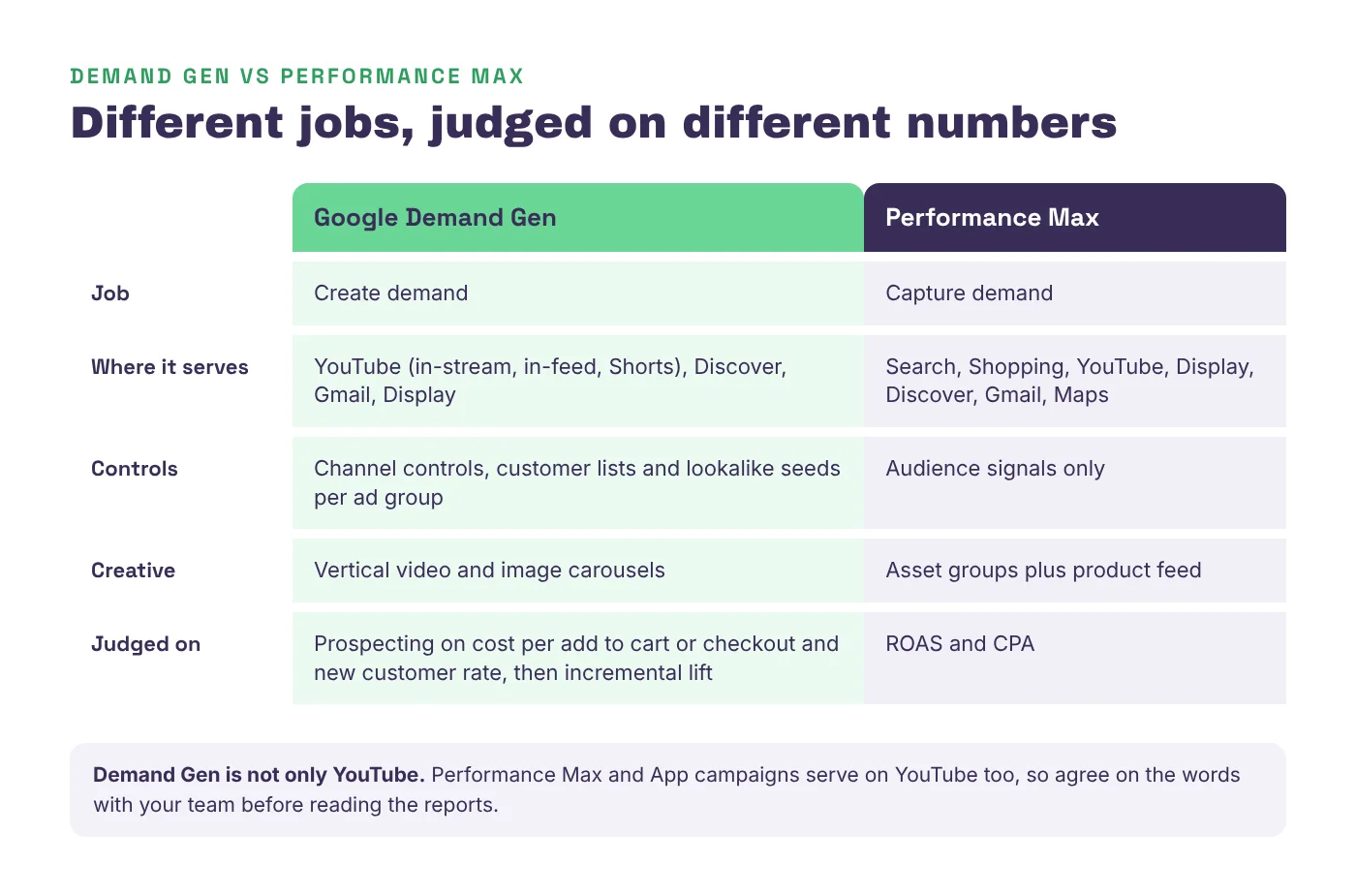
Performance Max captures demand that already exists. Demand Gen creates it. Performance Max uses automation across Search, Shopping, YouTube, Display, Discover, Gmail and Maps, and it is tuned to close a sale when buying signals are strong. Demand Gen is audience-led and visual, built for the feeds where people discover products rather than search for them.
- Job. Demand Gen creates demand. Performance Max captures it.
- Where it serves. Demand Gen runs on YouTube (in-stream, in-feed and Shorts), Discover, Gmail and Display. Performance Max adds Search, Shopping and Maps.
- Controls. Demand Gen gives you channel controls, customer lists and lookalike seeds at the ad group level. Performance Max takes audience signals only.
- Creative. Demand Gen is video and image first. Performance Max mixes asset groups with your product feed.
- How it should be judged. Demand Gen prospecting on cost per add to cart or checkout and new customer rate, then on incremental lift. Performance Max on ROAS and CPA.
One terminology point I raise with every client early. People often say "YouTube" when they mean Demand Gen. Demand Gen is not only YouTube, and Performance Max and App campaigns serve on YouTube too. Agreeing on the words up front saves a lot of confused reporting later.
How do you keep Demand Gen from retargeting people who already know your brand?
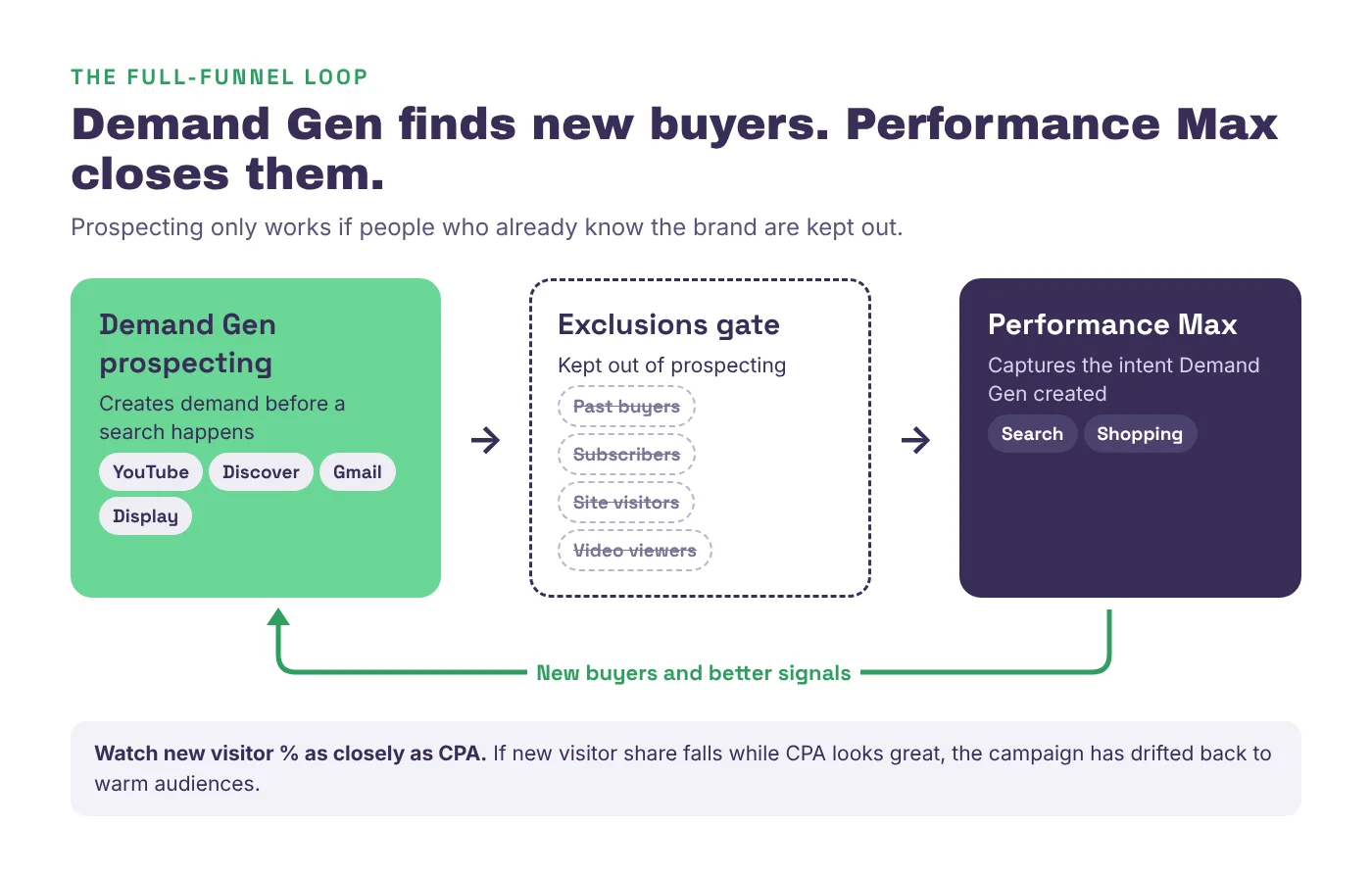
You force it to prospect. Left alone, Demand Gen will happily spend on people who already know the brand, because they are the cheapest conversions it can find. I'm aggressive with exclusions on every prospecting campaign. Past purchasers, email and SMS subscribers, recent site visitors and people who have already watched the brand's videos all come out.
Then I watch new visitor percentage as closely as I watch CPA. If the share of new visitors drops while CPA looks great, the campaign has found its way back to warm audiences, and the efficiency is mostly credit for sales you already had. Keep retargeting in its own campaign so the two never compete for the same people.
Seeding still matters. Lookalikes built from high-value customers, repeat buyers and VIP segments give the system a better starting point. Since March 2026, Google treats Demand Gen lookalikes as suggestions rather than hard limits, so the quality of the seed list matters more than the reach setting you pick.
When this is set up right, the payoff shows up outside the platform. On a subscription brand where we got the exclusions right, the marketing mix model ended up reading Demand Gen as the most incremental tactic in the whole mix.
Which conversion should a Demand Gen campaign optimize toward?
Start with add to cart, but be ready to graduate. Add to cart is a solid starting signal when purchase volume is too thin for the campaign to learn from. The number to watch is how often those add to carts become purchases.
On one account that rate was low, so we moved up to begin checkout, and then to begin checkout plus purchase. Both converted far better than add to cart had. The general rule is to optimize to the deepest action the campaign can get enough volume on, and only step down the funnel when it can't.
Whatever micro-conversion you use, keep it out of the primary conversion column. If add to carts count as account-level primary conversions, they inflate account ROAS and every other campaign's bidding starts chasing the wrong thing. Give the Demand Gen campaign its own campaign-level goal and leave purchases as the account's primary.

Where does Demand Gen actually serve, and how do you control it?
Demand Gen spans YouTube, Gmail, Discover and Display, and results often concentrate where you don't expect. Gmail has carried more than one of my accounts. If you never look at the placement split, you can't explain the results, and neither can your client.
Channel controls in Demand Gen sit at the ad group level. That means you can segment placements by ad group inside one campaign, which keeps the conversion signal in one place while giving you a target CPA or target ROAS lever per placement to steer where spend flows. Break placements into separate campaigns only if your MMM or multi-touch attribution reporting needs them separated.
Check one default too. Google is turning on view-through conversion optimization by default for new Demand Gen campaigns, and video served on the Display network now bills per thousand impressions. Decide on purpose whether views count as conversions in bidding, and set the window rather than inheriting it.
What creative works best in Demand Gen, and how do you keep it from disappearing?
Vertical YouTube Shorts video is the lead format. Hook in the first three seconds, show the product in use right away, and use creator-style framing rather than TV polish. For Discover and Gmail, use image carousels that mix lifestyle shots with product close-ups. Connect your Merchant Center feed so product cards can sit alongside the visual assets. For more on building video that sells, see our guide to YouTube ads for DTC ecommerce.
Creator content can be a huge lever here. YouTube's creator partnerships boost runs creator videos as ads from the creator's own channel inside Demand Gen. But creator content comes with usage rights that expire, and that is a risk most plans ignore.
On an occasion-wear brand, our top creator's rights ended and cost per add to cart roughly tripled until new creative caught up. Now we run a blend of creator videos and evergreen brand-shot videos in the same Shorts style, with no end date. That gives the campaign a floor of creative that can't disappear on us, while creators keep supplying fresh angles on top.
How should you budget for and measure Demand Gen?
Give the system room to learn. Budget enough that the campaign can collect steady weekly volume on its optimization event, and scale winners in 15 to 20% steps so you don't reset learning every time you touch it.
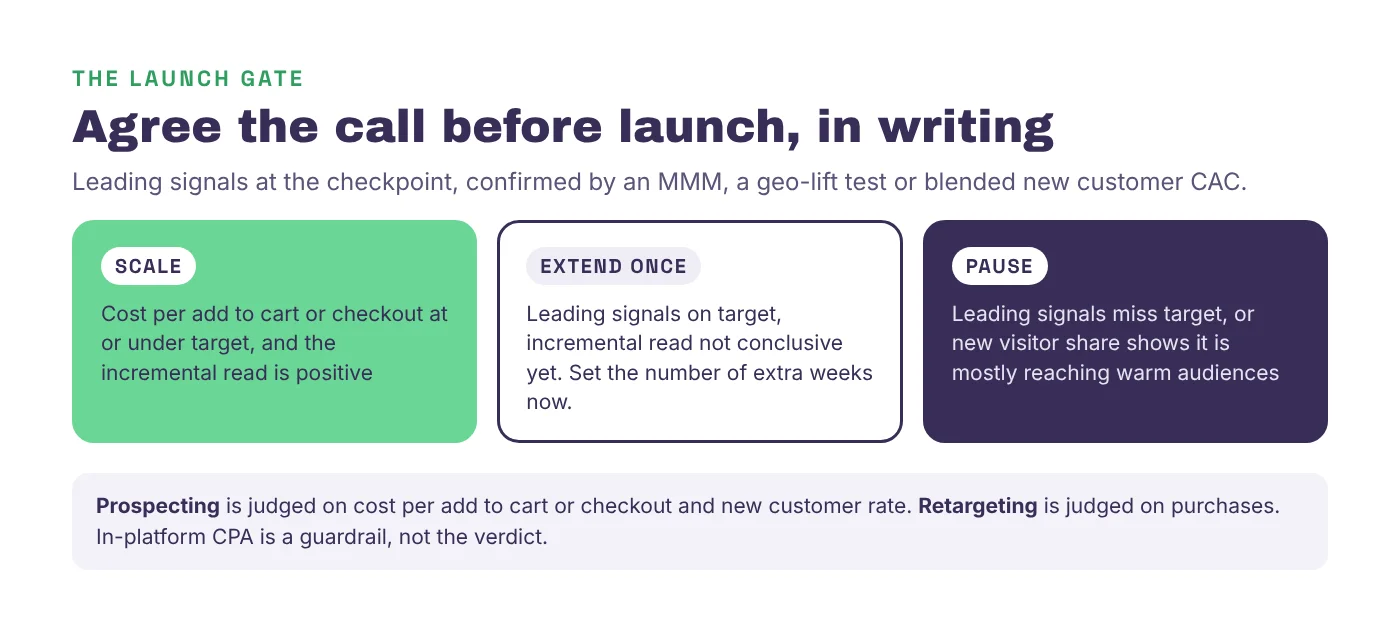
Then judge each campaign on its job. Prospecting gets judged on cost per add to cart or checkout and on new customer rate. Retargeting gets judged on purchases. In-platform CPA is a guardrail, not the verdict.
The real read comes from outside the platform, and the right tool depends on what the brand has. Use a marketing mix model if one is running. If not, run a geo-lift test with Demand Gen live only in test markets and other spend held steady. At minimum, track blended new customer CAC before and after launch. For how to design the test, see our incrementality testing playbook.
When should you scale, extend or pause a Demand Gen test?
Set the gate before you launch. Demand Gen takes time to read, so it's easy to keep "giving it another week." I set the scale, extend and pause thresholds up front and share them with the client in writing.
- Scale when cost per add to cart or checkout is at or under target and the incremental read from the MMM, geo-lift test or blended new customer CAC is positive.
- Extend once, for a set number of weeks, when the leading signals are on target but the incremental read isn't conclusive yet.
- Pause when the leading signals miss target at the checkpoint, or new visitor share shows the campaign is mostly reaching people who already know the brand.
That way the call at the checkpoint is already agreed. It's about the data, not how anyone feels that week.
How Adquadrant approaches Demand Gen
At Adquadrant we run Google for brands doing $10M or more in revenue, and Demand Gen sits inside that plan next to Performance Max, Search and YouTube rather than off on its own. Prospecting campaigns get full exclusions and a new visitor target. The optimization event graduates as purchase data allows. Placements are split by ad group so we can see and steer where spend goes. And the scale, extend or pause gate is written down before the first dollar runs.
Revelry is a good example of why prospecting deserves protection. Their 2026 budget came in at roughly half the prior year, and the reflexive move would have been to retreat into brand and retargeting. We protected prospecting instead, with a dedicated YouTube Shorts campaign in Demand Gen optimized to add to cart. Total spend came down 53%, Demand Gen's share of the budget rose from 6.8% to 8.5%, and cost per add to cart fell 66% in four months.

We read results against incremental lift, not platform credit. As a WorkMagic Official Agency Partner, we run geo-lift tests across a brand's full sales mix and use the result to decide where the next dollar goes, whether that is more Demand Gen, more Performance Max or neither.
On creative, we brief Shorts natively and keep an evergreen brand-shot library running under every creator push, so a usage-rights end date never takes the campaign's floor with it. Creator videos come in through YouTube's Creator Partnerships hub with the rights and end dates logged before the first boost runs, which lets us plan the replacement before performance tells us to.
The first thing a brand sees from us is a plan, not a spend increase. It covers which audiences come out of prospecting, which conversion the campaign starts on and when it graduates, the creative mix of creator and evergreen video, and the numbers that decide whether Demand Gen scales, extends or pauses.
How to choose a partner for Demand Gen
- They build prospecting and retargeting as separate campaigns, with exclusions on prospecting.
- They report new visitor percentage and new customer rate, not only CPA and ROAS.
- They can tell you which conversion your campaign optimizes to, and when they would change it.
- They keep micro-conversions out of account-level ROAS.
- They show you the placement split, including Gmail and Discover, not only YouTube.
- They have a creative plan that survives a creator's usage rights ending.
- They agree the scale, extend and pause thresholds with you in writing before launch.
- They measure with an MMM, a geo-lift test or blended new customer CAC.
Demand Gen can be one of the most incremental tactics in a DTC Google account. It just has to be forced to prospect and judged on the job it was built for. If you want a Demand Gen program built that way, talk to the Adquadrant Google and YouTube team.
About the author
Andy lives in Wilmington, NC with his wife and their five pets (two dogs and three cats). He graduated from Marist University in 2014 with a degree in mathematics. He is passionate about helping others and leveraging analytics to solve problems. Outside of work, he enjoys running, ultimate frisbee, triathlon training, and live music.