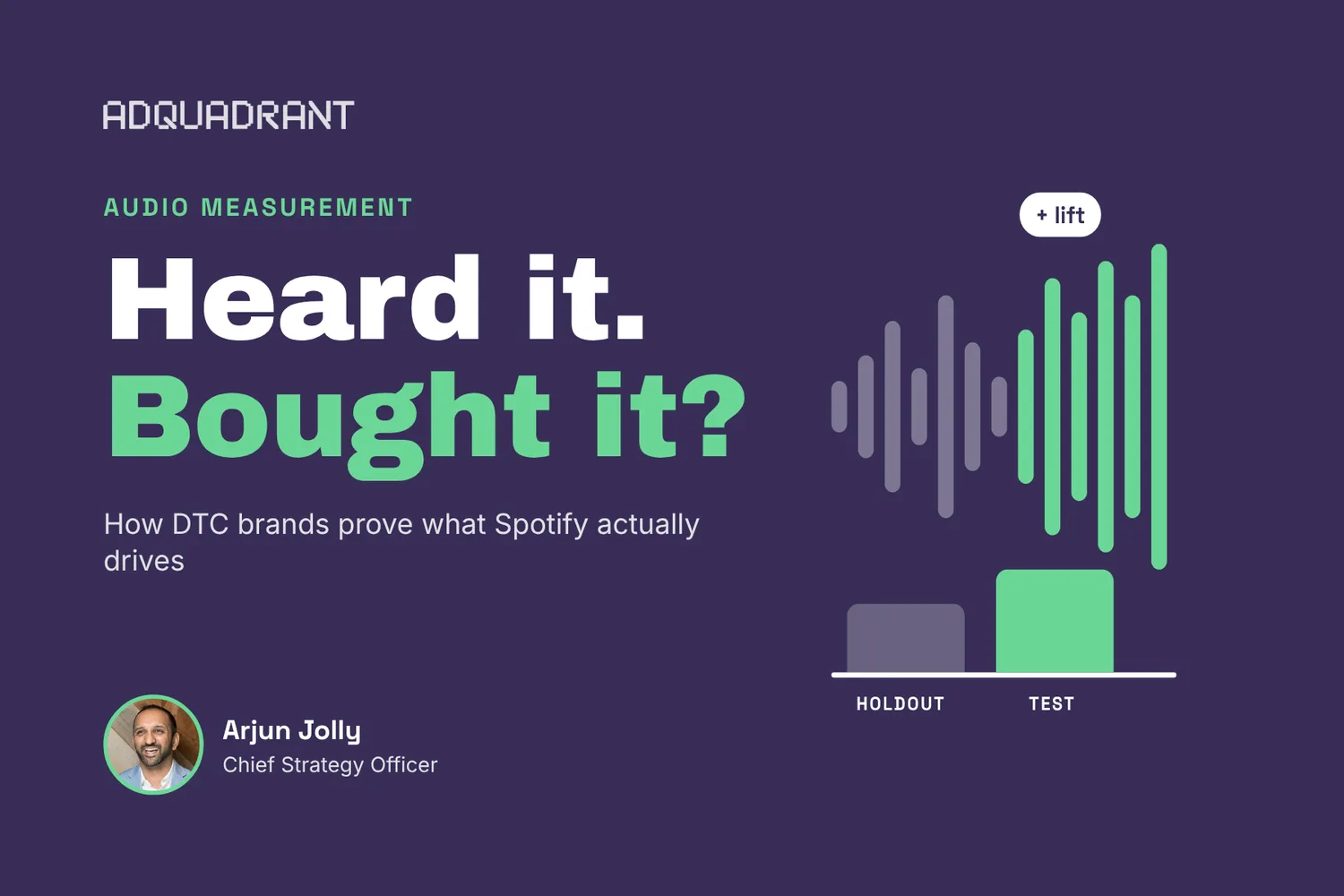

No, Spotify is not only an awareness channel. It can drive sales, but the attribution most brands use is built to miss it. Audio ads are rarely clicked, so a last-click report will almost always say Spotify did little. The only way to know what it adds is to measure it the way you would any upper-funnel channel, with a holdout or lift test that compares regions or people who heard your ads against ones who did not.
That gap between what audio does and what reports show is why so many brands try Spotify once, see weak numbers, and turn it off. Sometimes that is the right call. Often it is a measurement problem that looks like a performance problem.
Why Does Spotify Look Like an Awareness-Only Channel?
Three things make audio look weaker in reports than it may be.
- People rarely click audio ads. Most Spotify listening happens with the screen off, while someone is commuting, working out or cooking. They hear the ad, remember the brand, and search for it later on Google or go straight to your site. That sale gets credited to branded search or direct traffic.
- The delay is long. A podcast ad heard on Monday might turn into a purchase two weeks later. Short attribution windows cut that off.
- Platform reporting grades its own work. Spotify's own tools, such as Spotify Ad Analytics and the Spotify Pixel, can show visits and conversions from people who were exposed to an ad. That is useful, but exposure-based reporting cannot tell you whether those people would have bought anyway. Every ad platform has this problem, not just Spotify.
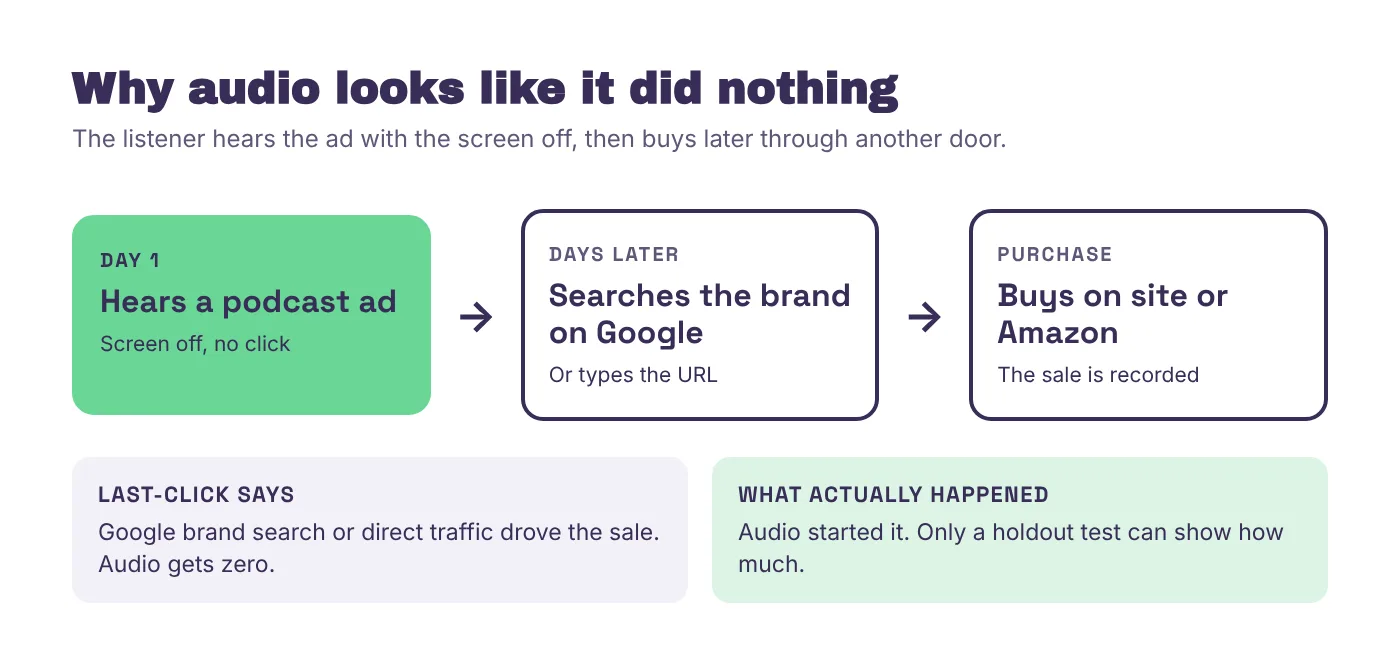
The result is that audio gets undercounted by last-click models and overcounted by its own dashboard. Neither number is the one a CFO should approve budget on.
What Should You Measure Instead?
The real question is not how many conversions Spotify reported. It is how many sales happened that would not have happened without Spotify. That is incrementality, and there are three ways to get at it.
Incrementality Testing vs. Marketing Mix Modeling vs. Multi-Touch Attribution
- Multi-touch attribution (MTA) assigns credit to each tracked touchpoint in a buyer's path. It is fast and detailed, but it only sees what it can track. Audio, which leaves almost no click trail, is mostly invisible to it.
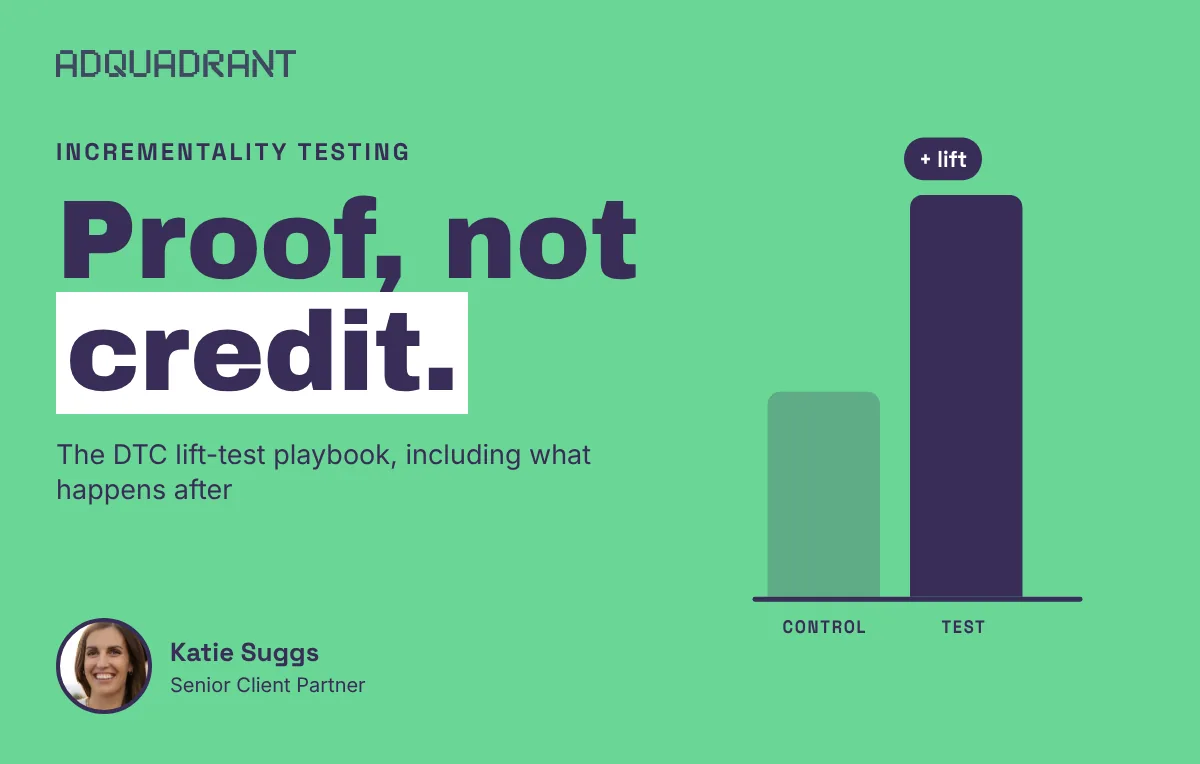
- Incrementality testing turns ads on or off for a test group and compares results against a matched group that did not change. For audio, this is usually a geo holdout, where some regions hear your ads and matched regions do not. It answers the causal question directly, one channel at a time.
- Marketing mix modeling (MMM) uses months or years of spend and sales data to estimate each channel's contribution, including channels that never get a click. It is the best way to see audio inside the full media mix, but it needs enough history and spend variation to be reliable.
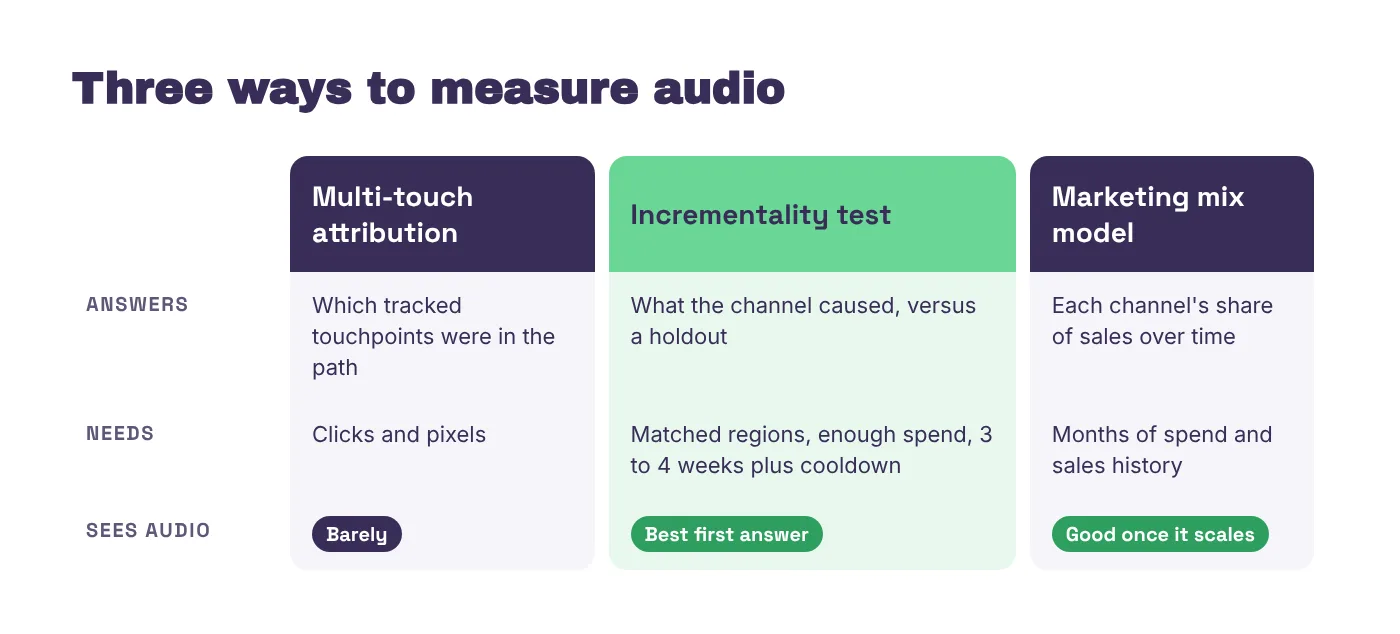
For a brand testing Spotify, the practical order is usually a geo holdout first to get a clean answer, then MMM to keep tracking audio's contribution as the plan grows. MTA stays useful for clickable channels but should not be the judge of audio. For the full testing method, see our DTC incrementality testing playbook.
How to Run a Spotify Geo Holdout
The setup is the same discipline as any good lift test.
- Agree on the decision before you launch. Write down what result means scale, what means hold and what means cut. If everyone agrees up front, a flat result is still a useful answer.
- Pick matched regions. Choose test and holdout regions that have tracked closely on sales over the past several months. Run Spotify only in the test regions.
- Run long enough to catch the delay. Audio needs time. Plan for at least three to four weeks of exposure plus a cooldown period to catch delayed purchases.
- Spend enough to move the needle. If the budget is too small to create a detectable difference, the test will come back flat no matter what. Size the spend to the lift you need to see.
- Measure total sales, not just site sales. If you also sell on Amazon or in retail, count those too. Upper-funnel channels often push a large share of their impact to places a pixel cannot see.
- Turn the result into a cost per incremental sale. That number lets you compare Spotify directly with Meta, Google, YouTube or TikTok on the same basis.

Where Audio Fits in an Omnichannel Plan
Spotify is strongest when it does a job no other channel does well, reaching people in screen-off moments with a voice they trust. For brands selling to Gen Z and millennial buyers, that reach can be hard to find elsewhere.
Audio also tends to work alongside other channels rather than alone. A listener who hears your podcast read may later click a Meta ad, search your brand on Google or buy on Amazon. That is exactly why judging it on its own last-click numbers misleads, and why a holdout that measures total sales is the fairer test.
A sensible way to treat it is as a scaling bet, not a core channel. Prove it in a controlled test, then decide how much budget it earns.
When Spotify Is Not Worth It
Not every brand should run audio. It usually struggles in three cases.
- Monthly media budgets are too small to fund both the test and the core channels.
- The product needs to be seen to be understood.
- There is no plan to measure it beyond the platform dashboard.
In those cases, the money usually works harder in channels you can already measure well.
How Adquadrant Approaches This
The question I hear most from founders and CMOs is some version of "is this channel actually working, or is it just taking credit?" Our answer is to stop letting any platform grade its own homework.
We run measurement for brands above $10M in revenue across Meta, Google, YouTube, TikTok and TikTok Shop, using incrementality tests, marketing mix modeling and data-driven attribution together. We do this as a WorkMagic Official Agency Partner, which gives our strategists independent measurement that reads results beyond your website. When a brand wants to know whether a channel like audio earns its budget, we design the holdout, agree on the decision rules before launch, and read the result in total sales, not platform clicks. Every channel then gets the same scorecard, a cost per incremental sale, so audio is judged on the same scale as Meta or Google.
That last part matters. In a recent geo test for a consumer electronics brand that sells on its own site and on Amazon, Google drove a 9.4% lift in site sales, and about 46% of the incremental orders landed on Amazon. A site-only report would have missed nearly half the impact. Audio behaves the same way, which is why we measure it the same way.
How to Choose a Measurement Partner for Audio and Other Upper-Funnel Channels
- They measure incrementality with holdouts or lift tests, not just platform-reported conversions.
- They agree on what result means scale, hold or cut before the test starts.
- They count sales everywhere you sell, including Amazon and retail, not only your site.
- They can combine tests with marketing mix modeling so the answer holds up over time.
- They report in cost per incremental sale, so every channel can be compared on one basis.
- They will tell you when a channel is not working, even if it is one they run.
Prove It Before You Scale It
Spotify is not just an awareness channel, and it is not a guaranteed sales channel either. It is a channel you should be able to prove. If you want to know what audio, or any upper-funnel channel, is actually adding to your business, book a measurement conversation with Adquadrant.
About the author
Arjun Jolly is Chief Strategy Officer at Adquadrant. Arjun received his undergraduate education in Economics from the University of California, Irvine, and went on to graduate Summa Cum Laude from Pepperdine University with an Executive Masters in Business Administration. Arjun currently lives with his wife in Irvine and enjoys trying new restaurants, riding around the mean streets of Irvine on his bike, and watching the latest binge-worthy shows.