


Running the media is half the job. Proving what it returned is the other half.
Our strategists run your accounts hands-on. Underneath that we build the measurement on WorkMagic: the geo lift tests that establish what your media actually caused, the calibration that corrects your attribution and media mix model, and the reporting that puts the answer in front of your team every morning.
of WorkMagic lift tests return a usable read, against roughly 70% industry wide
from test design to a causal answer you can move budget on
your site, the marketplace and retail, not only where a pixel happens to be watching
the reporting and the analyst both live where your team already works
How the measurement works
A controlled experiment, then everything else corrected against it.
Every attribution model is one set of assumptions arguing with another set of assumptions. A geo lift test is the only one that holds something back and watches what happens. We start there, then use the result to correct the numbers your team works from all week.
A geo lift test establishes what the channel actually caused
→
That result calibrates your attribution and your media mix model
→
One number you can plan the year with
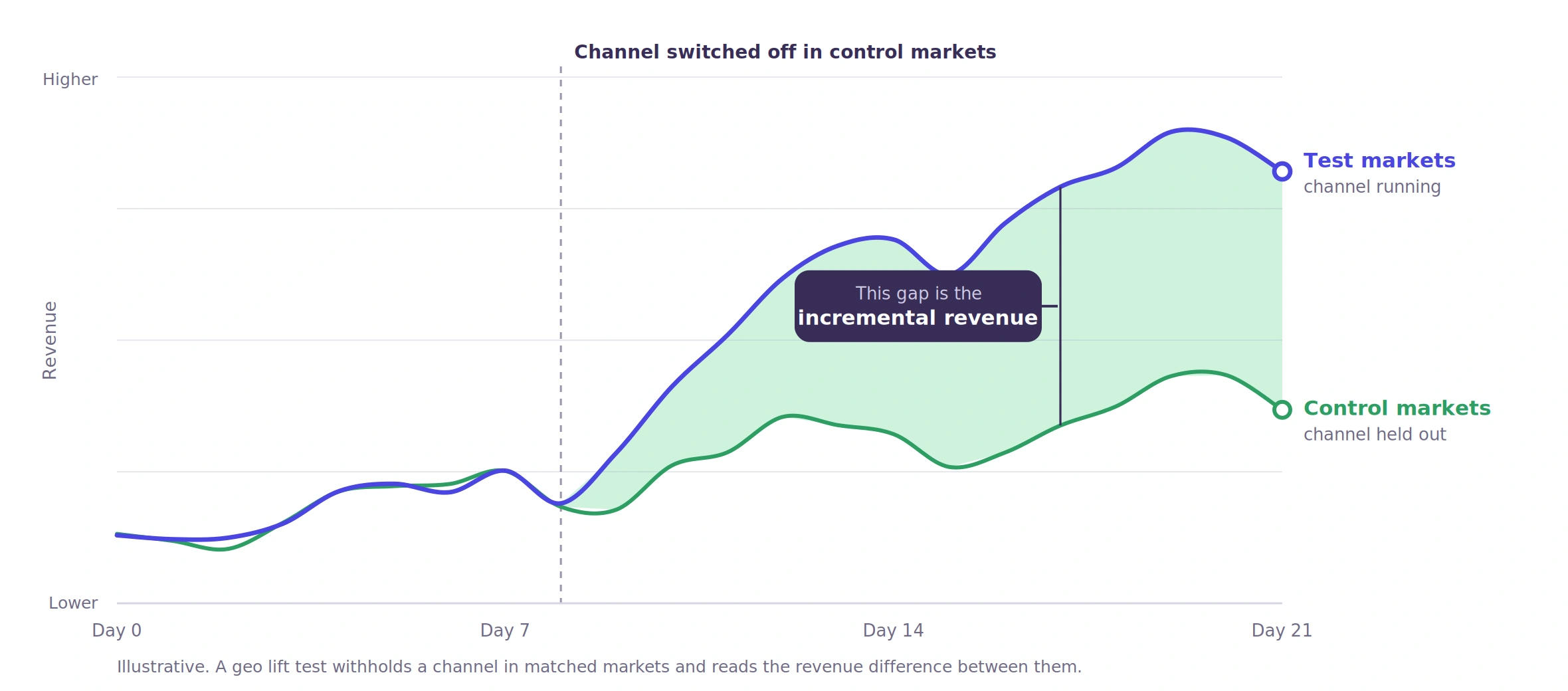
Two sets of matched markets. The channel runs in one and is held out in the other. Everything both markets do together is seasonality, promotions and brand momentum. The gap that opens after the switch is the part your media caused, and it is the only number worth defending in a budget meeting.
Geo incrementality testing
The experiment
We hold the channel back in matched markets and read the revenue difference. The answer does not depend on what any platform chooses to count, or on which touch it decides to claim.
Calibrated attribution
The daily view
Lift results correct the multi-touch attribution your team works from, so the numbers everyone looks at each morning are anchored to something causal rather than to a modelling choice.
Calibrated media mix modelling
The plan
The same truth feeds the model you plan the year with, including saturation curves and where the next dollar is worth more than it is where it sits today.
98%
WorkMagic · Official Agency Partner
WorkMagic publishes that 98% of its lift tests return a usable read, against roughly 70% industry wide. That is the technology’s track record, not a result we are claiming on your behalf. Yours exists once we run one.
What we build for you
Every source you spend from, every place you sell, one board.
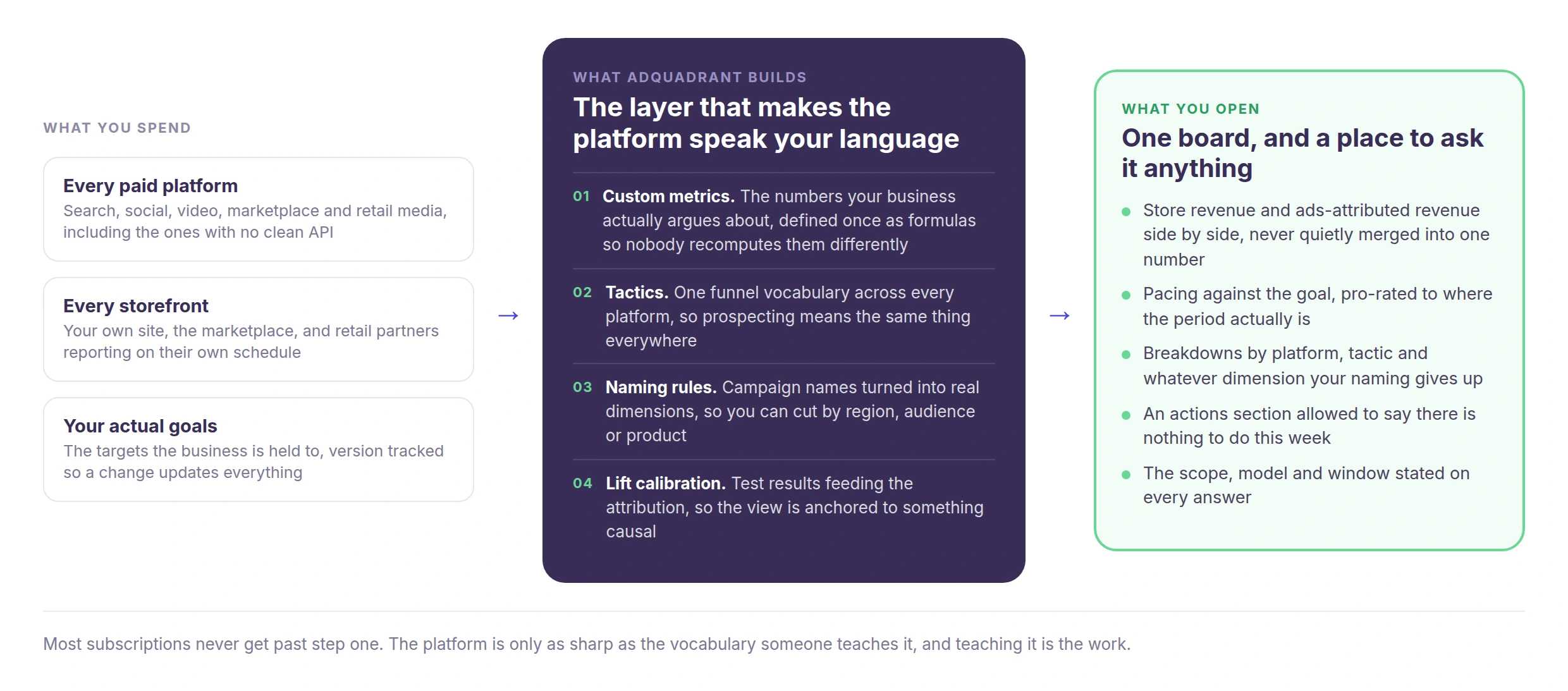
A measurement platform out of the box is a set of connectors and an empty vocabulary. It does not know what your business calls a new customer, which campaigns count as prospecting, or what your team is held to this quarter. Teaching it is the work, and it is the part we own.
A day with it
An analyst in your Slack. A strategist still holding the wheel.
WorkMagic ships an AI analyst that sits on your data. We give it the vocabulary, the goals and the guardrails, then put it in the channel your team already works in. You type the way you would to a colleague. It answers in seconds, shows where the number came from, and tells you when it thinks you are about to read something the wrong way. Nothing it produces reaches you or your board without one of our strategists deciding it should.
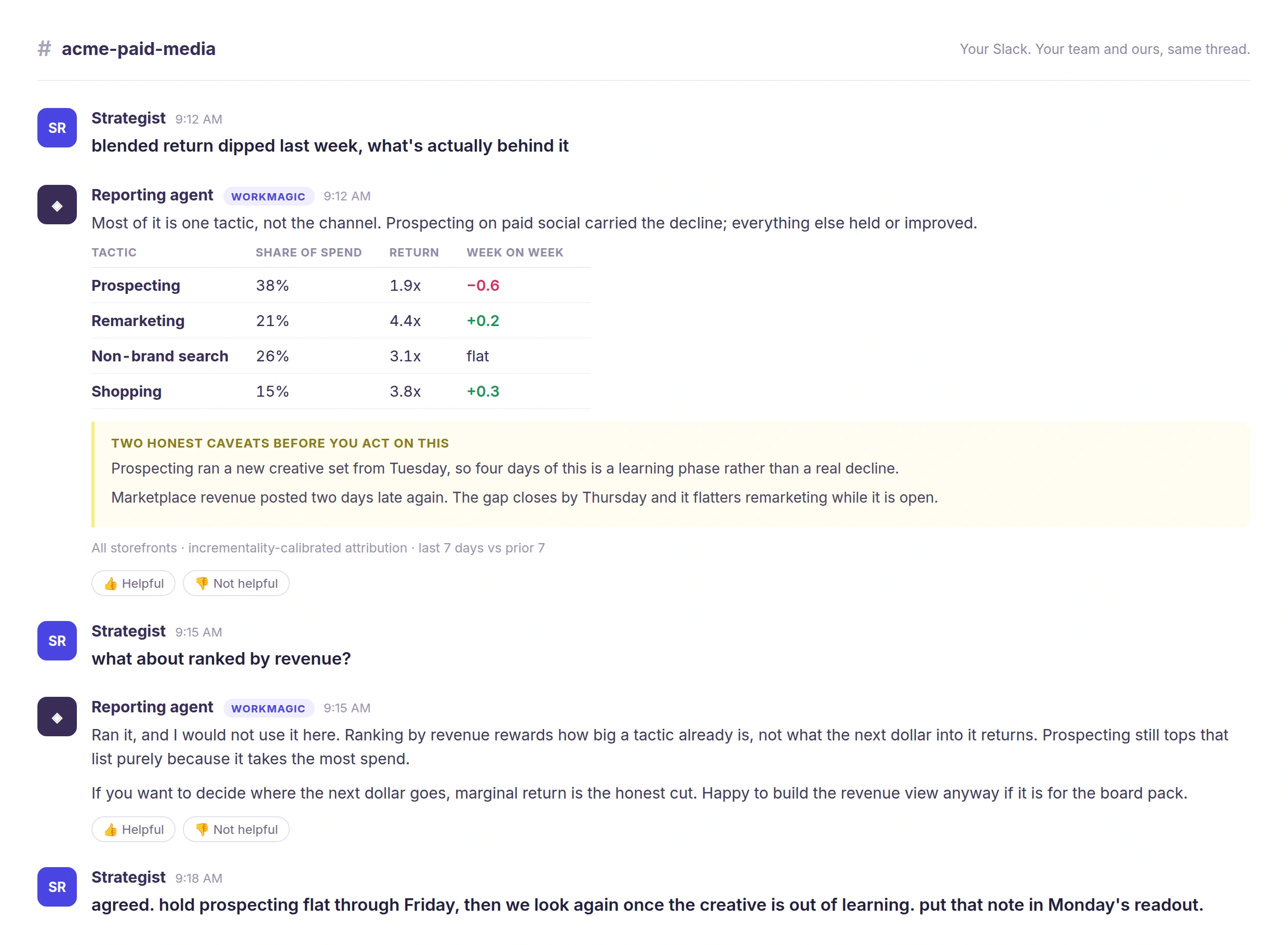
Illustrative. Real threads are messier, shorter and full of typos, which is rather the point.
Half-formed questions, dictated notes, a hunch you want checked. It handles speech rather than syntax, and follow-ups stay in the thread so you can keep pulling.
Bounce a plan off it before you take it to the client. Ask it to argue the other side. Ask what would have to be true for the idea to work.
It will tell you when the cut you asked for answers the wrong question, and it flags what it is unsure about before you act rather than after.
It drafts, checks and challenges. Our strategists edit, overrule and decide. The recommendation your team receives has a name attached to it.
A morning pacing check before anyone opens a dashboard. A weekly readout with the note to your team already drafted. A mid-week look while there is still time to act. Alerts that stay quiet unless something is genuinely worth your attention.
In practice
Two mornings that do not involve a dashboard.
The point is not that reporting gets faster. It is that the reporting arrives before anyone thinks to ask for it, and that the hard questions get an experiment rather than an opinion.
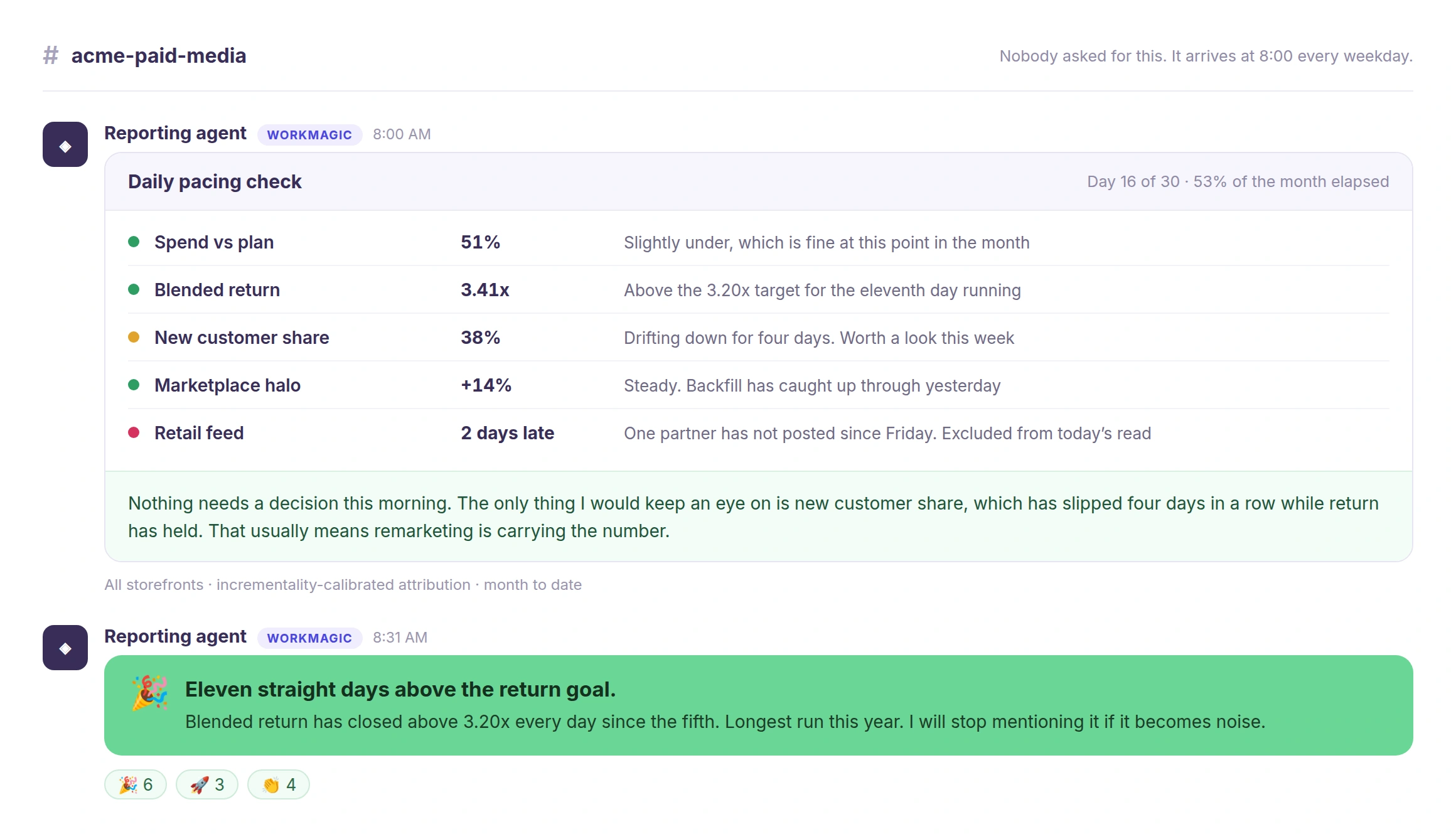
It shows up before you do
A pacing check pro-rated to where the month actually is, five numbers with a status on each, and one plain paragraph telling you whether any of it needs a decision. When something is worth celebrating it says so, and it tells you it will stop if that becomes noise.
The question nobody could answer before
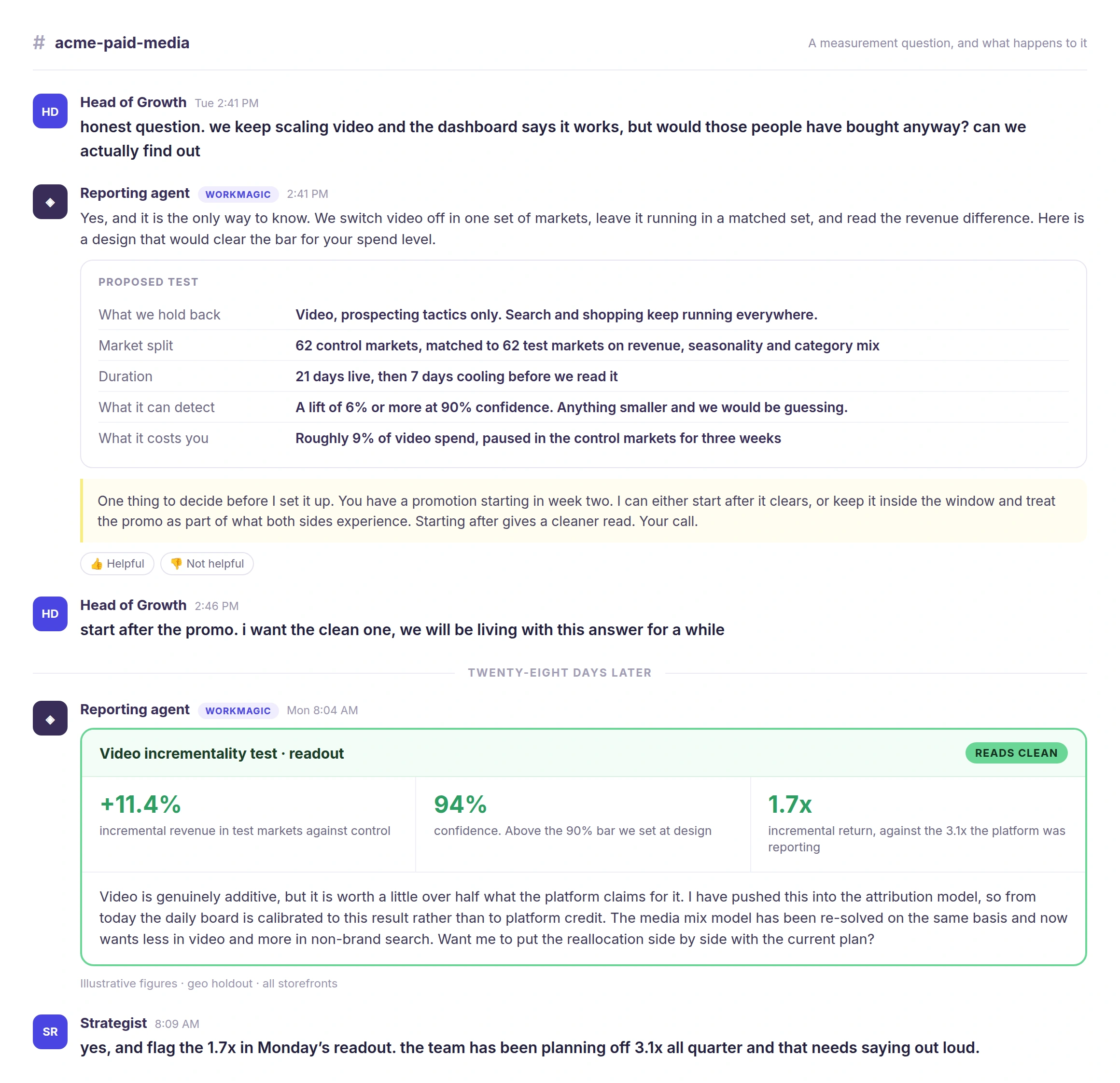
Would those sales have happened anyway. It is the only question that matters and most stacks cannot answer it. Here it turns into a designed experiment with a stated cost and a stated detection limit, a human decision about timing, and a readout four weeks later that recalibrates everything downstream of it.
One plus one equals three.
A measurement platform with nobody running it is a licence fee. An agency without one is asking you to take its word. The value is in the same team owning the decision and the proof, on the same data, every week.
Powerful, and largely unused. Tests need designing, models need calibrating, the agent needs a vocabulary. Most subscriptions run at a fraction of what they were bought for.
Confident reporting with nothing underneath it. When the agency both runs the media and grades it, there is no independent number anywhere in the room.
We design the tests, calibrate the models, build the reporting, then manage the media against whatever comes back. The proof is independent of us, and we are the ones held to it.