
Most DTC brands do not struggle because they lack effort. They struggle because they build the wrong growth system for the stage they are in. The in-house vs agency decision is a good example. Founders often assume that bringing paid media inside means more control, lower cost, and better alignment. Sometimes that is true. Often, it is only partly true.
The better question is not who clicks the buttons. The better question is which model gives you the speed, measurement, and strategic range to grow profitably. If you are a founder, CEO, CMO, or VP of Marketing trying to scale without losing margin discipline, this is the crossroads that matters.
The Core Dilemma: Choosing Between In-House Teams and Specialized Growth Agencies
The choice between building an in-house media buying team and hiring a specialized e-commerce growth agency comes down to infrastructure, not preference. An in-house team can offer proximity to the brand, faster internal communication, and strong product context. A specialized agency brings channel depth, broader testing data, and a system already built to manage complexity.
If your need is basic campaign management on one or two channels, an internal hire can work. If your need is full-funnel planning across Meta, TikTok, creators, SEO, and retention inputs, the bar rises quickly. At that point, you are no longer hiring a media buyer. You are building a growth engine.
That is where many brands misread the problem. They compare one salary to one agency fee and call it a decision. But the real comparison is narrower focus versus wider capability. An internal team may know your brand better. A DTC performance marketing agency should know the market better, including what is changing in platform behavior, creative fatigue, attribution, and audience response across categories.
There is also a strategic risk in keeping everything inside. In-house teams can become echo chambers, especially when the same people own strategy, execution, reporting, and interpretation. Agencies see more patterns because they sit across brands, channels, and testing environments. That cross-account intelligence often shortens the distance between guesswork and a smart decision.
AI has shifted this balance even further. The strongest agencies are no longer just staffing models. They are technology companies wrapped in service. If an agency has proprietary systems, Agentic AI workflows, and a GenAI Suite that improves forecasting, creative iteration, and decision speed, you are buying access to a capability that is expensive to recreate internally.
Uncovering the Hidden Costs of an In-House Paid Media Team
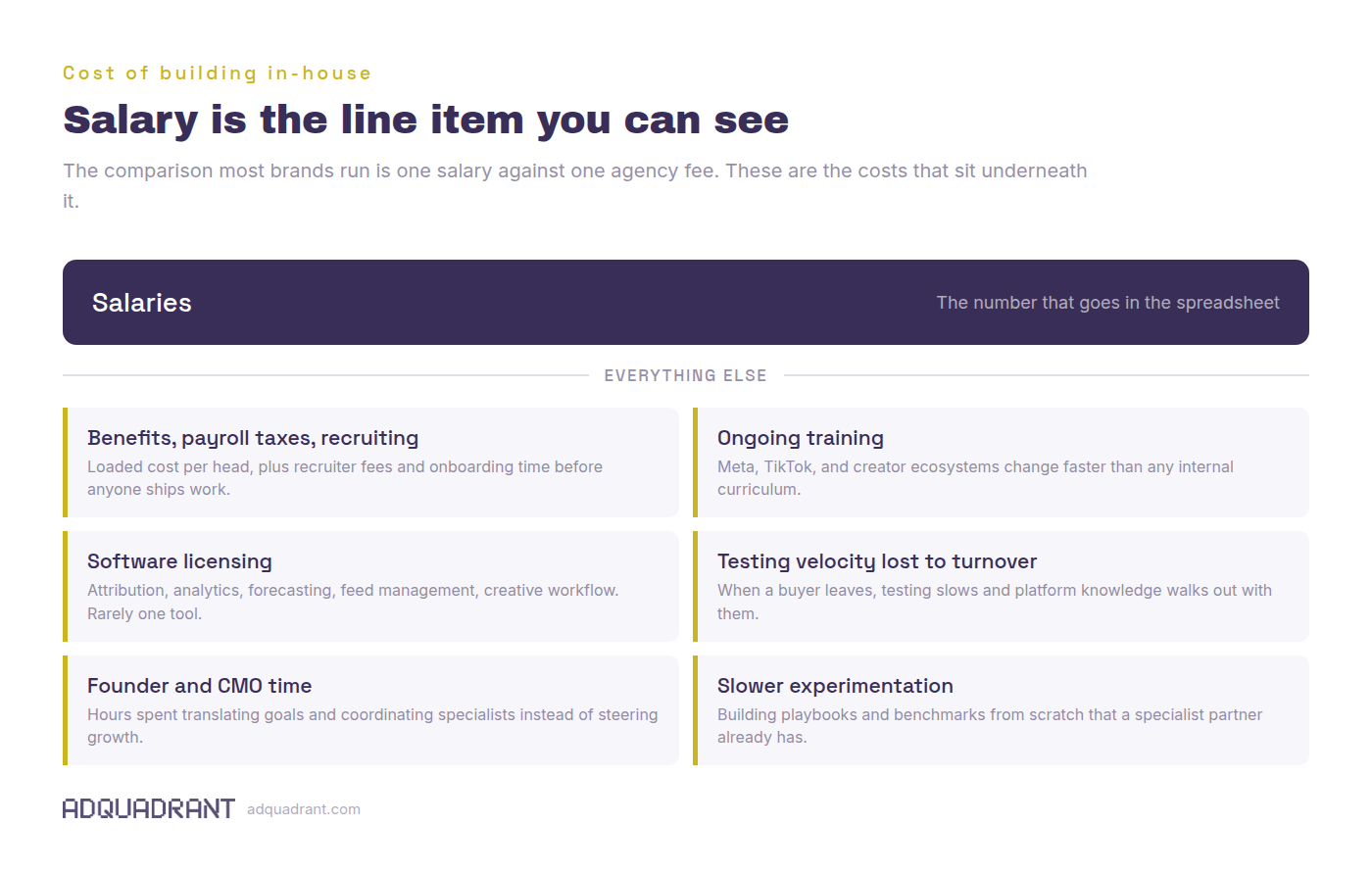
The hidden costs of an in-house paid media team include more than compensation. Salary is only the visible line item. The real cost includes hiring friction, software, management time, training, turnover, and the slower pace that comes from building systems from scratch.
Start with labor economics. A strong internal team usually requires more than one person. You may need a media buyer, strategist, creative partner, analyst, and someone who owns reporting or marketing operations. Then layer on benefits, payroll taxes, recruiter fees, onboarding time, and ongoing training as platforms change.
Next comes the stack. Modern AI-powered paid media depends on more than ad platform dashboards. Serious teams need tools for attribution, creative analysis, forecasting, feed management, experimentation, reporting, and workflow automation. Enterprise-grade systems are expensive, and many DTC brands end up patching together tools that do not speak cleanly to each other.
The hidden costs of in-house marketing also show up in turnover. When a key buyer or strategist leaves, performance usually does not pause politely. Testing slows down. Reporting quality slips. Platform knowledge walks out the door. The replacement cycle costs money, but the larger loss is momentum.
Management overhead is the least visible cost and often the most painful. If your CMO or founder is spending hours every week translating goals, reviewing channel decisions, resolving data questions, and coordinating specialists, that is time not spent on product, brand, partnerships, or customer experience.
What brands often underestimate:
- Benefits, payroll taxes, and recruiting costs on top of salary
- Ongoing training as Meta, TikTok, and creator ecosystems change
- Software licensing for attribution, analytics, forecasting, and creative workflows
- Lost testing velocity during hiring gaps or employee turnover
- Founder and CMO time spent managing execution instead of steering growth
- Slower experimentation compared with an agency that already has playbooks, benchmarks, and channel specialists
Scaling Up: Revenue Thresholds and Long-Term Agency Partnerships
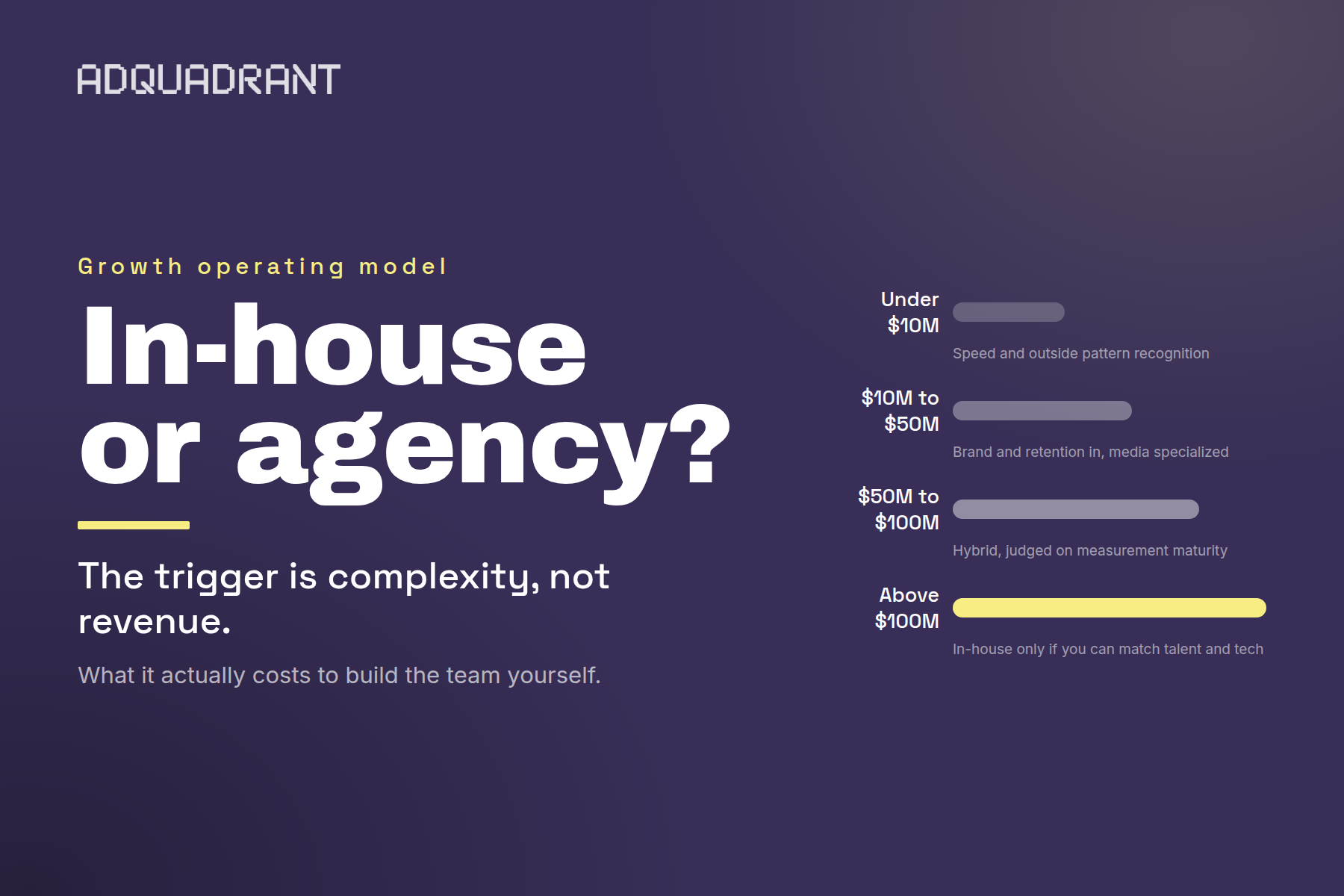
A common question is at what revenue threshold a DTC brand should build in-house media buying capability. The short answer is that revenue alone is not the trigger. Complexity is.
At roughly the $10M stage, many brands are still proving channel mix, offer durability, and creative repeatability. At the $50M stage, margin discipline becomes less forgiving and POAS (profit on ad spend) matters more than ROAS. By the time a brand approaches $100M, scale does not simplify media buying. It compounds it.
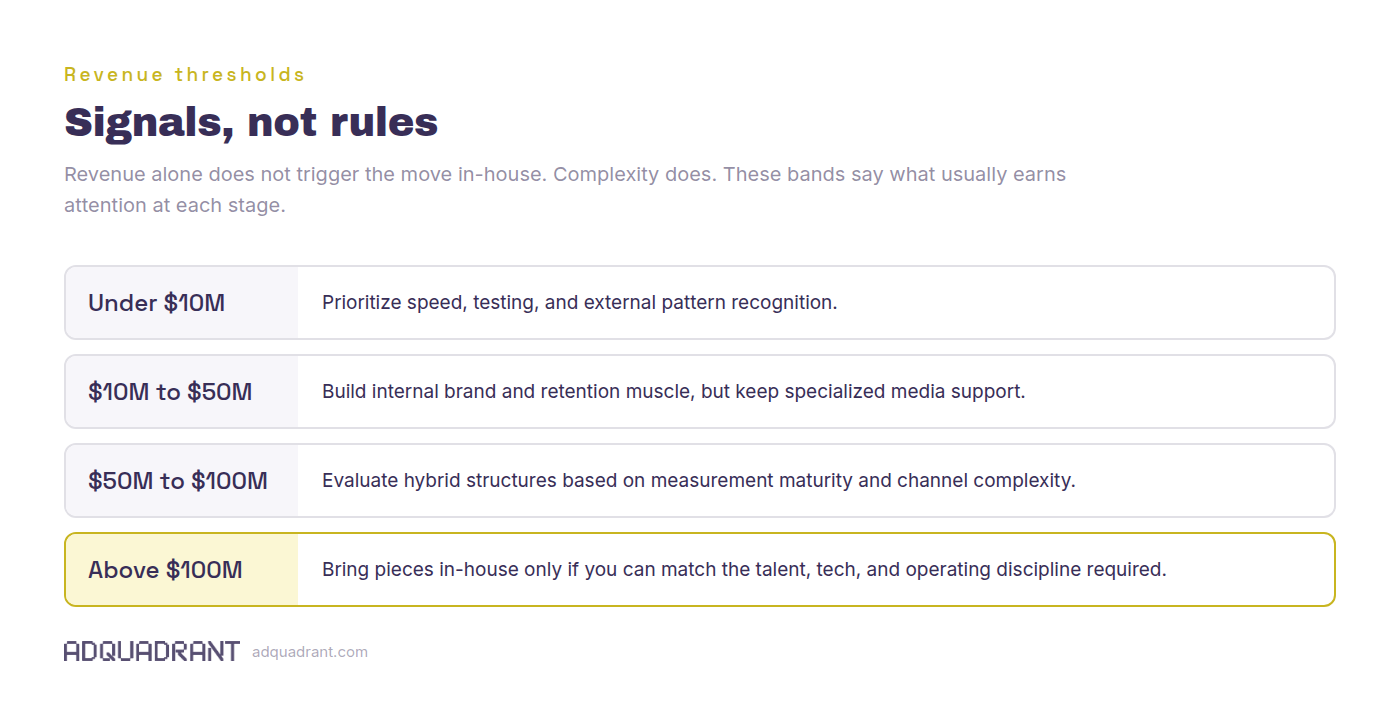
Revenue thresholds are signals, not rules:
- Under $10M: prioritize speed, testing, and external pattern recognition
- $10M to $50M: build internal brand and retention muscle, but keep specialized media support
- $50M to $100M: evaluate hybrid structures based on measurement maturity and channel complexity
- Above $100M: bring pieces in-house only if you can match the talent, tech, and operating discipline required
For many brands, the best answer is a hybrid model. Keep brand leadership, merchandising alignment, and retention ownership in-house. Pair that with a specialized agency that handles AI-powered media buying, creator marketing, cross-channel strategy, and measurement.
What to Look for When Hiring a Performance Marketing Agency
Start with business fluency. You need Commerce Strategists who understand margin structure, inventory realities, and the difference between growth that looks good in-platform and growth that holds up in finance.
The second filter is technology. Ask whether the agency owns proprietary systems or simply rents software like everyone else. If they have a GenAI Suite, Agentic AI workflows, and forecasting tools that improve decision speed, that matters.
The third filter is channel range. A strong partner guides full-funnel media across TikTok, Meta, influencers, and SEO, while understanding how those channels interact.
Measurement is the fourth filter. You want a partner that tracks POAS, contribution margin, and channel-level profitability. Good reporting helps you decide where to invest next, not just summarize what happened.
Creative agility is the fifth filter. The best agencies combine human strategy with AI speed so they can produce, test, and refine concepts quickly.
What to ask before you sign:
- Do you understand our COGS, margin targets, and payback expectations?
- What parts of your technology are proprietary?
- How do you use AI-powered paid media systems in planning, execution, and reporting?
- Do you optimize to POAS and contribution margin, or only ROAS?
- How do you connect media strategy with creative production and testing?
Conclusion: Making the Right Move for Your Brand's Next Era of Growth
The in-house vs agency decision is not a referendum on talent. It is a decision about operating model. Sustainable performance now depends on advanced measurement, creative intelligence, and AI systems that can move faster than manual workflows.
Next actions you can start this month:
- Audit your current paid media setup and list every cost beyond salary or agency fee.
- Compare your reporting metrics and identify whether you are managing to ROAS or true profit signals like POAS.
- Map your channel complexity for the next 12 months, including creators, TikTok, Meta, SEO, and retention dependencies.
- Decide which functions require brand proximity and which require outside specialization.
- Interview agency partners on systems, not just staffing, and ask how their AI stack changes decision quality.
Stop patching together tools and chasing trends. Partner with Adquadrant's Commerce Strategists to fuel sustainable, profitable scale with our proprietary AI-powered growth system. Contact us today.
About the author
Cooper Davis is a Senior Paid Media Account Manager at Adquadrant and sits on the AQ Marketing team. Whether he is analyzing formations or optimizing ad spend, he lives for the win. Away from the conversions, you will find him watching Manchester United and adding to his sneaker wall, because limited releases and limited budgets both require serious strategy.