
For years, DTC teams treated keyword control as the safety rail for Google Ads. Exact match, tight ad groups, query sculpting, and long negative keyword lists gave media buyers a sense of precision. Google AI Max changes that operating model. My view is simple: for most DTC brands, fighting to preserve keyword-level control is now the wrong battle. The brands that win over the next two to four quarters will shift effort away from manual query management and toward stronger inputs like product feeds, audience signals, conversion values, and measurement quality.
That claim will make some operators uncomfortable, and it should. Less manual control can mean more wasted spend if your data is weak. But the answer is not to resist automation. The answer is to train it. When Google AI Max takes over more matching and bidding decisions, your job changes from pulling levers to designing the system those levers run on.
The Evolution of Search: How Google AI Max is Reshaping DTC Campaigns
Google AI Max changes DTC search campaigns by moving decision-making away from keyword-by-keyword management and toward intent-based matching across broader campaign environments. In practice, that means Google is relying more heavily on broad match logic, real-time auction signals, landing page content, creative, historical conversion data, and audience context to decide when and where to show your ads.
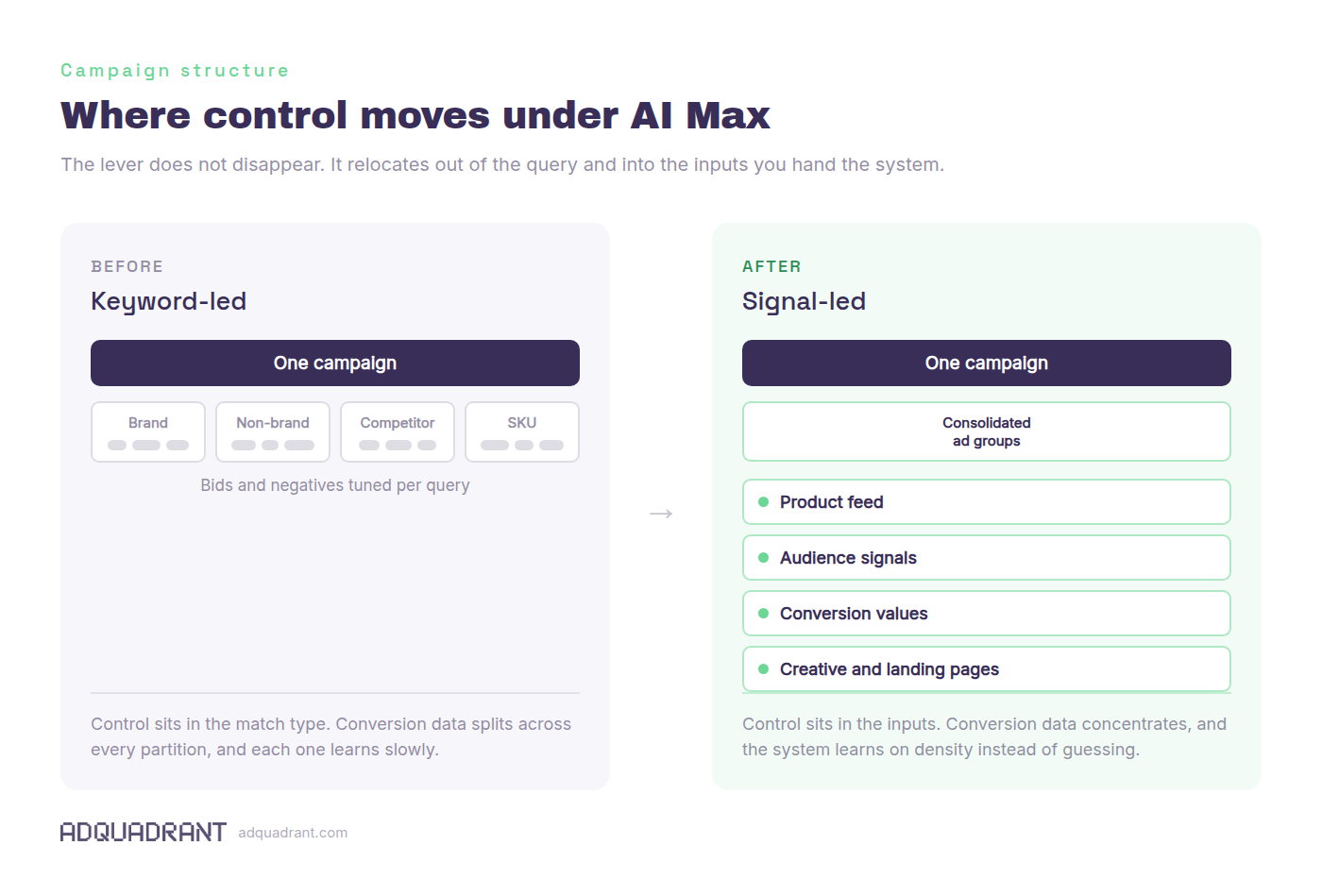
For legacy search managers, the biggest shift is psychological as much as tactical. The old model rewarded segmentation. You could break campaigns into branded, non-branded, competitor, category, and SKU-level structures, then tune bids and negatives with a high degree of control. Under Google AI Max, that granularity often works against learning. Too many partitions can starve the system of conversion data, limit signal density, and create artificial walls between related demand pockets.
This is why many DTC search campaigns now need consolidation. Instead of dozens of tightly separated ad groups, you need fewer, data-rich campaign structures that give the algorithm room to learn. That does not mean giving Google a blank check. It means setting firmer business rules at the account level while allowing more flexibility inside the campaign.
The media buyer's role changes with that shift. You are no longer a trader adjusting bids at the query level all day. You are a strategist who decides what data enters the system, what value the system optimizes toward, and what guardrails define success. In other words, Google AI Max does not remove the need for expertise. It raises the bar for where expertise matters.
The Broader Shift: Leveraging AI Solutions to Optimize Media Buying
If you want to use AI to optimize your media buying, start by understanding what AI is actually good at. It is good at handling thousands of micro-decisions faster than a human can. That includes budget pacing, bid adjustments, auction-time intent interpretation, creative rotation, daypart shifts, and campaign triggers based on live performance patterns.
The best AI solutions for automating media buying decisions do more than automate clicks inside an ad platform. Many tools on the market are still patchwork. They summarize dashboards, suggest bid changes, or automate rules you could have written yourself five years ago. Useful, sometimes. Strategic, rarely.
A stronger system uses predictive logic and agentic behavior. Agentic AI means the system can take action across workflows, not just report on them. It can identify a margin problem in one product set, connect that signal to budget pacing, adjust media pressure, and forecast the likely effect before more spend goes out the door. That is a different class of automation than a tool that simply says your cost per acquisition went up yesterday.
For DTC brands, the real advantage comes when AI is connected across the funnel. Search should not operate in isolation from TikTok, SEO, creator content, CRM, and measurement. Search demand is often created elsewhere. If your systems are disconnected, Google may optimize against a narrow view of the customer while your broader business absorbs the cost. When your data, creative, and media channels work as one system, automated media buying becomes more controllable, not less.
Pivoting to Signals: Optimizing Product Feeds and Audiences
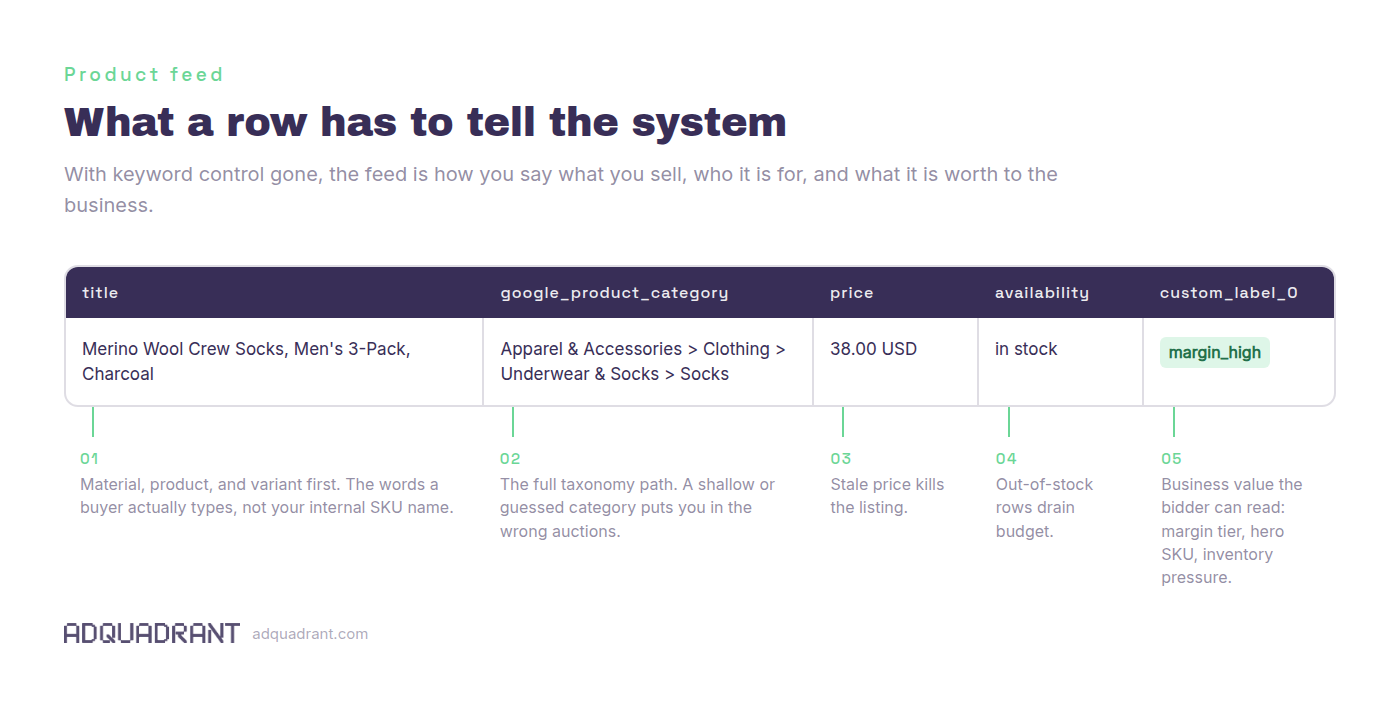
When keyword-level control fades, product feed optimization becomes one of the most important jobs in the account. Your product feed is now one of the clearest ways to tell Google what you sell, who it is for, and when it should be shown. Titles, descriptions, categories, images, pricing, availability, and custom labels all act like signals the system can read.
A weak feed leaves the algorithm guessing. A strong feed gives it context. For DTC brands, that means your feed should reflect shopper language, product economics, and merchandising priorities, not just whatever fields happened to come out of your ecommerce platform.
Product feed optimization checklist
- Front-load high-intent terms in product titles.
- Enrich product descriptions with real buying context.
- Use accurate Google product categories.
- Add custom labels based on business value (margin tier, inventory pressure, hero products).
- Keep price and availability clean.
- Improve image quality and consistency.
- Audit title logic monthly.
Audience signals matter just as much. Customer Match lists, repeat purchaser segments, high-LTV cohorts, and cart abandoners can all help steer automated systems toward better users. Use seed audiences with intent. A high-LTV seed list tells the system more than a broad all-customer file.
Creative intelligence also plays a bigger role than many search teams admit. Headlines, descriptions, image assets, landing page copy, and offer framing all help AI understand product context and likely buyer fit. In a more automated environment, creative is no longer just the message. It is part of the targeting system.
Safeguarding Profitable ROAS When the Machines Take Over Bidding
The right question is not how to keep every bid under manual control. The right question is how to maintain profitable ROAS when automation controls more bids than you do. A campaign can post strong ROAS and still hurt the business if margins are thin, discounting is heavy, or repeat rate is weak.
That is why DTC brands need to move closer to POAS (profit on ad spend) and COGS (cost of goods sold). If the algorithm optimizes to revenue alone, it may overvalue low-margin SKUs, over-serve discount buyers, or chase conversion volume that looks good in-platform but weakens contribution margin.
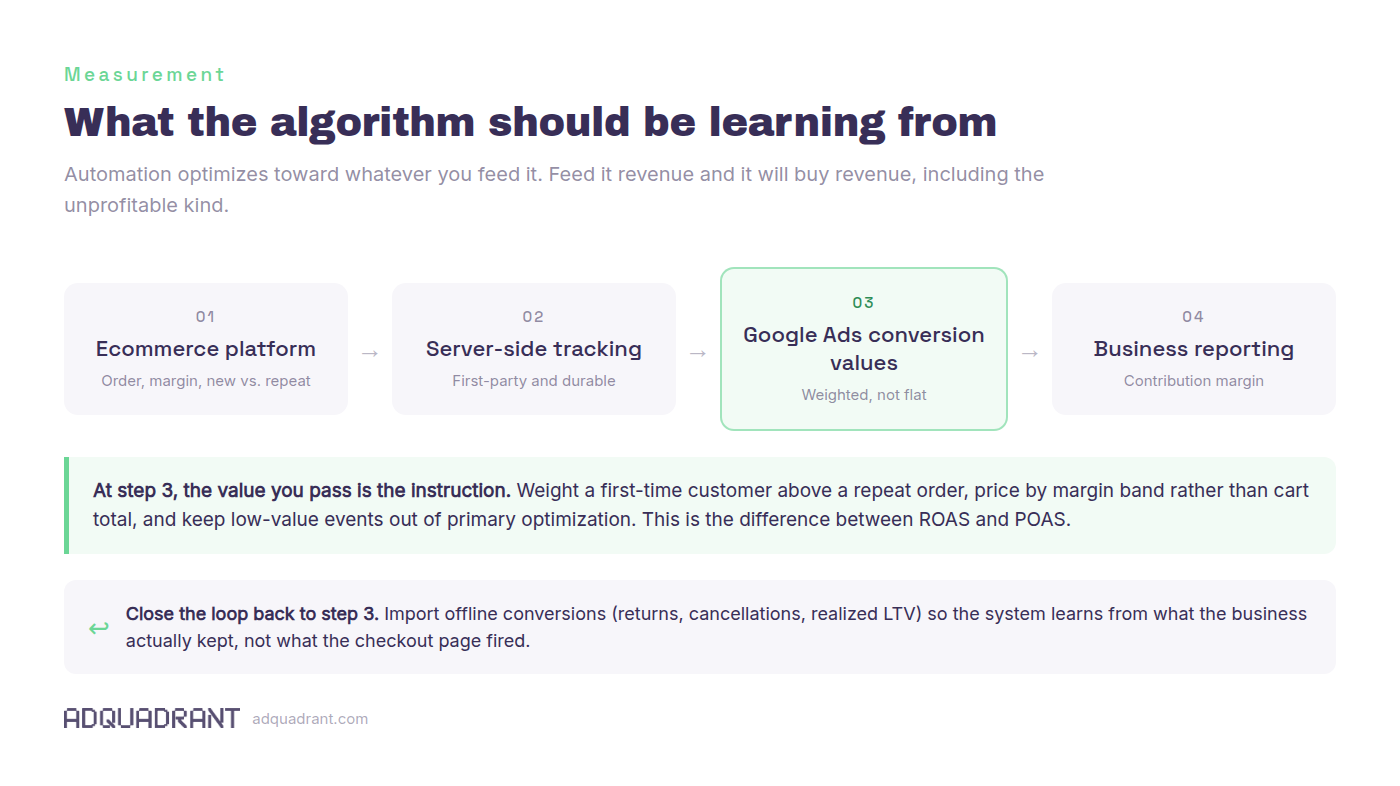
Value-based bidding is one of the clearest ways to train the system toward better outcomes. Instead of treating every conversion the same, you pass conversion values that reflect business quality. That can mean weighting first-time customers differently from repeat orders, excluding low-value events from primary optimization, or adjusting value logic by product margin bands.
Measurement architecture checklist
- Track online purchase value accurately.
- Use server-side tracking where possible.
- Import offline conversion data when relevant.
- Separate primary and secondary conversions.
- Define new customer value clearly.
- Review attribution against business reporting weekly.
- Set targets with enough room for learning.
The Limits and Costs of Letting AI Drive More of Search
This approach has tradeoffs, and not every brand should move the same way at the same speed. If your conversion tracking is unreliable, your product feed is thin, or your catalog economics are unstable, more automation can amplify bad inputs. Google AI Max is powerful, but it is not a substitute for operational discipline.
There is also a reporting cost. You will lose some of the neat storylines that came from keyword-level management. Query visibility may be less precise. Causality may feel blurrier.
This approach can also fail for brands with very low conversion volume. Automated systems need enough data to learn. If your account does not generate sufficient conversion density, broad automation can become unstable.
What to Do This Month
- Consolidate fragmented search structures where they are limiting signal density.
- Audit your product feed titles, descriptions, categories, and custom labels against merchandising and margin priorities.
- Refresh first-party audience inputs, especially high-LTV and new customer segments.
- Review bidding against POAS, COGS, and contribution margin, not ROAS alone.
- Tighten your measurement architecture so Google learns from real business outcomes.
Most accounts are now running more automation than their inputs can support. If closing that gap is the priority this quarter, that is the work our AI search team does: turning on the Google features your account is leaving switched off, and measuring them against what the business actually keeps.
About the author
Erick Smith is a Senior Client Partner at Adquadrant. A San Diego native with 15+ years across the paid and organic landscape, he pairs data analysis with plain talk to act as a trusted advisor and growth strategist for the brands he works with. Away from the office, you will find him with his family at the beach, in the mountains, or watching the Padres.