
Ecommerce brands get sales from YouTube, not just views, when they run it like a performance channel. That means Demand Gen campaigns bidding on purchases, a product feed attached to the video, separate creative for Shorts and for in-stream, real order values passed back to Google, and a lift test planned and budgeted before spend scales. Skip any of those and YouTube tends to look like a branding cost in last-click reports, and the budget drifts back to Meta.
In the YouTube accounts I work on, the gap I see most is not budget or targeting. It is that teams build one video, run it everywhere, judge it on last click, and never set aside the money to prove what it did. This guide walks through how I set it up instead.
Key takeaway: Build YouTube around purchase goals, give Shorts its own social-style creative, send Google the actual value of each order, and know the minimum spend for the lift study you want before you launch. That last part decides whether YouTube survives your next budget review.
Why does YouTube belong in the performance budget?
YouTube combines three things few platforms offer together. It reaches people across connected TV, desktop, mobile and Shorts. It sits inside Google's intent data, so it can use search and browsing behavior to find likely buyers. And it can carry a product feed, so a shopper can go from a video to a product page in one tap.
Most brands still underinvest because last-click reporting makes YouTube look weak. A shopper watches a product demo on their TV on Sunday, searches the brand name on their phone on Tuesday, and buys on their laptop on Thursday. Last click hands the credit to branded search. YouTube looks like a cost center.
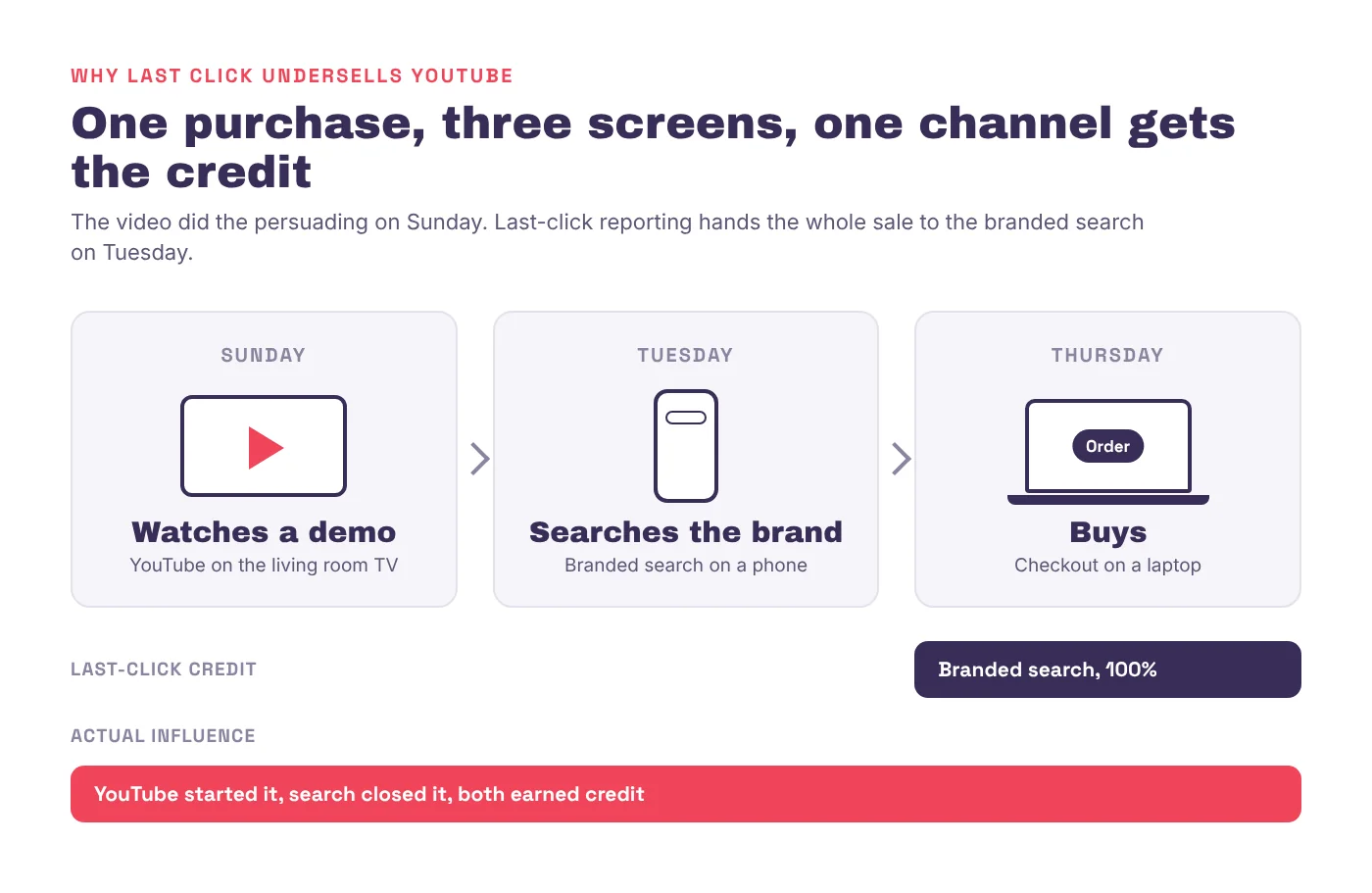
That is a measurement problem, not a channel problem, and incrementality testing usually shows it.
There is a cost argument too. Meta and TikTok auctions are crowded with DTC advertisers, while YouTube in-stream still draws fewer direct-response buyers.
Which YouTube campaign types drive ecommerce sales?
The campaign types that drive sales are the ones built around a purchase goal, not a view goal. Google folded its conversion-focused video formats into Demand Gen, so that is where most DTC performance work on YouTube now lives.
Demand Gen as the core
Demand Gen runs across YouTube in-stream, in-feed and Shorts, plus Discover and Gmail, and it replaced video action campaigns. It should carry most of your conversion-focused YouTube budget, with conversion bidding, product feeds, lookalike segments and channel controls that let you run on YouTube only for a clean read.
Performance Max as the backstop
Performance Max also serves YouTube inventory, but you get far less control over how much budget goes to video and which creative runs there. I treat PMax as a capture engine and use Demand Gen when I want YouTube to create demand on purpose.
Awareness formats with a job to do
Video reach and non-skippable formats fit launches and seasonal pushes, measured with a Brand Lift or Search Lift study or branded search volume, never on cost per purchase.
- Demand Gen, YouTube only. New customer acquisition, judged on incremental CAC and new customer ROAS.
- Demand Gen with a product feed. Catalog and hero SKU sales, judged on product revenue and contribution margin.
- Performance Max. Capturing existing demand, judged on blended ROAS and overlap with search.
- Video reach and non-skippable. Launches and seasonal pushes, judged on Brand Lift, Search Lift or branded search volume.
How do you make YouTube ads shoppable?
Connecting your Merchant Center feed to Demand Gen is one of the fastest ways to make YouTube shoppable. It adds product cards alongside your video, so a viewer can go straight from the ad to a product page.
The feed matters more than most teams expect. The shopper has not typed a query, so Google relies on your titles, images, prices and custom labels to pick which products sit next to which video.
- Match the products in the feed to the products in the video. Use a product filter or custom label so a video about your best-selling serum does not show your gift sets.
- Add custom labels for margin tier, hero products and inventory depth.
- Exclude low-margin and low-stock items. Paying to send a new customer to an item that sells out next week wastes the click.
- Keep sale prices accurate between the card and the page.
What YouTube creative actually converts?
Creative is the biggest lever in YouTube performance, and the polished brand film rarely wins for DTC.
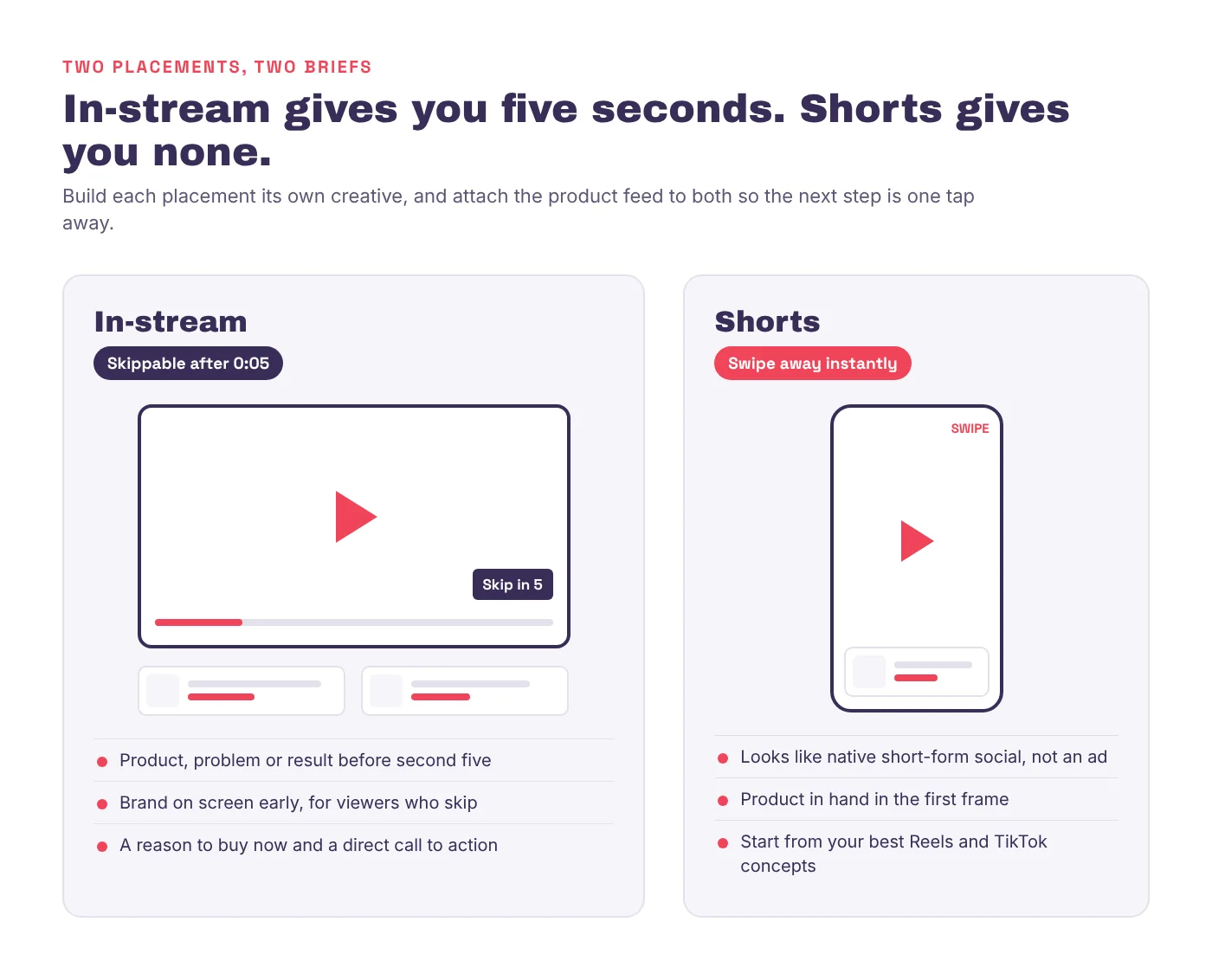
The mistake I see most is treating YouTube as one placement. In-stream and Shorts behave differently, and they need different creative.
In-stream gives you five seconds
In-stream viewers can skip after five seconds. Show the product, the problem or the result before that point, and get the brand on screen early so a viewer who skips at second six still knows who you are. Give a reason to buy now, such as an offer, a bundle, a guarantee or a proof point, and end with a direct call to action. Captions matter because many people watch on mute.
Shorts gives you zero
On Shorts, a viewer can swipe past your ad immediately. There is no five-second window. That changes the whole brief. Shorts creative should look and feel like native short-form social content rather than a YouTube ad cut down to vertical. Think a person talking to camera, the product in hand in the first frame, fast cuts and on-screen text. If your Shorts ad looks like an ad, it gets swiped.
The practical upside is that your best Meta Reels and TikTok concepts are often the strongest starting point for Shorts. Rework them with the product shown right away and captions built in, rather than recutting your in-stream video.
Format and volume
Plan for three aspect ratios, with 16:9 for in-stream and connected TV, 9:16 for Shorts, and square for in-feed. Aim for three to five concepts per campaign, each with two or three hooks, and rotate new ones in before performance falls.
Bring creator videos straight into Demand Gen
Creator-led demos and reviews bring the credibility of a real person using the product, and they tend to hold attention longer than studio ads. YouTube's Creator Partnerships hub inside Google Ads makes this much easier than it used to be. Once a creator links their video to your account, creator partnerships boost lets you run it as an ad in Demand Gen, including a co-branded partnership format in in-feed and Shorts. Pair those linked videos with your product feed and the creator's demo sits next to the exact products they are talking about. You still need the creator's permission and usage rights for paid use, so settle that before you plan around a video.
How should you bid on YouTube for ecommerce?
Start with conversions, then move to value
New Demand Gen campaigns often need volume before value-based bidding works well. A common path is to start on Maximize Conversions or a target CPA with room to learn. Once the campaign has steady purchase data, move to Maximize Conversion Value or target ROAS. An aggressive target on day one usually chokes delivery before the system has learned who buys.
Send the real value of each order
Value-based bidding only works if your purchase conversion action reports the actual revenue of each order. If every purchase comes through at the same static value, or with no value at all, the system has no way to tell a $40 order from a $400 one, and it will chase the cheapest buyers. Check that your purchase tag or integration passes dynamic revenue and currency on every order before you switch to a value strategy.
You will see advice to send gross margin instead of revenue. It can work, but it is hard to keep accurate for most brands, and I do not run it on any of my accounts. Dynamic revenue plus Google's new customer acquisition goal, which lets you bid more for buyers you have not seen before, gets most brands most of the way there.
Seed audiences with intent
Seed launches with Customer Match lists of high-value buyers, custom segments built from your best-converting search terms, and product viewers who did not buy. Exclude recent purchasers, since reaching last week's buyers inflates ROAS and adds no new revenue.
How much budget does a YouTube lift study need?
This is the question I wish more brands asked before launch. Google's lift studies are the cleanest way to see what YouTube caused, but each one has a spend floor, and for smaller brands it is often a minimum they cannot reach. Plan the study when you plan the budget, not after the first month looks soft.
Here is what Google publishes for US campaigns as of October 2026.
- Brand Lift, one question. $10,000 over the first 10 days. Measures survey lift in ad recall, awareness, consideration or purchase intent.
- Brand Lift, two questions. $20,000 over 10 days.
- Brand Lift, three questions. $60,000 over 10 days.
- Search Lift. $10,000 over 28 days. Measures lift in searches for your brand on Google and YouTube.
- Conversion Lift, user-based. No published floor. Google sets the budget per study from your conversion history.
- Conversion Lift, geo-based. Also set per study, and usually higher than user-based.
A few details that catch people out. The Brand Lift minimum climbs steeply per question, and the third question triples the cost of the second. Google's Enhanced Lift option needs three times the standard Brand Lift budget. If you run Brand Lift and Search Lift on the same campaigns, the US minimum is still $10,000, not $20,000, and Google recommends at least 1.5 million combined impressions for Search Lift. Countries are grouped into three budget tiers, so the same study can cost more in Canada or Germany than in the US.
Conversion Lift is the study most DTC brands actually want, and it is the one with no published dollar figure. Google calculates the budget during setup from the conversion volume of the campaigns you want to measure, and it rates each design as high, medium or low feasibility. Access usually runs through your Google account team, and a geo-based study must target a single country. If the feasibility comes back low, do not run it. You will spend the money and get an inconclusive answer.
If you cannot reach the floor, you still have options. Run a geo holdout outside Google's tools, where you pause or raise YouTube in matched regions and compare total sales. Or watch branded search volume, direct traffic and new customer counts before, during and after a defined YouTube flight. Neither is as clean as a Google lift study, but both beat judging the channel on last click.
How do you measure YouTube on incrementality?
Judge YouTube on last-click ROAS and it loses almost every time. Judge it on incremental revenue and it often earns more budget.
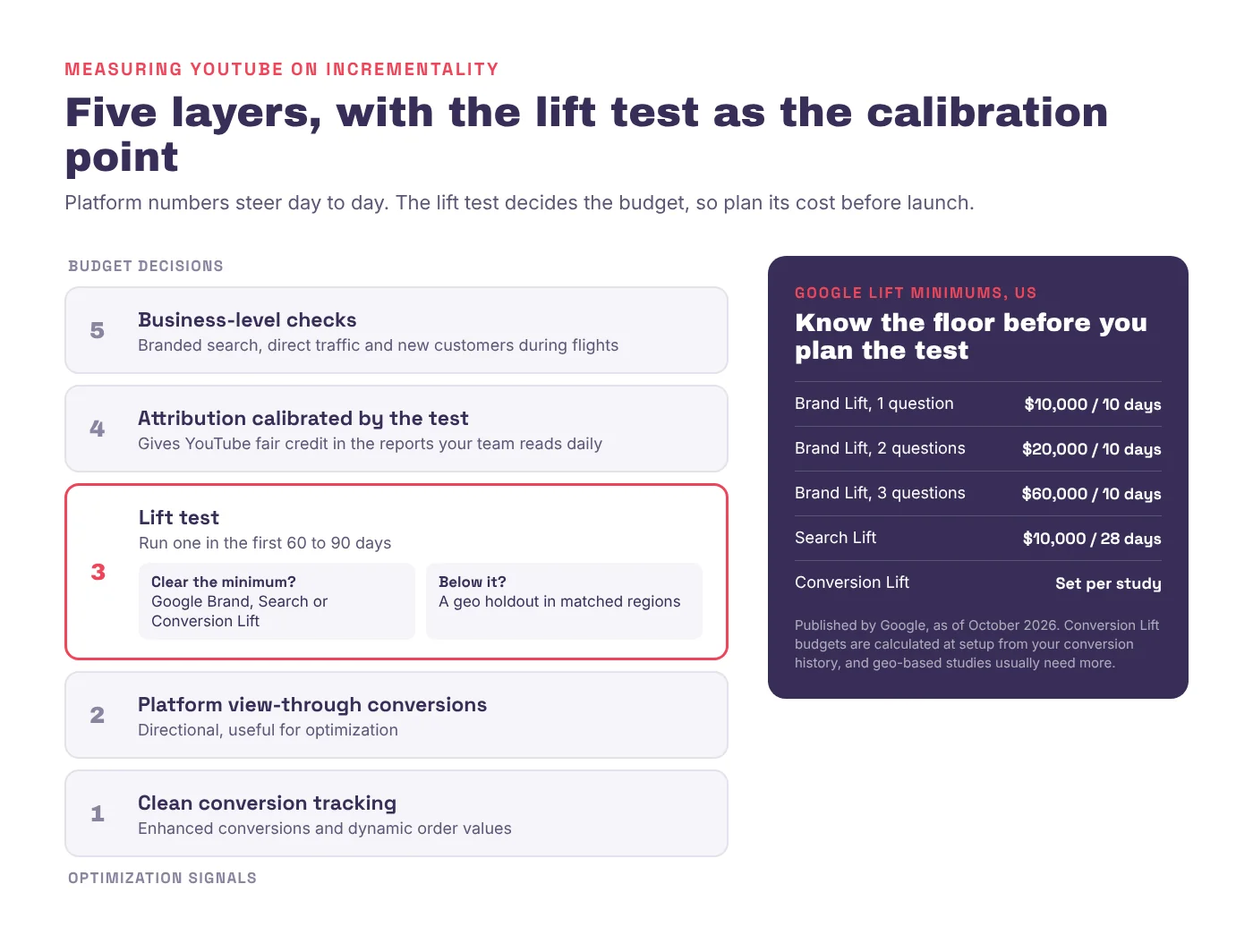
- Clean conversion tracking. Use enhanced conversions and server-side tracking where you can, with dynamic order values, so Google sees as much accurate purchase data as possible.
- Platform view-through conversions. Useful for optimization, not for budget decisions.
- A lift test. A Google lift study if you clear the minimum, or a geo holdout if you do not. Run one in your first 60 to 90 days.
- Attribution calibrated by that test. Use the result to tune the model your team reads every day so it gives YouTube fair credit.
- Business-level checks. If branded search, direct traffic and new customers rise when YouTube spend rises, the channel is working even if platform numbers look soft.
A 90-day plan to launch
Days 1 to 30. Fix tracking and dynamic order values, clean the feed for your top 20 to 50 SKUs, build three concepts in in-stream and Shorts versions, confirm your lift study minimum, and launch one YouTube-only Demand Gen campaign.
Days 31 to 60. Iterate on hook and hold rates, judging Shorts and in-stream separately. Attach the feed, test linked creator videos, and start the lift study or geo holdout.
Days 61 to 90. Read the result. If YouTube drives incremental new customers at an acceptable cost, shift budget from saturated channels and move to value-based bidding. If not, the test tells you whether to fix creative, audience or offer.
The limits and tradeoffs
YouTube is not the right first step for every brand. It needs creative volume in two styles, enough conversion data for automated bidding to learn, a test budget on top of the media budget, and patience, because lift studies take weeks to read. You will also rely more on tested results than on clean click paths, so agree on the measurement plan, and its cost, before launch.
How Adquadrant runs YouTube for DTC brands
At Adquadrant we run YouTube for brands doing $10M or more in revenue, usually alongside their Google search and Meta budgets. The approach follows everything above, with three habits I would push any team to copy.
The measurement plan comes before the media plan
Before we launch, we look at how the account is being graded today, decide which lift study answers the budget question, and check its spend floor against the plan, so nobody is surprised in week six. When a brand clears Google's minimums, we use Google's lift studies. For a pet food brand running a national campaign, we launched YouTube alongside it and had Google run a Search Lift study. Searches for the brand name rose 718%. When a brand cannot reach the floor, we design a geo holdout instead. As a WorkMagic Official Agency Partner, we run those geo-lift tests across a brand's full sales mix, then use the result to set the next month's budget, creative and audience calls.
In-stream and Shorts are briefed as two different buys
In-stream gets hooks built for the five-second skip. Solvable's flagship YouTube video opened on a spoken claim, ran nearly 40 seconds and sat at break-even. Our team recut it to open on a physical bill held to camera and cut a third of the runtime. On the same bidding strategy, it now carries 9.4 times the budget it started with at a 125% return on ad spend. Shorts gets native short-form creative instead. When Revelry's 2026 budget came in at roughly half the prior year, we protected prospecting and stood up a dedicated YouTube Shorts campaign optimized to add-to-cart. Cost per add-to-cart fell 66% in four months while total spend came down 53%.
Bidding runs on real order values
We confirm dynamic revenue is flowing before any campaign moves to a value-based strategy, and we use the new customer acquisition goal where the brand's growth depends on first orders. Creator videos come in through the Creator Partnerships hub with the usage rights settled first, and run as paid media next to the product feed.
The first thing a brand sees from us is a plan, not a spend increase. That plan covers how YouTube is being graded today, which lift study fits and what it costs, the first in-stream and Shorts briefs, and the numbers we will judge the channel on. Hooks are then briefed, tested and retired on a weekly cadence.
How to choose a YouTube ads partner
- They plan Shorts and in-stream creative separately and can show you both.
- They bid on purchases with real order values, not on views or static conversion values.
- They tell you the spend minimum for a lift study before you sign, and have a plan if you cannot reach it.
- They judge YouTube on incremental new customers, not last-click ROAS.
- They can run creator videos as paid media and handle the usage rights.
- They manage YouTube alongside your Google search and Meta budgets, so the credit is not fought over channel by channel.
YouTube can be one of the most efficient new customer channels in a DTC media mix. It just has to be built and measured like a performance channel. If you want a YouTube program judged on real revenue, talk to the Adquadrant YouTube team.
About the author
Originally from Boston, MA, Laura moved to San Diego in 2021 and enjoys exploring California via beaches, hikes, and burrito shops. A graduate of Emmanuel College, she began her marketing career in higher education before transitioning to digital marketing agencies, where she has been for the past five years.