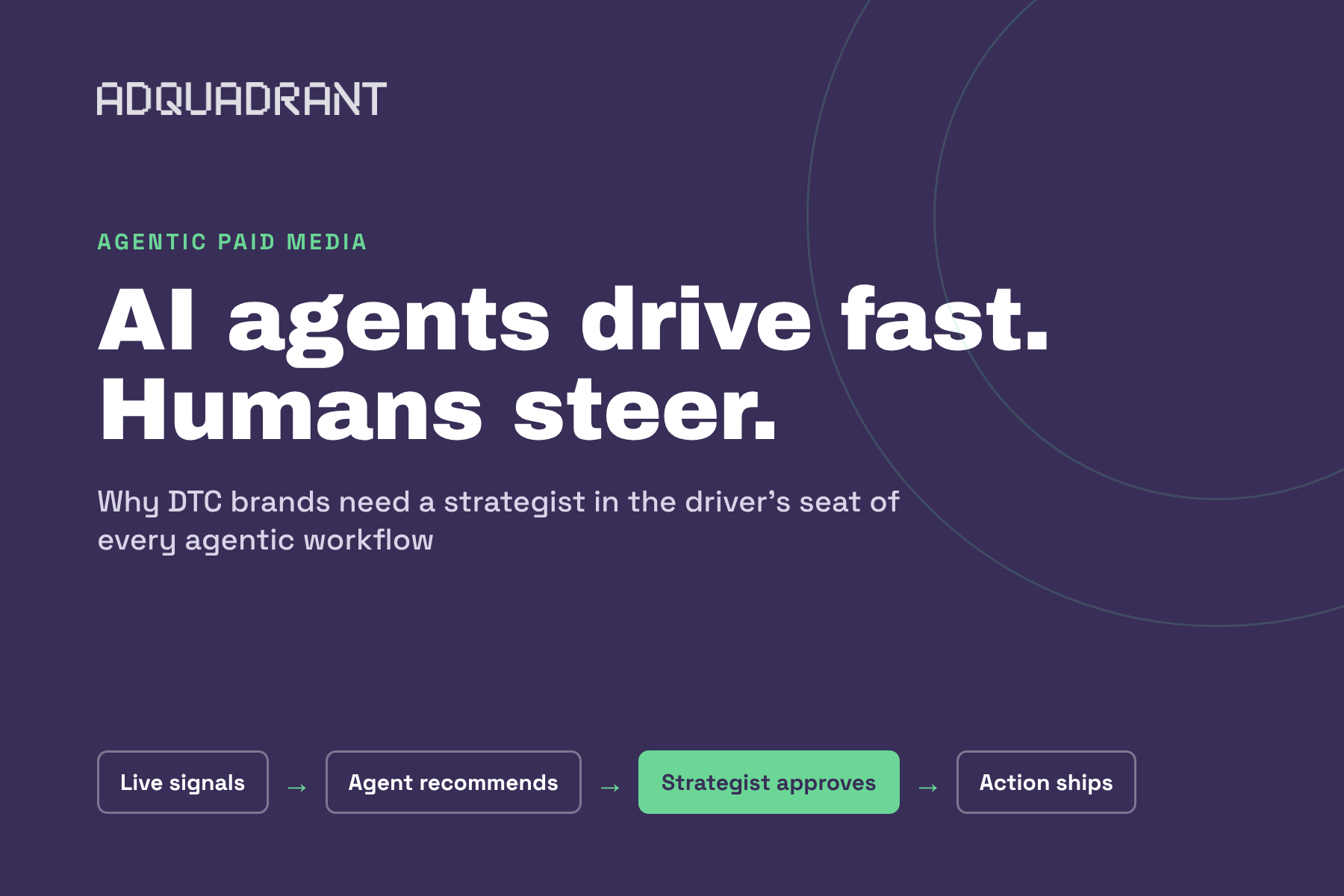

Most DTC brands do not have a media buying problem. They have a workflow problem. Campaigns still run through disconnected dashboards, delayed reports, manual budget shifts, and channel-by-channel decisions that land after the market has already moved.
AI agents are fixing a lot of that. They can watch every signal, shift budget the same day, and push changes into Meta and Google without waiting for a weekly call. Capital allocation is about to get very fast and very cheap. But there is a story building in the market that goes one step further, and I think it is a dangerous one. The story says that once the agents are good enough, you no longer need the people behind them.
I do not buy it. After years of managing paid media budgets, my view is simple. No tool will replace the human in the driver's seat. The agent can drive faster than any of us. Someone still has to choose the destination, read the road, and grab the wheel when the system is confidently heading the wrong way.
The short version. Agentic paid media lets DTC brands move from reactive campaign management to adaptive decision making. The strongest results come when AI agents handle high-volume execution and a strategist orchestrates the whole system, sets the guardrails, and ties every decision back to margin and revenue.
What Are Agentic Paid Media Workflows?
Agentic paid media workflows are AI systems that complete multi-step optimization tasks without waiting for a person to push every button. Instead of only surfacing alerts or summarizing data, they monitor performance, interpret signals, take actions, and learn from the outcomes across campaigns.
That matters because most teams are still stitched together. One person owns reporting. Another owns creative. Another owns buying. By the time an insight moves between them, the opportunity is smaller or gone. For a brand trying to scale efficiently, that lag is waste.
The better path is one connected system where strategy, media, creative, and measurement inform each other. Agents carry the repeatable work. People spend their time on the calls that need judgment.
Why the Human Stays in the Driver's Seat
There is a growing pitch that goes like this. Connect an AI tool to your ad accounts, ask it questions in plain English, and let it write changes straight into Meta and Google. No agency, no strategist, no team. Just prompts.
I understand the appeal. I also think it is one of the riskiest bets a growing brand can make right now. Be skeptical of anyone selling software as a full replacement for experienced operators, no matter how polished the demo looks. A tool that reads your data and edits your campaigns has no idea that your hero SKU is about to go out of stock, that finance just tightened the payback window, or that the brand team would never approve the claim it just wrote into a headline.
Here is what an experienced strategist brings that a prompt box cannot.
- An understanding of the client's actual goal, which is rarely the number the platform is optimizing toward
- Pattern recognition from years of watching auctions, seasons, and creative cycles across many brands
- The judgment to know when a "winning" change is quietly hurting margin, brand, or customer quality
- Ownership of the outcome when something goes wrong, and the context to fix it fast
The way I think about it, the agent is the engine and the strategist is the orchestrator. Capital allocation will become quick and seamless. Direction still has to come from a person who knows where the business is trying to go.
What Agents Should Own Across Meta and Google
None of this means keeping agents on a short leash. A lot of day-to-day execution can and should be handed to them. On Meta Ads, that includes launching new ads from an approved creative library, rotating out fatigued variants, and shifting budget toward fresher assets in Advantage+ campaigns. On Google Ads, it includes refreshing Performance Max headlines and descriptions, rebalancing spend across product groups, and steering search, Shopping, and PMax budgets together as demand moves.
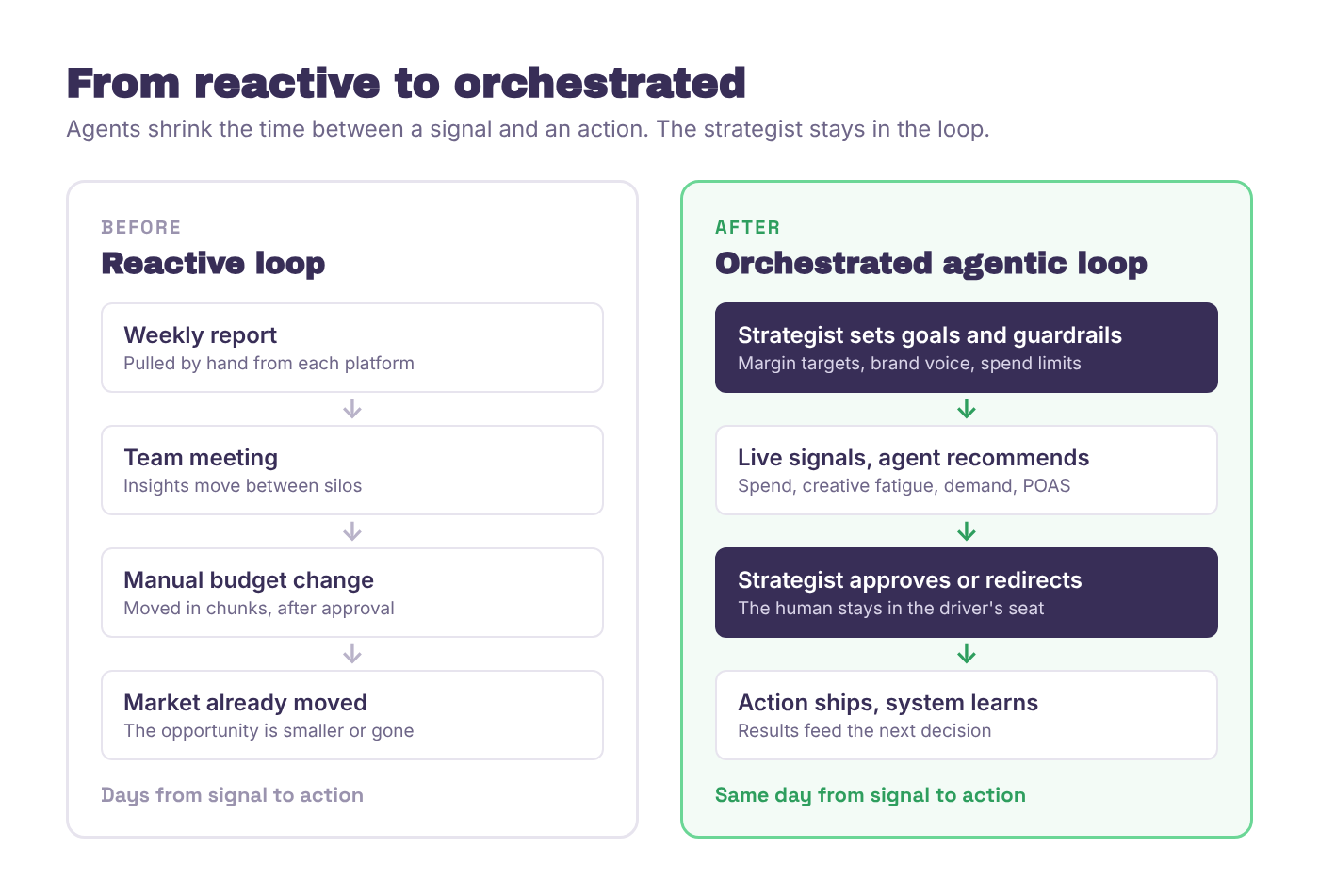
Agents are also better than people at budget fluidity. A human buyer managing several accounts tends to move budget in chunks on a weekly rhythm. An agent can make smaller reallocations the same day. If Google demand softens while Meta remarketing efficiency climbs, the system can respond before the next review instead of after it.
What makes this work is the feedback loop, not the automation itself. The agent proposes, the strategist approves or redirects, the change ships, and the result feeds back into the next decision. Take the strategist out of that loop and you do not get a faster system. You get a system that compounds its own mistakes at machine speed.
The Settings Most Brands Never Check
Here is a small piece of the agentic workflow that I think deserves its own section, because it is where a lot of quiet damage happens.
Google now writes and adapts more of your ad copy for you. In Performance Max and in AI Max for Search, features like text customization and automatically created assets let Google generate headlines and descriptions on your behalf. To keep that copy on brand, Google added controls. Brand guidelines in Performance Max let you set things like business name, logo, colors, and fonts. Text guidelines, available in both AI Max and Performance Max, let you exclude specific words and phrases and add messaging restrictions in plain language, such as "do not imply a discount" or "never call the product cheap."
Two things go wrong when nobody owns these settings.
- You leave money on the table. Many accounts have never reviewed which automated features are switched on or off. Features that could be driving incremental reach sit unused because no one knew they existed or trusted them enough to test.
- You publish a voice you did not choose. If generated copy is switched on without text guidelines in place, the system can put a tone or a claim in front of customers that does not match your brand or your goals. Nobody wrote it, so nobody catches it.
This is exactly the kind of work an agent cannot do for itself. It takes a person who knows the brand voice, knows the legal and claims boundaries, and knows what Google currently calls each setting, which changes often. Set the guardrails first. Then let the agents run inside them.
Tracking Real Revenue With COGS and POAS
AI only improves what you tell it to improve. Point an agent at in-platform return on ad spend and it may scale spend without improving profit. Serious agentic programs need business metrics, not just platform metrics.
The two most important inputs are cost of goods sold (COGS) and profit on ad spend (POAS). COGS tells the system what it actually costs to sell a product. POAS tells it whether revenue is turning into profitable growth. With margin-aware data, agents can bid harder on high-margin products, ease pressure on low-margin offers, and move budget toward the campaigns that grow net contribution. Two products can post the same ROAS and produce very different profit.
Optimize to the next dollar, not the average
There is one more step most teams skip. A target ROAS tells you how your spend performed on average. It does not tell you what the next dollar will return. Two campaigns can both sit at a 3.0 ROAS while one is about to hit diminishing returns and the other still has room to scale.
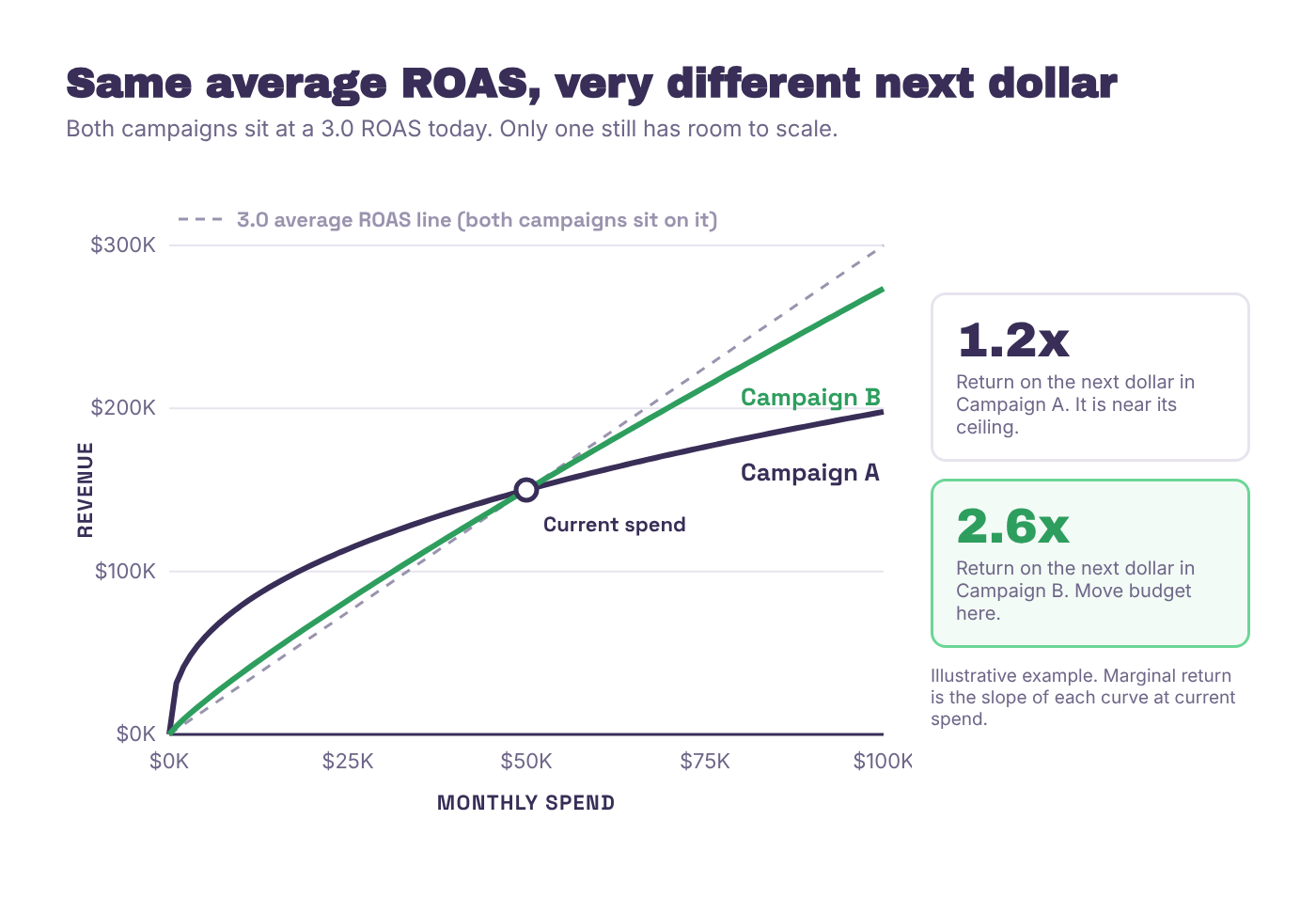
This is where agents earn their keep. They read performance at a finer grain and react faster than a weekly review, so they can steer budget toward marginal return, the profit from the next dollar spent, instead of defending an average. I think of the job less as managing campaigns and more as allocating capital. The agent does the math continuously. The strategist decides how much risk the business wants to take and where the ceiling is.
What to Have in Place Before You Automate
Agentic paid media can improve performance quickly, but weak inputs, loose controls, and thin creative pipelines let the system spend faster than your team can learn. Four things need to be ready.
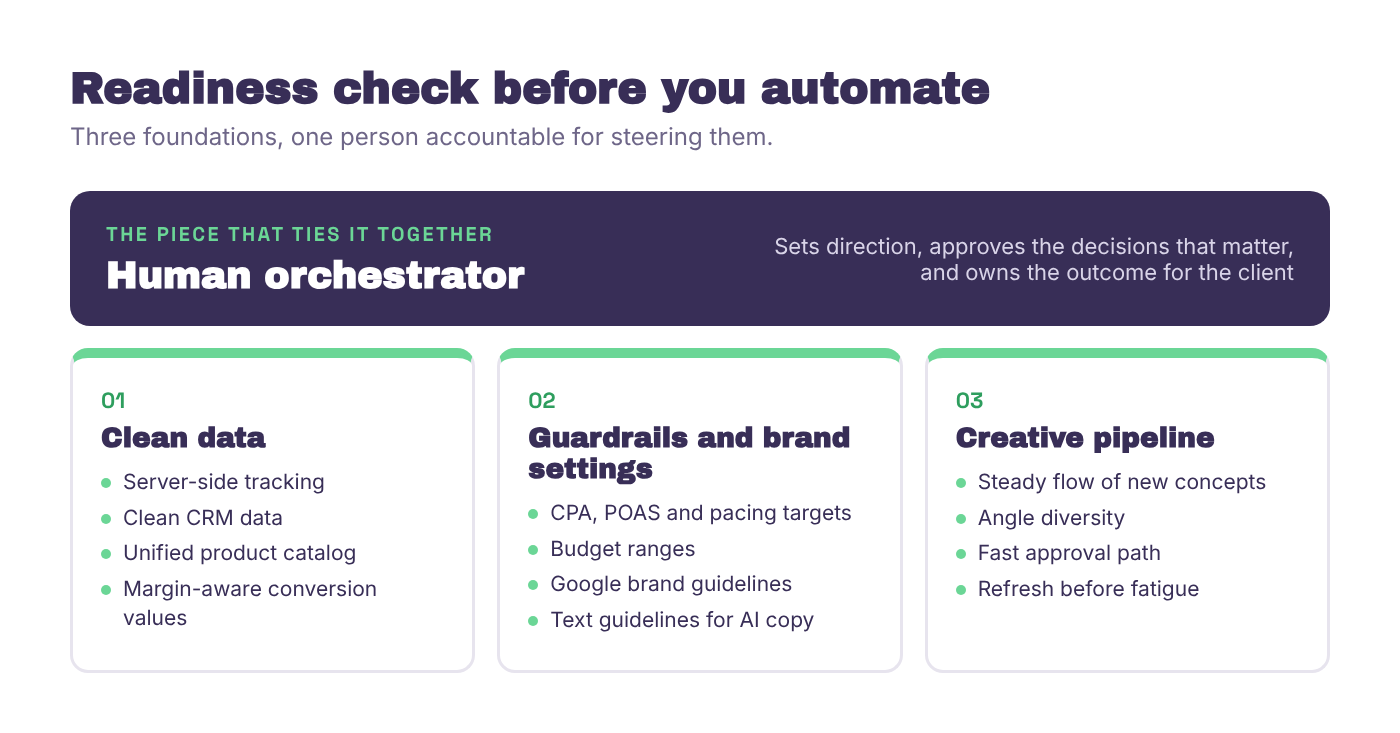
- Clean data. Server-side tracking, clean CRM data, unified product catalogs, and conversion events that reflect real business value.
- Guardrails and brand settings. Clear targets for cost per acquisition, POAS, spend pacing, and budget ranges, plus reviewed brand guidelines and text guidelines in Google so generated copy stays on voice.
- A creative pipeline. Better optimization exposes weak creative faster. If delivery gets more efficient but your pipeline cannot keep up, performance stalls.
- A human orchestrator. Someone who sets direction, approves the decisions that matter, and owns the outcome. If your strategy is unclear, no agent will fix it. It will simply execute poor priorities more efficiently.
There are real costs, too. Agentic systems take setup, integration work, and operating discipline. Approval processes, reporting, and the handoff between creative and media all need a rethink. That investment pays off only when someone is accountable for steering it.
What to Do Next
- Audit your current media workflow for reporting lag, manual handoffs, and disconnected tools
- Review which automated features are switched on in your Google accounts, and set brand guidelines and text guidelines before expanding them
- Validate your tracking foundation, including server-side events, catalog health, and margin data
- Define automation guardrails around spend, acquisition cost, and POAS
- Shift at least one budget decision from average ROAS to marginal return
- Decide who on your side, or your partner's side, is the orchestrator approving what the agents do
The brands that win the next few years will not be the ones that hand their accounts to a chatbot. They will be the ones that pair fast agents with experienced people who know where the business is going. That is how we run media at Adquadrant. Our strategists orchestrate AI agents across Meta and Google, set the guardrails, approve every meaningful change, and measure the result against revenue, backed by our partnership with WorkMagic. If you want a team that keeps a human behind the wheel, see how our AI-powered measurement and decision system works.
About the author
Cooper Davis is a Senior Strategist, Paid Media at Adquadrant and sits on the AQ Marketing team. Whether he is analyzing formations or optimizing ad spend, he lives for the win. Away from the conversions, you will find him watching Manchester United and adding to his sneaker wall, because limited releases and limited budgets both require serious strategy.