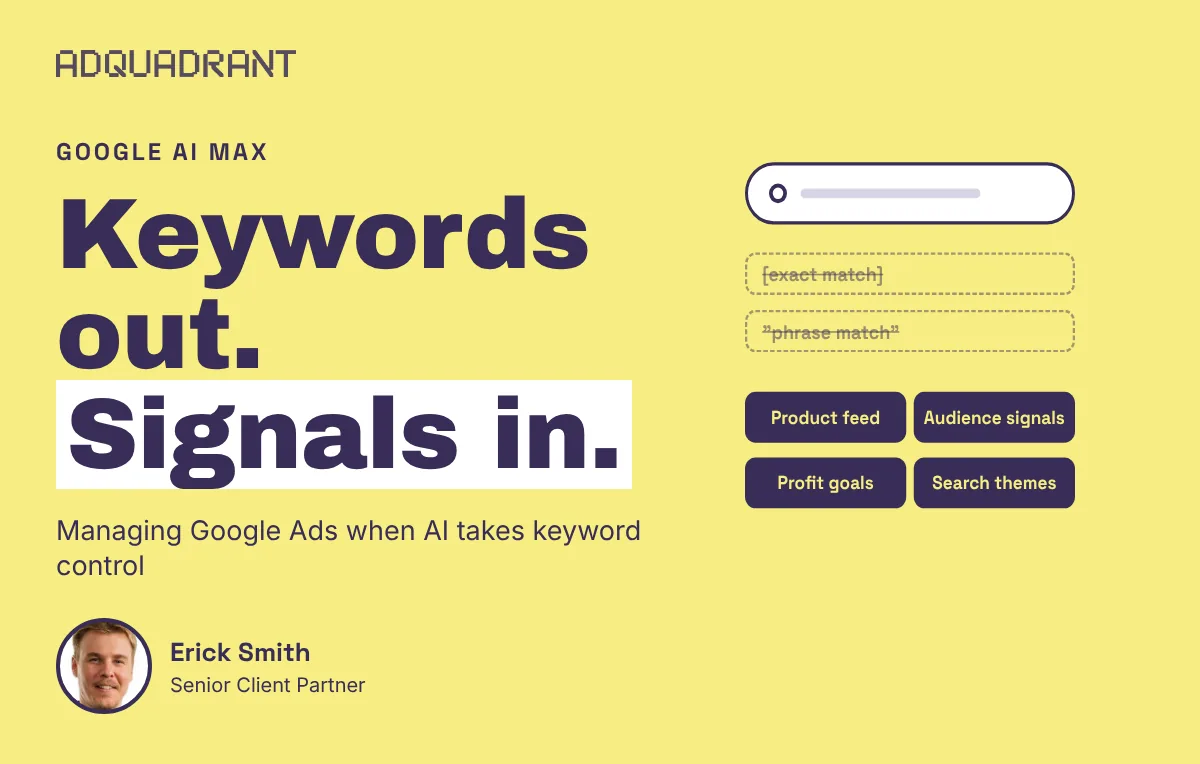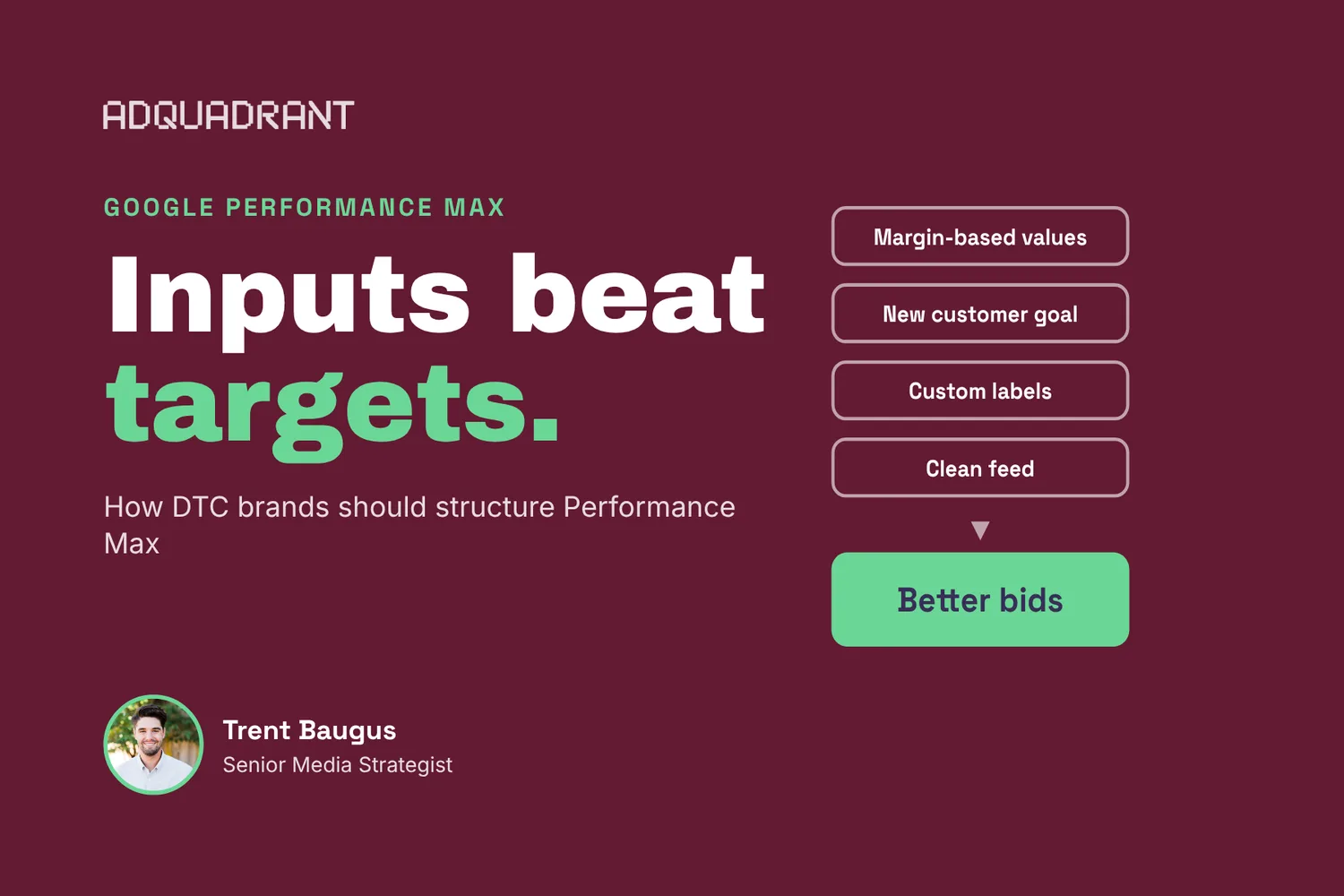

Structure Performance Max around your margins, not your catalog. Budgets and target ROAS live at the campaign level, so products that need different targets belong in different campaigns, split with custom labels in your feed. Asset groups then organize creative and product themes inside each campaign. And the biggest bidding gains come from better inputs, like margin-based conversion values and the new customer acquisition goal, not from nudging the target up and down.
I manage Google accounts for DTC brands, and the most common Performance Max problem I see isn't the bid strategy. It's a structure that asks one target to do the job of several, fed by product data that tells Google very little about what each sale is worth. Here is how I set it up instead.
How should an ecommerce brand structure Performance Max campaigns?
Start by knowing which settings live where, because that decides the whole structure.
- Campaign level. Budget, bid strategy and target ROAS, the new customer acquisition goal, campaign-level negative keyword lists, brand exclusions, and device and age controls.
- Asset group level. Creative, the listing group of products it serves, audience signals and search themes.
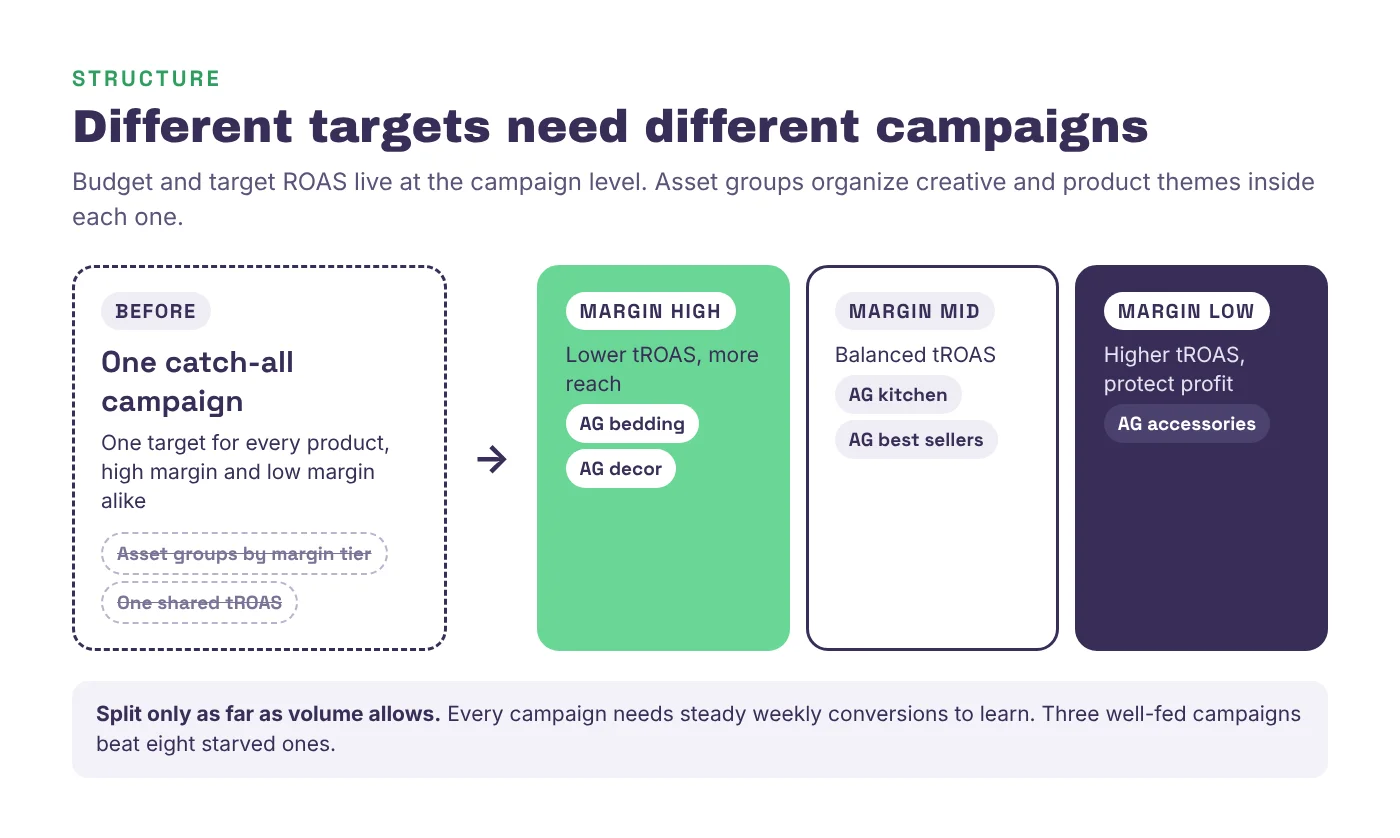
Asset groups don't get their own ROAS target. So the advice to put each margin tier in its own asset group with its own target doesn't work in the platform. If your high-margin and low-margin products need different targets, they need separate campaigns.
The structure I use most is a small number of campaigns split by margin tier, built off a custom label in the feed. Inside each campaign, asset groups follow product themes so the creative, headlines and audience signals match the products being shown. Best sellers and seasonal collections can get their own asset groups when they need different creative.
The limit is volume. Every campaign needs enough conversions to learn. If a tier can't produce steady weekly conversion volume on its own, fold it into the next one rather than splitting further. Three well-fed campaigns beat eight starved ones.
How do you build margin segmentation with custom labels and supplemental feeds?
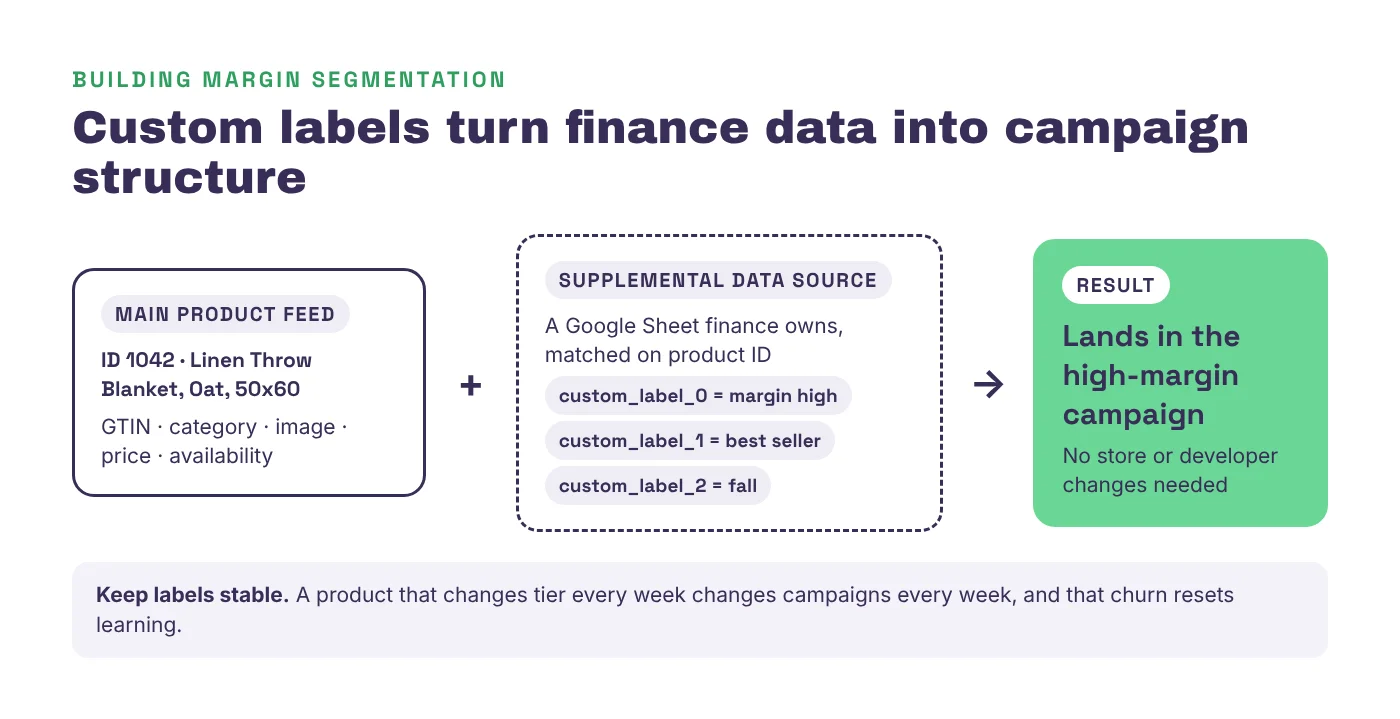
Custom labels are how this structure actually gets built. Google Merchant Center gives every product five custom label fields, custom_label_0 through custom_label_4. Performance Max can filter listing groups on them, so a label like "margin high" becomes the line that decides which campaign a product belongs to.
Most ecommerce platforms don't hold margin data in the product feed, and you shouldn't wait for a developer to add it. A supplemental data source solves that. It's a Google Sheet or file connected in Merchant Center that adds or overrides attributes for products already in your main feed, matched on product ID. Finance owns the margin numbers, the sheet maps each product to a tier, and the labels flow into the feed without touching the store.
These are the labels I use most often.
- Margin tier. High, mid and low, which drives the campaign split.
- Best seller or growth product. Keeps proven products from soaking up budget meant for new ones.
- Season or collection. Lets you pull a collection forward or back without rebuilding anything.
- Price band. Useful when average order value changes how much a sale is worth to you.
Keep the labels stable. If a product moves between tiers every week, it moves between campaigns every week, and that churn resets learning.
Does bidding strategy matter in Performance Max?
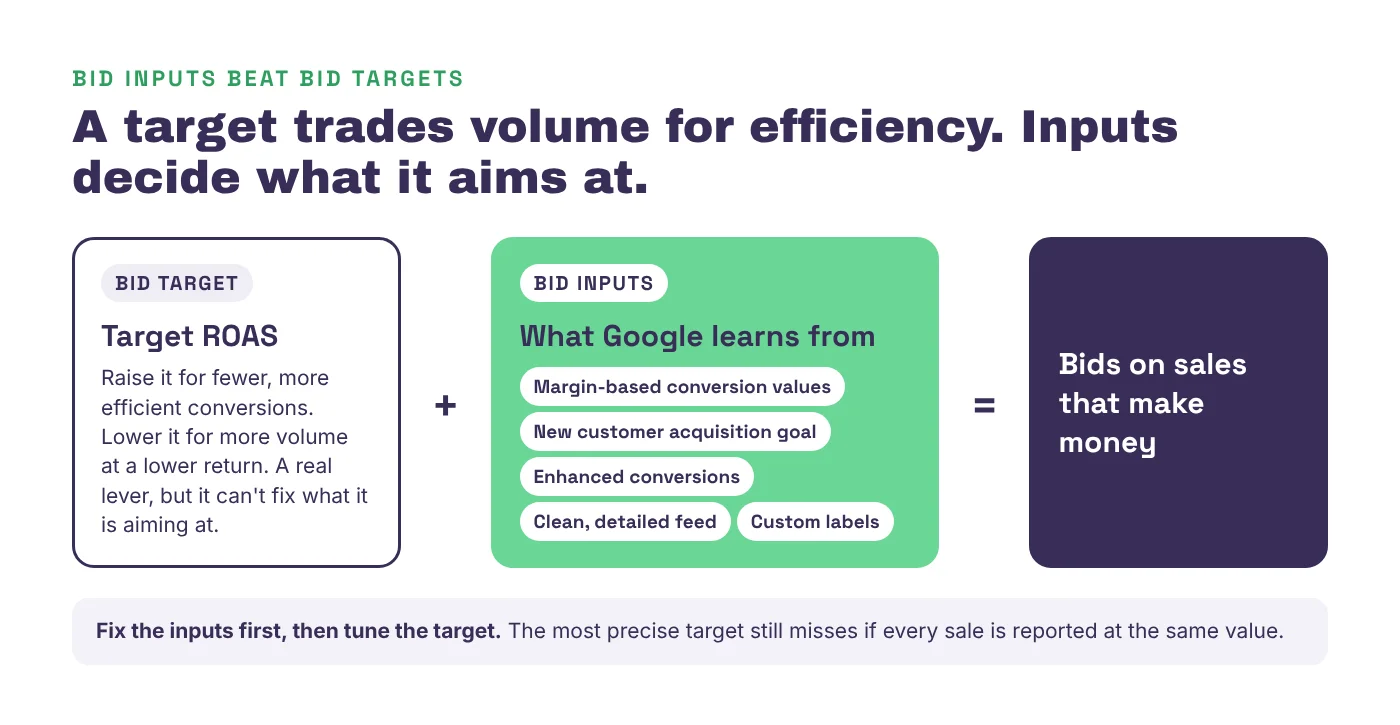
Yes, and it's worth being straight about that. Changing a target ROAS does shift the trade between volume and efficiency. Raise the target and the campaign spends more selectively on fewer, more efficient conversions. Lower it and the campaign reaches further for more volume at a lower return. That lever is real, and I use it.
What a target can't do is fix bad inputs. If every conversion is reported at the same value, or at gross revenue with no idea of margin, the most precise target in the world is still aiming at the wrong number. That's why I'd put it this way. Bid inputs beat bid targets.
These are the inputs that move results most.
- Conversion values tied to profit. Pass margin-adjusted values, or optimize toward profit on ad spend, so the system bids up on sales that actually make money.
- The new customer acquisition goal. Tell Google what a new customer is worth by bidding higher for them, or only bidding for new customers when acquisition is the job. Feed it real customer lists so it can tell new from returning.
- Clean conversion tracking. Enhanced conversions, one purchase action counted once, and accurate revenue values before any budget increase.
- A product feed with real detail. The feed is how Google decides which product to show for which search, so it's a bidding input too.
Which product feed fixes matter most for Performance Max?
The feed works as targeting, relevance and creative all at once. These are the fixes I check first.
- Product titles. Lead with brand, product type and the attributes people search for, such as size, color, material and use.
- Descriptions. Clear, specific and written for the buyer, not stuffed with keywords.
- GTINs and identifiers. These improve matching and eligibility.
- Product type and Google product category. Every item classified correctly, because listing groups and reporting depend on it.
- Images. A strong primary image plus lifestyle images. Merchant Center's AI image tools make it easier to test new backgrounds without a reshoot.
- Price and availability. Accurate at all times, so you aren't paying for clicks on products that are out of stock or disapproved.
What can you see and control in Performance Max now?
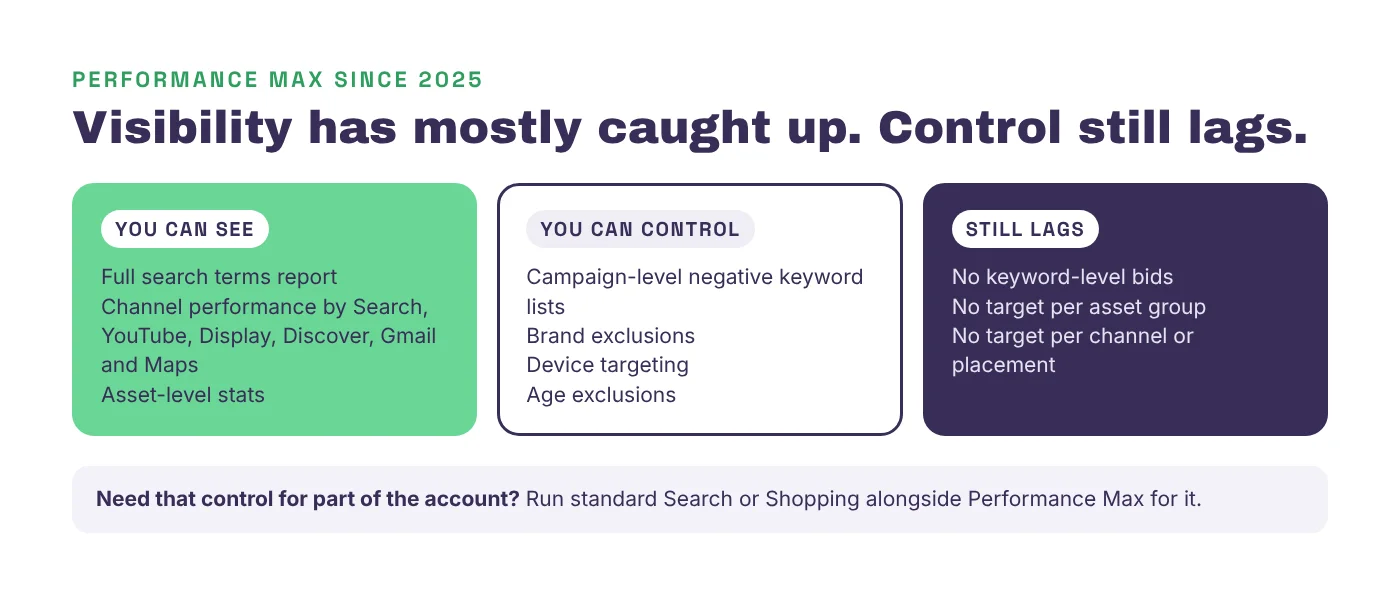
A lot of Performance Max advice still describes the campaign as a black box. That was fair a couple of years ago. Since 2025, visibility has mostly caught up, and control still lags Search and Shopping.
What you can see now. A full search terms report, channel performance reporting that breaks results out by Search, YouTube, Display, Discover, Gmail and Maps, and asset-level stats you can segment and download.
What you can control now. Campaign-level negative keyword lists, brand exclusions, device targeting and age exclusions.
What still lags. There's no keyword-level bidding, asset groups can't carry their own targets, and you can't set a target per channel or placement. If you need that kind of control for part of the account, it still belongs in a standard Search or Shopping campaign alongside Performance Max.
The other cost is time. New campaigns need several weeks of stable data, and big structural changes during that window reset learning. Plan the structure before launch so you aren't rebuilding it in week three.
Performance Max is also built to capture demand that already exists. If it's growing slower as spend rises, the fix may sit above it, in a Demand Gen campaign that finds new buyers for Performance Max to close. And because it will happily take credit for branded and returning demand, read its results through incrementality testing, not platform ROAS alone.
How Adquadrant approaches Performance Max
At Adquadrant we run Google for DTC brands doing $10M or more in revenue, as a Premier Google Partner. Every Performance Max build starts with the inputs. We map margin tiers into custom labels through a supplemental data source, split campaigns where targets truly differ, and fix titles, identifiers and images before we touch a target.
The new customer acquisition goal is where a lot of the upside sits. For a connected hardware brand, we built the brand's own customer lists into separate purchaser and high-value-purchaser segments and switched the account to optimize toward high-value new customers rather than blended return. New households went from 14% to 28% of purchases year over year, and new customers reached 88% of Google-driven orders.
Feed creative is the other lever teams underrate. Pier 1's ornament collection was running on plain white product images, the same as the rest of the category. We tested AI-generated seasonal backgrounds built in Merchant Center against those originals and changed nothing else. Click-through rose 81% while return on ad spend and cost per acquisition both held flat. That's a better input producing a better result, with the bid target left alone.

We judge the results on incremental revenue, not platform credit. As a WorkMagic Official Agency Partner, we run geo-lift tests that show what Performance Max added on top of what a brand would have sold anyway, and that read sets the next month's targets and budget split.
The first thing a brand gets from us is an input audit, not a new target. It covers conversion values, new customer setup, feed quality and the campaign structure those should drive.
How to choose a Performance Max partner
- They can tell you which settings live at the campaign level and which at the asset group level, and structure around it.
- They build margin segmentation with custom labels and supplemental feeds, not a single catch-all campaign.
- They pass conversion values tied to margin or profit, not only revenue.
- They know when to use the new customer acquisition goal and how to feed it customer lists.
- They treat the product feed as part of the media plan, with a regular fix and test cadence.
- They use the newer reporting and controls, including search terms, channel performance, negative keyword lists and brand exclusions.
- They measure Performance Max on incremental results, not only platform ROAS.
Performance Max rewards the brands that give it the best information. Bid targets still matter, but they can't make up for inputs Google can't read. If you want a Performance Max program built from the inputs up, talk to the Adquadrant Google team.
About the author
Trent is originally from Portland, OR and graduated from Vanguard University of Southern California with a BA in Marketing. Outside of work, Trent enjoys watching football (especially the Oregon State Beavers), traveling, and playing golf.