
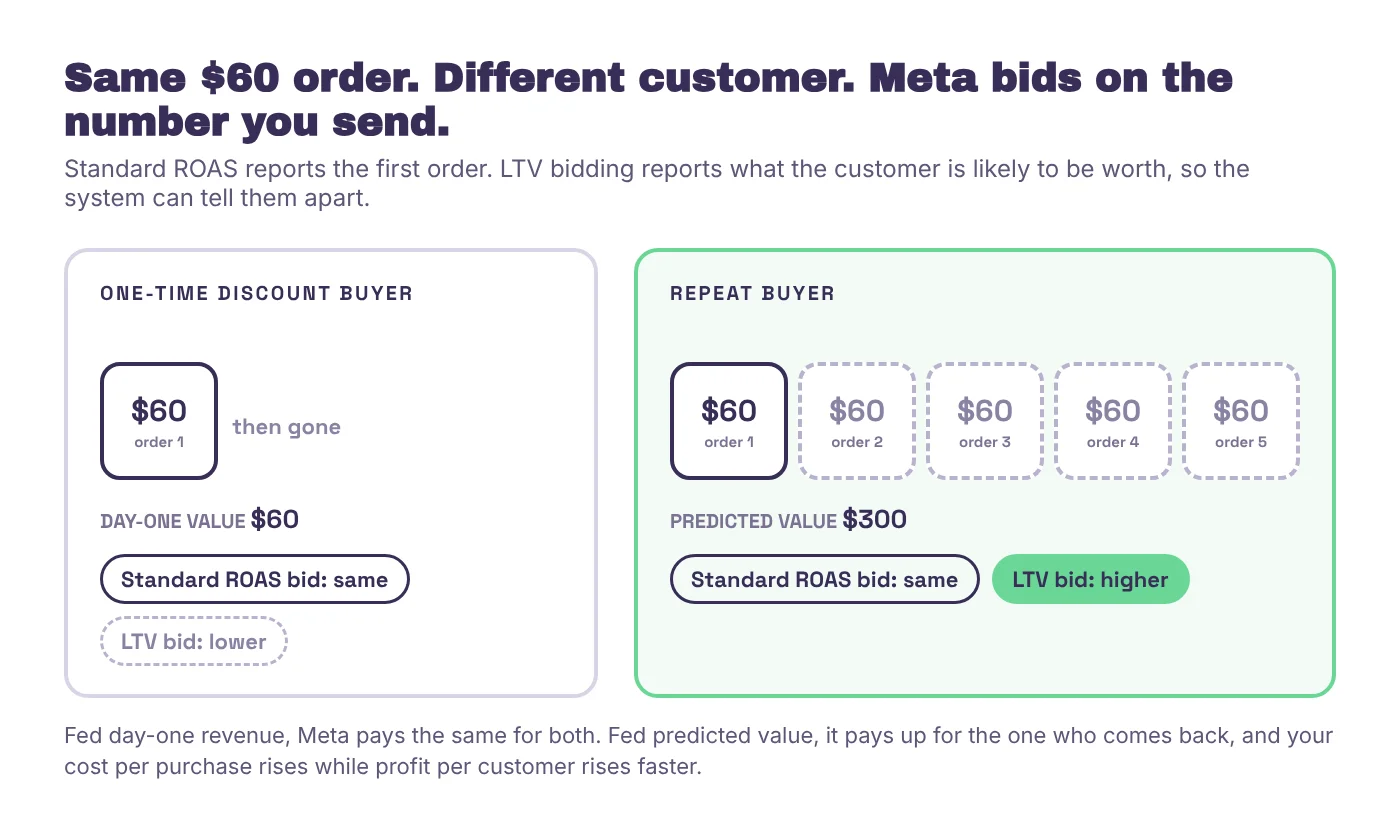
LTV-based bidding on Meta means telling Meta what a new customer is likely to be worth over time, so it bids more for the buyers who come back. Most DTC brands still send Meta the cart total from day one, and that's the wrong number to optimize on. Meta bids on the value you report. A $60 first order from a one-time discount buyer gets the same aggressive bid as a $60 first order from someone who'll reorder five times.
The short version: Meta now lets you bid on purchase value, profit or predicted lifetime value (pLTV), and each one needs more data than the last. Pick the strongest signal your account can actually support, send it through the Conversions API (CAPI), set your ROAS goal from break-even math, and prove the result with a lift test. And expect your cost per purchase to go up when you get it right.
What is LTV-based bidding on Meta, and why does it beat standard ROAS?
Value-based bidding lets Meta bid higher for people it predicts will spend more, instead of treating every purchase the same. LTV-based bidding takes that a step further. You give Meta a predicted customer lifetime value, so the system learns who buys again and stops treating a one-and-done buyer like a loyal one.
Here's how the two compare.
- Value sent to Meta. Standard ROAS sends first-order revenue. LTV bidding sends a predicted 6 or 12 month customer value.
- What the algorithm learns. Standard ROAS teaches it who buys once, cheaply. LTV bidding teaches it who comes back.
- Profit lens. Standard ROAS looks at revenue. LTV bidding looks at contribution margin over time.
- Best fit. Standard ROAS suits low-repeat, single-purchase products. LTV bidding suits subscription, consumable and high-retention brands.
- Data needed. Standard ROAS can run on the pixel. LTV bidding needs server-side data through CAPI and a predictive model.
- Main risk. Standard ROAS overpays for low-retention buyers. LTV bidding carries model error and slower feedback.
As acquisition costs climb, the brands that can only justify spend on the first order lose auctions to the brands that can justify it on the third.
Which value signal should you send Meta?
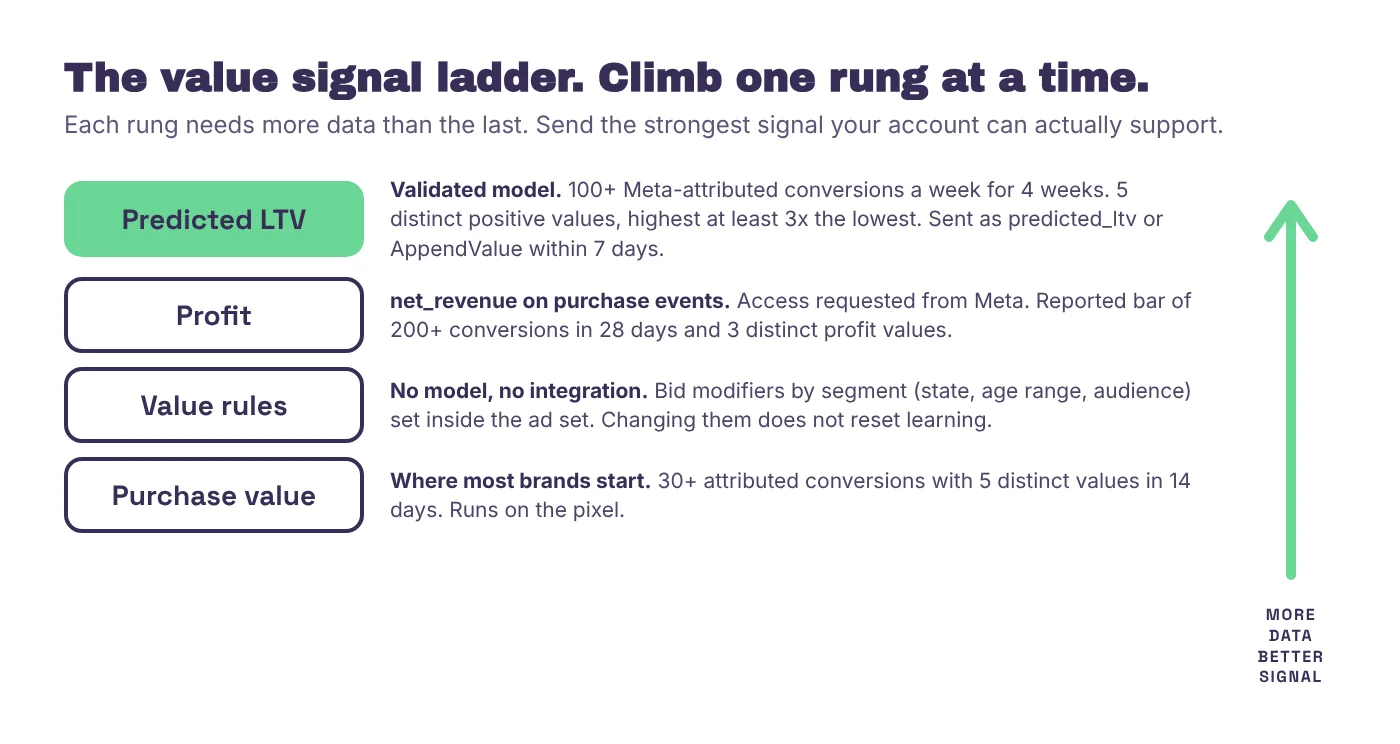
Send the strongest signal your account has the volume and data to support. I think about it as a ladder, and most accounts should climb it one rung at a time.
- Purchase value. Meta optimizes for higher order values. For purchases, value optimization needs at least 30 attributed conversions with at least five distinct values in the past 14 days. This is where most brands should start.
- Value rules. This is the rung most guides skip. Value rules are essentially bid modifiers you set inside the ad set. You tell Meta that certain segments (a state, an age range, a custom audience) are worth more or less, and it bids accordingly. You don't need a model or a new integration to use them.
- Profit. Meta optimizes for margin after product costs, using a net_revenue value on purchase events, so a high-margin order counts for more than a discounted one. Brands have to request access from Meta, and reported requirements include at least 200 conversions in the last 28 days and at least three distinct profit values.
- Predicted LTV. Meta optimizes for the new customers likely to be worth the most over time. It needs a validated model and at least 100 Meta-attributed conversions per week for each of the last four weeks.
A brand selling a single $40 product with low repeat rates may never need more than the first rung. A subscription or consumable brand spending heavily on Meta should be working toward the top.
How do you send predicted LTV to Meta through CAPI?
Meta's predicted LTV setup works one of two ways (Meta developer documentation, checked October 2026).
- Real time. Add predicted_ltv and currency to the conversion event's custom_data, alongside the normal value.
- Delayed. Send the purchase as usual, then send the score within 7 days in a separate AppendValue event, matched to the original by event_id or order_id.
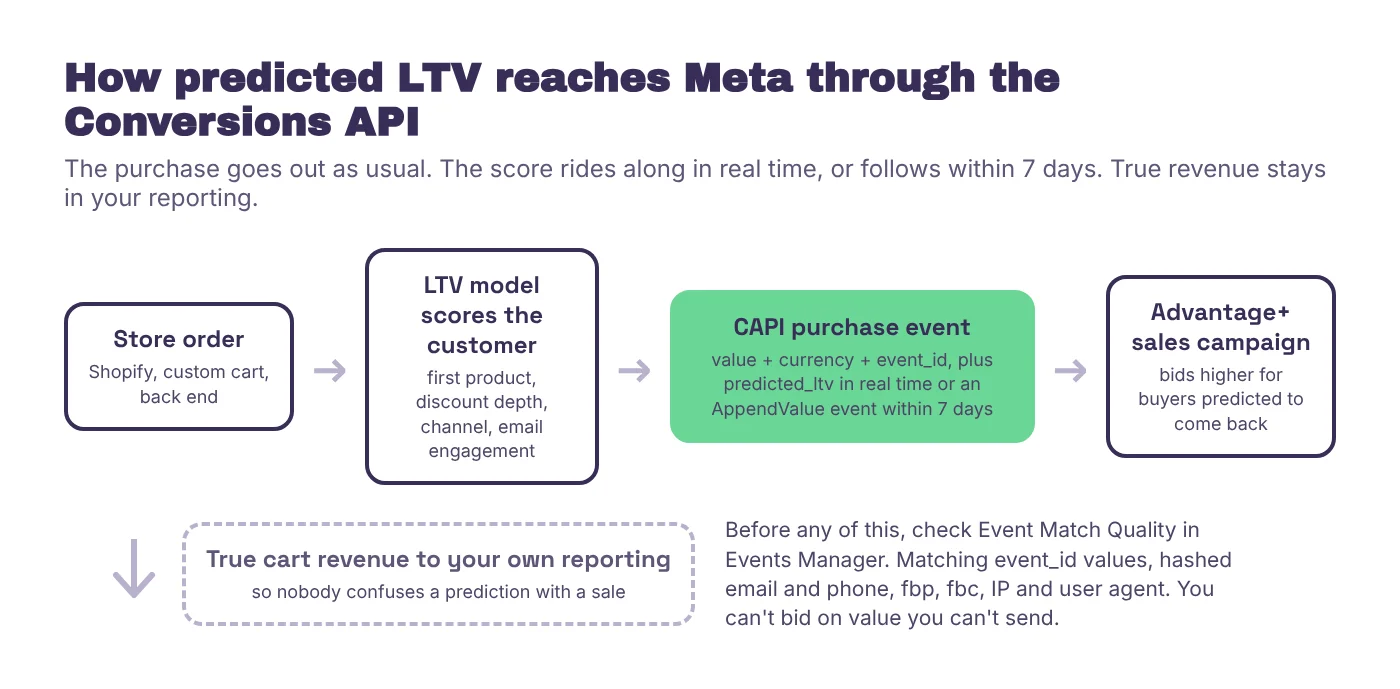
The other requirements are specific. It only works with web Conversions API events. The model needs at least five distinct positive values, with the highest at least 3x the lowest. Only one conversion event per dataset can carry predicted LTV, and Meta recommends about two weeks of model training before you launch.
Your model scores each new customer at order time, using signals like first product, discount depth, channel and email engagement. Keep true cart revenue in value and in your own reporting, so nobody confuses a prediction with a sale.
If your account doesn't meet Meta's bar yet, some brands send a margin-weighted or LTV-weighted purchase value instead. That works, but it inflates reported ROAS, so label it clearly in every report.
Either way, every purchase event still needs the basics. That means a matching event_id so Meta can deduplicate pixel and server events, a valid ISO currency, and hashed email and phone plus fbp, fbc, IP and user agent where available. Check your Event Match Quality score in Events Manager before you touch anything else.
How should you set up Advantage+ sales campaigns for high-LTV customers?
Advantage+ sales campaigns (formerly Advantage+ shopping) automate targeting, placement and creative. Fed flat revenue, they can't tell a one-time discount buyer from a loyal customer. Fed a better value signal, they start finding more of the second group.
A few setup rules help.
- Set the ROAS goal from break-even math. Calculate break-even ROAS from predicted 90-day customer value and gross margin, not from day-one product cost.
- Start without a floor, then add one. Run maximize value of conversions first, then add a ROAS goal near your trailing average and step it up slowly. In my experience a floor set even slightly too high can choke delivery, so run a no-floor campaign alongside the floored one and let them check each other.
- Consolidate. Fewer, larger campaigns give Meta more value examples per week, and value bidding needs those examples.
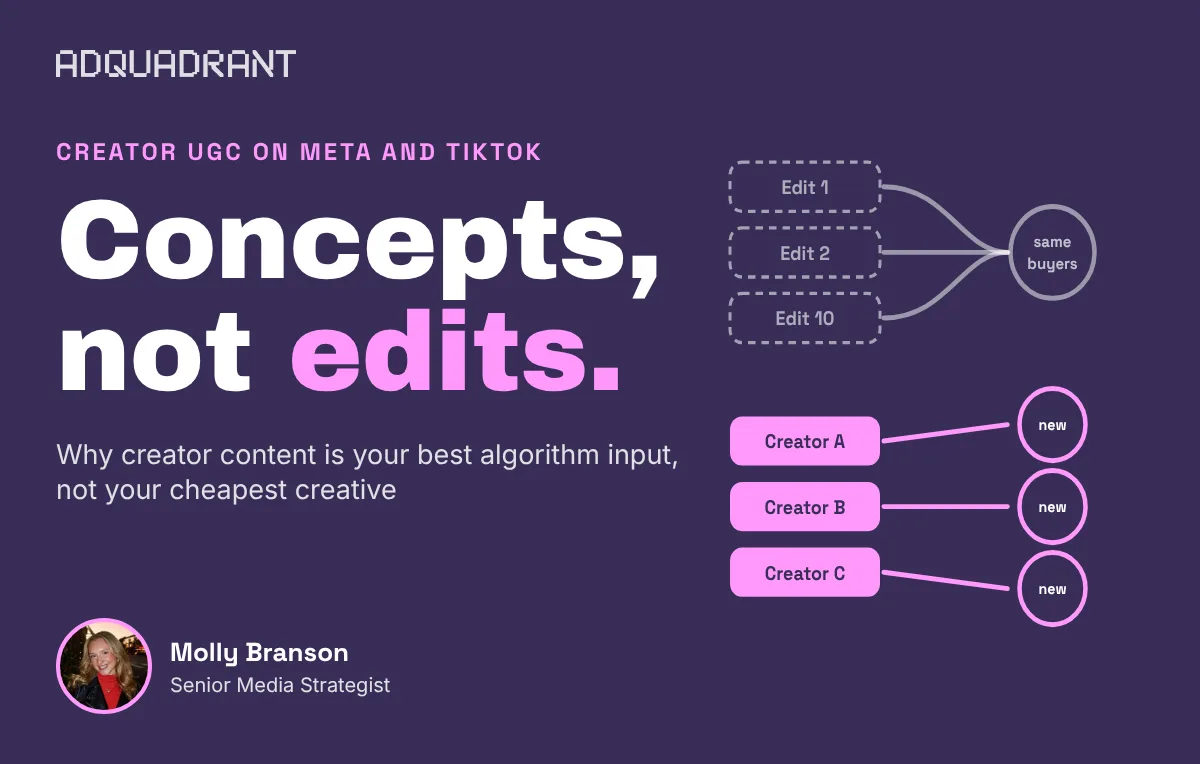
- Feed it varied creative. Meta matches ads to people through the creative itself, so a range of distinct concepts gives a value-optimized campaign more ways to reach high-value buyers.
When you switch signals, plan on a two to three week calibration period. Avoid big goal changes mid-learning, and judge results on blended contribution margin, not daily platform ROAS. Value rules are the exception here. Our Meta rep confirmed that changing value rules doesn't reset learning, so you can tune those a lot more often than you'd move a ROAS goal.
Why isn't Meta value optimization working?
When value optimization stalls, it's usually one of four things. I'd check them in this order.
- No value variance. If products sit at similar price points and you send cart revenue, Meta has nothing to tell buyers apart. Profit, value rules or predicted LTV create the signal.
- Too little volume. Each rung on the ladder needs more conversions. Below the bar, consolidate campaigns or stay on the rung below.
- Dropped parameters. Deduplication errors between pixel and CAPI can strip value or currency. Confirm matching event_id values and check Events Manager diagnostics.
- Timing mismatch. If your score arrives too late, it never reaches optimization. Score at order time, or use AppendValue within 7 days.
Also check your goal. A ROAS goal set far above historical performance stalls delivery.
And one thing that looks like a failure but usually isn't. When you start bidding on value, your cost per purchase will probably go up, which can be a little terrifying the first week. Meta is now chasing more valuable customers, and those customers cost more to win. If your profit per customer is going up faster than your cost per customer, it's working. Judge it on profit per conversion, not CPA.
Where does LTV bidding fail, and who should skip it?
LTV models carry error, and slower feedback means problems take longer to show up. Skip predicted LTV if your products rarely sell twice, if you're too new to have the repeat-purchase history a model needs, or if discount depth alone explains your LTV differences. Use purchase value, value rules or profit as the step in between.
The same logic applies to any longer-window value product. If the value is realized right away and nothing meaningful happens after the conversion, there's nothing for a longer window to learn from.
Prove the switch worked with a test, not with Meta's own report. Predicted values make in-platform ROAS look different by design, so compare LTV campaigns only with other LTV campaigns, and confirm real gains with a Meta conversion lift study or a geo holdout. Our incrementality testing playbook shows how.
How Adquadrant approaches this
Value bidding is most of my day job, and almost everything in this post shows up in the accounts I run every day. The lessons don't change much whether the value is a reorder or a lead.
On our insurance lead gen accounts we don't send Meta a flat lead. Each lead carries a dynamic value, its expected payout, and the campaigns optimize for highest value. That's really the closest most advertisers get to "predicted value at the moment of conversion" today, and it's the same idea as LTV bidding with a much shorter feedback loop.
In September 2026 we added state-level value rules on one of those accounts. We split states into four buckets. Winners got a 5% bid increase, almost-profitable states got a 15% decrease, states that needed some love got 30%, and the bleeders got 80%. In the first week, revenue per lead went way up, and so did cost per lead, by about the same amount. When I compared the same five creatives inside and outside the value rules ad set, ROAS was essentially flat. Profit per lead, though, looked healthier than the rest of the account. So we decided to take a big swing and moved the rules into a scale campaign. Since then they've usually been profitable, but not every test is a home run, and they haven't beaten business as usual or been the scale unlock we hoped for yet. That's the honest version, and it's why I'd tell any brand to judge value bidding on profit and give it time.
The bigger lesson is that data comes before bid strategy. A lot of my time goes to tracking, not bidding. A lead gen brand we worked with had no event IDs passing from pixel to CAPI, so there was no deduplication and no way to follow a lead through to a sale. Their down-funnel quote event can't reach Meta until 2027. You can't bid on value you can't send.
So for the $10M+ DTC brands we run on Meta, we start with the data. We audit CAPI and Event Match Quality first, then decide which rung the account can support today, whether that's purchase value, value rules, profit or predicted LTV. We write down the break-even ROAS before launch, and we judge the result on incremental contribution margin with WorkMagic as our measurement partner, not on platform ROAS. Meta is pushing profit bidding hard right now too, including funded profit tests for agencies, so the brands that already have clean margin data flowing through CAPI will be first in line.
The payoff shows up when Meta finally knows what an order is worth. For TELETIES, moving Meta to value optimization delivered a 6.95x ROAS at a $7.32 cost per purchase on a $51 average order. The full story is in our TELETIES case study.

How to choose a partner for value-based bidding on Meta
Look for a team that can show you:
- How they audit CAPI and Event Match Quality before changing bid strategies
- Hands-on experience with value optimization, value rules, profit and predicted LTV on Meta
- Break-even ROAS goals built from margin and customer value, written down before launch
- Proof from conversion lift or holdout tests, not platform ROAS alone
- Media buyers and measurement people working from the same numbers
What should a DTC brand do next?
- Check your Event Match Quality and fix matching parameters before you touch bid strategy.
- Count your weekly Meta-attributed purchases and distinct values to see which rung of the ladder you qualify for.
- Move your highest-volume campaign to maximize value of conversions with no ROAS floor, and run it for 14 days before judging.
- Try value rules on the segments you already know are worth more or less to you.
- Build or buy a predictive LTV model, then run a one-week parallel send before switching any campaign to it.
- Write down your break-even ROAS from 90-day customer value and gross margin, and use that number instead of a gut target.
Meta can only bid on what you tell it a customer is worth. Send it the right number. Then let the system find the buyers who come back. If you want help building the data behind it, Adquadrant's Meta team can help.
About the author
As a Senior Media Strategist, Daniel brings ad buying experience across social and search platforms, with millions of ad dollars managed annually. He loves to challenge himself, and his current challenge is completing an Ironman triathlon. He believes in "being where his feet are," giving his full effort and attention to work during work hours and to his wife and kids when he is not working. He loves nothing more than swimming with his kids and going on dates with his wife.