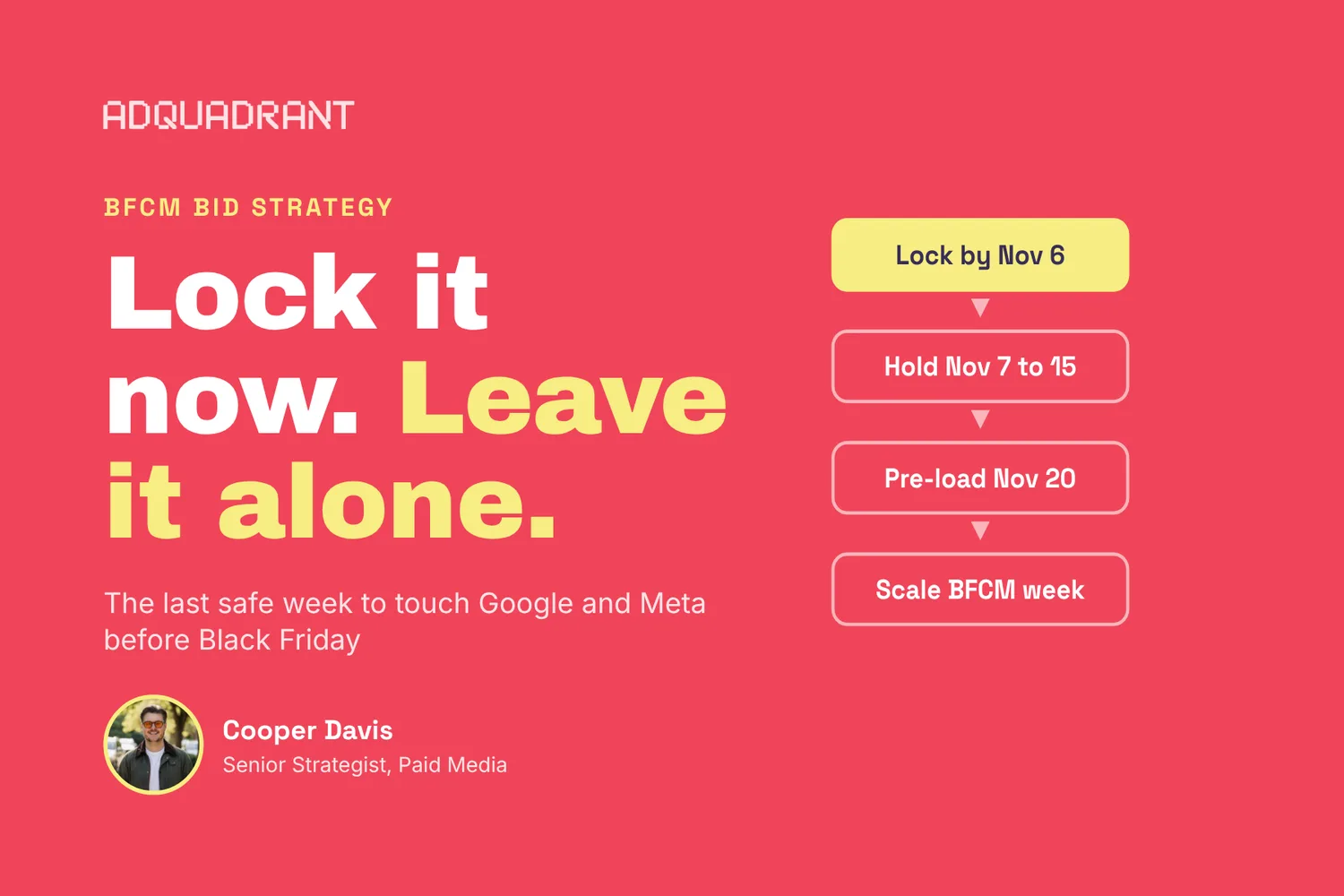

Your customer acquisition cost keeps rising on Meta and Google in Q4 because every advertiser in the country is bidding on the same inventory, and the platforms re-learn every time you touch a campaign. CPMs climb through November, the sharpest spikes land between Black Friday and Cyber Monday, and a campaign that gets restructured inside that window spends the most expensive days of the year back in learning. The fix is not a smarter bid on Black Friday morning. It is locking your structure and your guardrails by the end of the first week of November, pacing budget into the days that earn it, and then having the discipline to leave it alone.
If you are reading this in the first week of November, you are still inside the window. If you are reading this on November 15, most of what follows is a plan for next year, and the hold-and-scale rules near the end are what you can still use.
Why CAC rises in Q4 even when nothing in your account changed
On paper, Q4 should be the easiest quarter to buy. More people are shopping, intent is higher, and your creative has a promo attached. The data says otherwise for most DTC brands, and the reason is mechanical.
CAC is CPM divided by click-through rate and conversion rate. When the auction fills up with seasonal advertisers, marketplaces and every brand that only shows up in November, CPMs go up and your CAC goes up with them unless your click-through rate or conversion rate improves enough to cover the gap. In early November they usually do not. Seasonal advertisers have already entered the auction, but shoppers are still browsing. You pay a peak-week price for a pre-peak customer.
The second mechanic is the one that actually costs money. Every bid change, audience change or placement change pushes a campaign back toward learning, and in my experience that pushes real optimization out three to four weeks. Do that on November 10 and your campaign is still in test mode on Black Friday. I have said this to clients the same way every year, because every year someone wants to make one more tweak the week before. The goal of early November is to expedite learnings, not restart them.
The last safe day to restructure is November 6, not Black Friday week
Most Q4 bidding advice says "start in late October." I would put it more bluntly. Friday, November 6 is the last safe day to touch structure, and after that the job is to protect what the algorithm has learned.
That means a few things get done now or they do not get done this year.
Consolidate before the surge. Fragmented accounts re-learn in pieces. On Google, that is fewer, bigger Performance Max campaigns with an evergreen asset group and a promo asset group, not 25 asset groups fighting over the same signal. For a footwear brand last December we took four-plus PMax campaigns and 25 asset groups down to one campaign with two asset groups, and used the client's high-value customer list as the signal to turn on new-customer optimization. On Meta it is the same idea, fewer ad sets that each clear 50 optimization events a week so Advantage+ has a learning pool worth learning from.
Build the promo in paused objects. Your Black Friday asset group or ad set should exist today, paused, with the creative and the offer loaded. On the day, you flip the switch. You do not rebuild.
Upload your lists. Customer Match on Google, custom audiences and value-based lookalikes on Meta. First-party data is the one signal that gets stronger as the auction gets noisier, and it has to be in the account before the algorithm needs it.
Take brand search off machine bidding. This is the one I would push hardest. Smart Bidding on branded terms during Q4 is how CPM inflation leaks into the cheapest traffic you own. For that same footwear brand we moved brand search from Maximize Conversions to Target Impression Share with a CPC cap and watched clicks go up 59%, CPCs drop 33% and conversion value rise 21% on 5% more spend. Brand search is not where you want Google exploring premium audiences.
Guardrails need conversion volume before they need a target
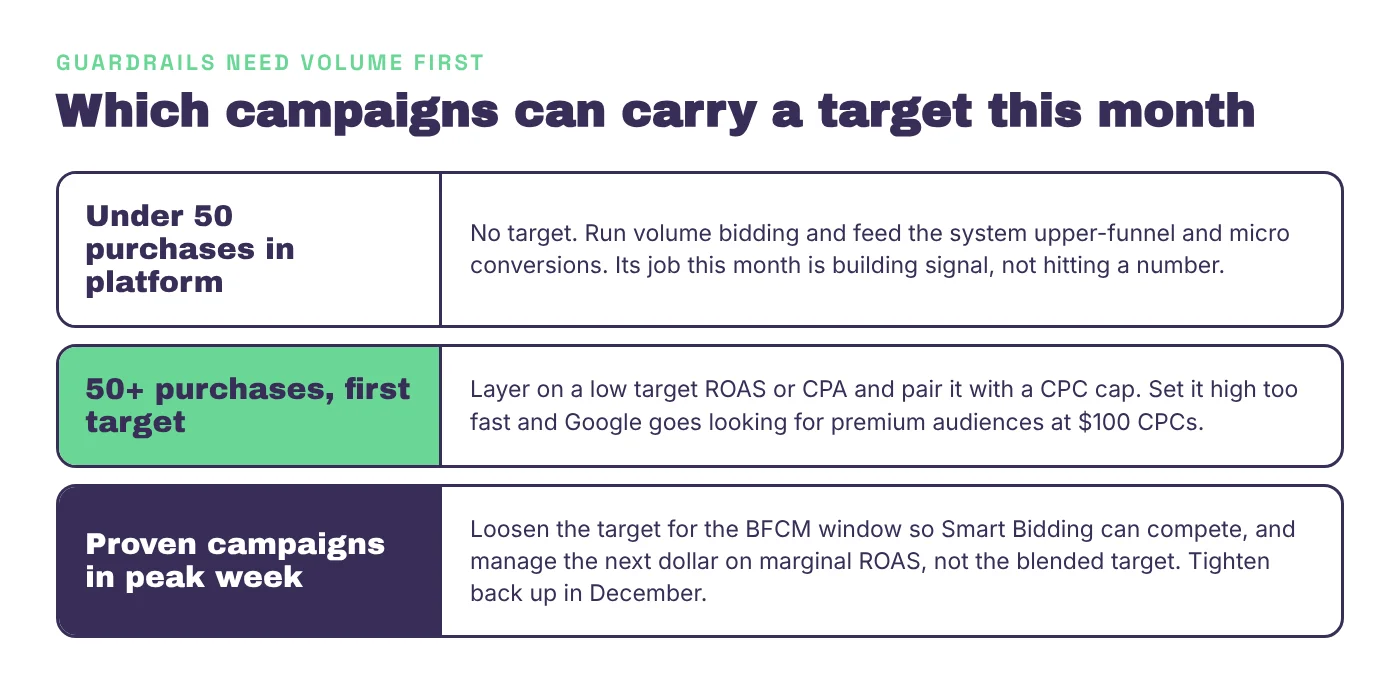
Here is the part most BFCM guides skip. A target ROAS or target CPA only works on a campaign that has enough purchase history to bid against. My rule of thumb is roughly 50 purchases in platform before a campaign carries a target. Below that, a target does not save you money. It starves delivery, because the system has no historical volume to optimize toward and would rather not spend than miss.
An apparel brand I worked with crossed 50 purchase events in platform on December 11 last year. That is the day the top campaign moved to target ROAS, and not a day sooner. Until then it ran on volume bidding with upper-funnel and micro conversions feeding the system. It is easier to walk into learning phase with conversion data than to walk in with none, if that makes sense.
So before you lower a single target, audit every active campaign for purchase volume in the last 30 days and sort them into two buckets. Campaigns that can carry a target, and campaigns that need to keep building signal through the peak. Putting a target on the second bucket in November is how you end up with a campaign that spent nothing on Cyber Monday.
Lower the target, but think in marginal ROAS, not target ROAS
Once a campaign is ready for a target, the standard advice is to loosen it for the BFCM window. A 400% target that works in September will choke off spend when CPMs jump, so you drop it to 300% or 350% and tighten back up in December. That is correct as far as it goes.
I would reframe the whole decision. The question is not what your target says. The question is what the next dollar returns. Every campaign has a marginal ROAS, the return on the last dollar you added, and in peak week that number is usually well above your blended because intent is up. Managing to a target ROAS tells Google to protect an average. Managing to marginal ROAS tells you where to put the next dollar, and it is almost never spread evenly. When I had incremental budget to place on a large account this summer, it went into Shopping and PMax, where marginal return was highest, and not into the sub-$0.70 channels that would have dragged the blended number down.
One warning from a mistake I made on our own account this spring. If you set a target ROAS too high on a campaign that is not ready for it, Google does not save you money. It goes looking for a "premium" audience, and your $20 CPC can and will turn into a $100 CPC. When you first move a campaign to a target, layer it on low and pair it with a CPC cap. Step it up after the peak, not into it.
Pace like a rainy day fund
Here is how I think about budget across Q4. Early November is a dead zone for most DTC brands. CPMs are already up because the seasonal advertisers have arrived, but intent has not. That is the window to hold.
So on the accounts I run, we proactively scale back the known-weak weeks, trim to brand search and the most bottom-funnel tactics we have, and save those dollars like a rainy day fund. Then we push them into Black Friday week, where the CPM is higher but the shopper is actually buying. In practice that means raising target ROAS during non-promo weeks and lowering it, with more weekly budget, during promo weeks. The money is the same. The timing is what changes the return.
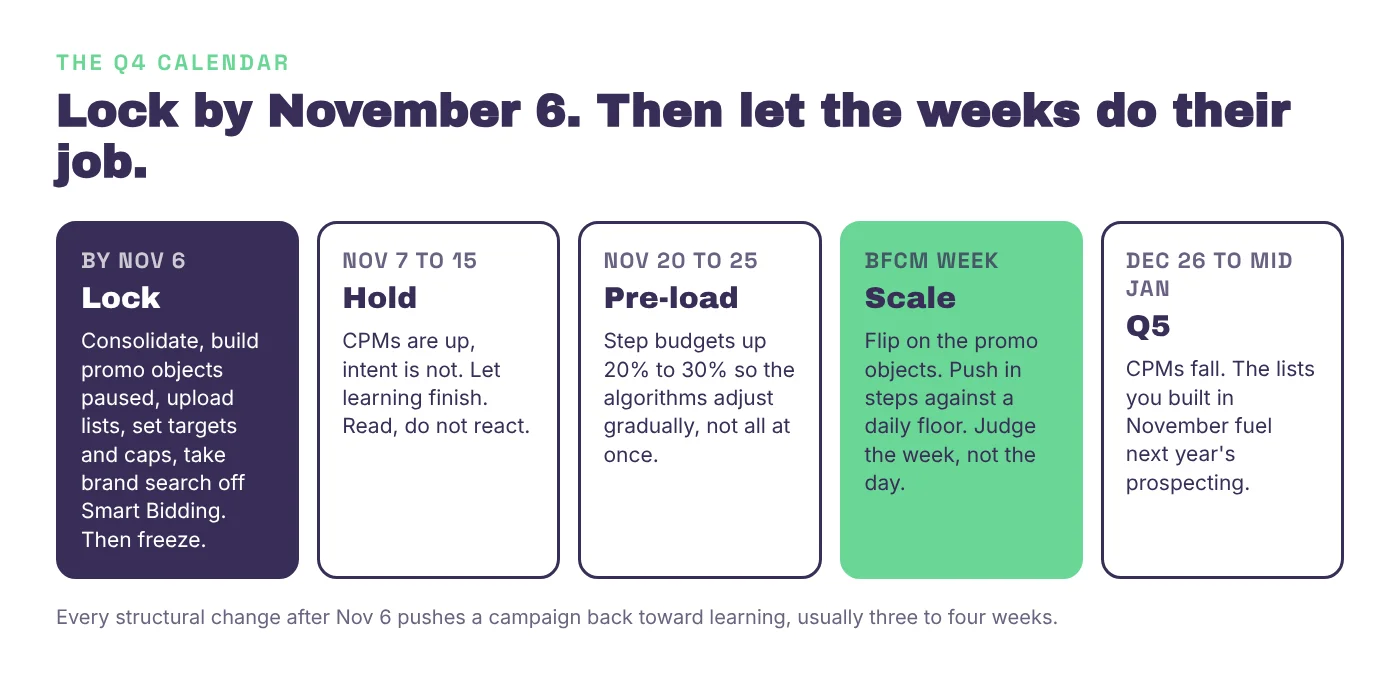
A rough calendar, if you want one:
- By November 6. Consolidate, build promo objects paused, upload lists, lock targets and caps, take brand search off Smart Bidding. Then freeze.
- November 7 to 15. Hold. Let learning finish. Read, do not react.
- November 20 to 25. Pre-load budget increases of 20% to 30% so the algorithms step up gradually instead of all at once.
- Black Friday through Cyber Monday. Flip on the promo objects, push in steps, judge the week.
- December 26 to mid-January. Q5. CPMs fall, costs show huge variance, and the customer lists you built in November fuel next year's prospecting.
Judge the peak on the week, not the day
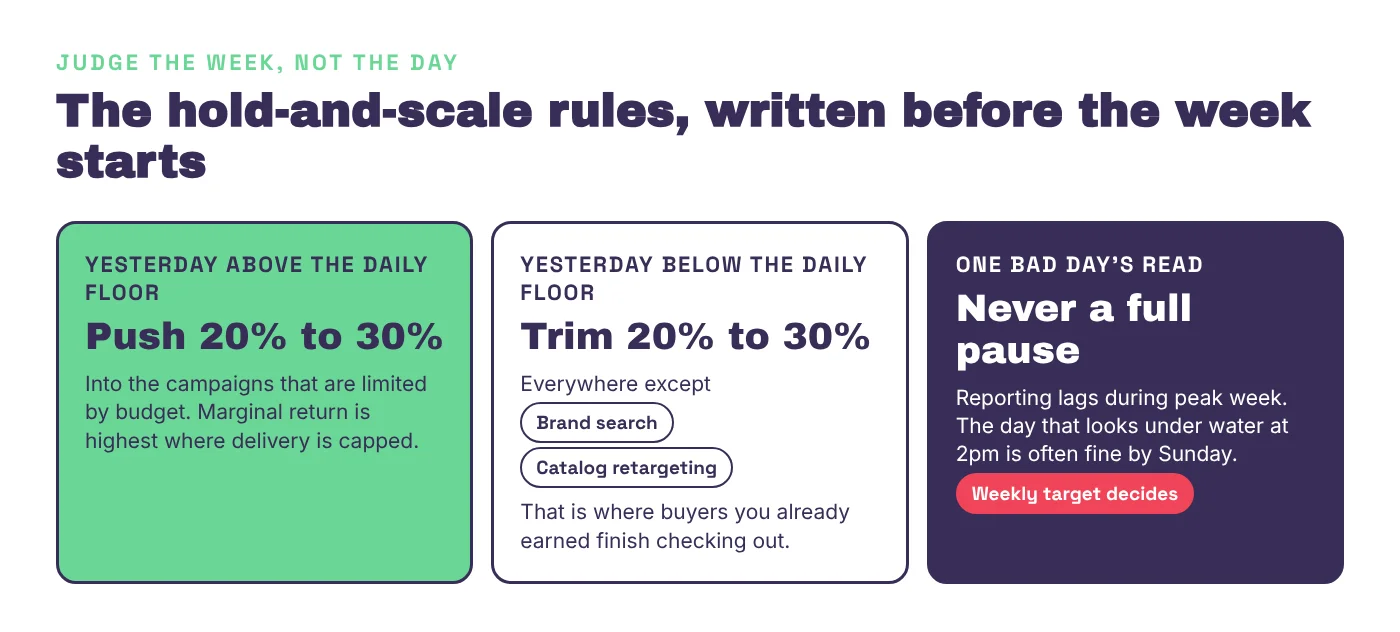
This is where good accounts get blown up. Platform reporting lags during peak week, sometimes by a day or two. A campaign that looks under water at 2pm on Black Friday is often fine by Sunday, and the brand that paused it at 2pm killed its own best day.
So we write the rules down before the week starts, and they are simple on purpose. Set a daily ROAS floor and a weekly target. If yesterday landed above the floor, push spend 20% to 30% in the places that are limited by budget. If a day drops below the floor, scale back 20% to 30%, but not on brand search and not on Meta catalog retargeting, because those are where the buyers you already earned finish checking out. Never a full pause on a single day's read. If we pushed hard on Friday and came in under the floor Saturday, it is too early to adjust back, because the latency is still there.
Two numbers worth having in your head. In apparel and footwear I have consistently seen Cyber Monday do about 1.5x Black Friday. And last year one of my apparel accounts had its best day on the Sunday in between, the day most people assume is a lull. If you had cut budget Saturday night, you would have missed it.
On the Sunday of that same weekend I took that account from $1,600 a day on Friday down to $1,100 and cut everything that had not attributed a purchase in three days. Sunday versus Friday, spend was down 22%, CPCs were down 62%, clicks were up 102% and CAC was down 22% with the same number of purchases. Cheaper clicks plus a more transactional audience, based on what the week had already taught the account, is a better chance to convert. That is the move the week earns you. The move the week does not earn you is panic.
One section for Meta, and one paragraph for TikTok Shop
Everything above applies to Meta, with one translation. Cost caps are the right tool for most of the year because they protect CAC. In peak week they can throttle delivery on exactly the days you want volume, because Meta would rather not spend than exceed the cap. For your proven campaigns, a bid cap set on BFCM unit economics gives the system a ceiling while letting it compete, and the 50-events rule, the freeze, and the week-not-day read all carry over as written.
TikTok Shop in Q4 is a different playbook. It is a creator-volume and GMV Max game more than a bid-strategy game, and the readiness bar comes first. My colleague Ellie Galinas wrote the piece I would send you on that, when GMV Max is ready to turn on.
Who should not restructure this week
Not every account should touch bidding right now. If a campaign exited learning in the last seven days, leave it alone. If your promo, inventory and creative are not locked, a bid change now adds a second variable to a test you are already running. If your attribution lags more than a few days, set your hold-and-scale rules on a weekly read, not a daily one. And if a campaign is under 50 purchases, see above. Its job this month is building signal, not hitting a target.
How Adquadrant approaches BFCM bidding
I run Google for DTC brands above $10M in revenue, and our Q4 playbook is the one you just read. We lock structure by the first week of November and we are candid with clients about why we will not make the one more change in mid-November. We gate every target on conversion volume and tell you which campaigns are not ready yet, which is not always what people want to hear. We pace budget into the days that earn it, and we write the hold-and-scale rules down before the week starts so a budget decision on Black Friday takes minutes, not a meeting. If you are a $10M+ brand running Google and Meta in-house, this is the checklist we run with you in the first week.
The one thing we do differently from most of the advice out there is how we judge the week. Platform ROAS is a diagnostic to us, not a verdict. Our strategists work alongside WorkMagic as the measurement partner, so the push-or-hold call during peak week is made on measured revenue across channels and backed by incrementality testing where the account has the volume to support it.
And we take the learning phase seriously as a cost worth paying. For a wellness brand last November, Google CAC on a new account sat around $860 while the system collected purchase data, a necessary evil, then dropped to $308 and then to roughly $150 once it had enough signal. The brand had been at $204 playing it safe on brand search only, with no scale behind it. The $860 week bought the $150 weeks.
The footwear brand result above is the cleanest example of what locking the right campaign to the right strategy before the surge looks like.
How to choose a partner for peak season
- They can show you their hold-and-scale rules in writing before November, not explain them after.
- They gate bid targets on conversion volume and will tell you which campaigns are not ready.
- They know how your account's marginal ROAS differs by campaign, not just the blended target.
- They freeze structure before the surge and have a plan for what gets flipped on, not rebuilt, in BFCM week.
- They judge the peak on measured revenue across channels, not last-click platform ROAS.
- They have a Q5 plan ready before Cyber Monday ends.
If you want a second set of eyes on your Q4 setup before November gets away from you, our Google team will walk through it with you. The good news is there is still time, but not much.
About the author
Cooper Davis is a Senior Strategist, Paid Media at Adquadrant and sits on the AQ Marketing team. Whether he is analyzing formations or optimizing ad spend, he lives for the win. Away from the conversions, you will find him watching Manchester United and adding to his sneaker wall, because limited releases and limited budgets both require serious strategy.