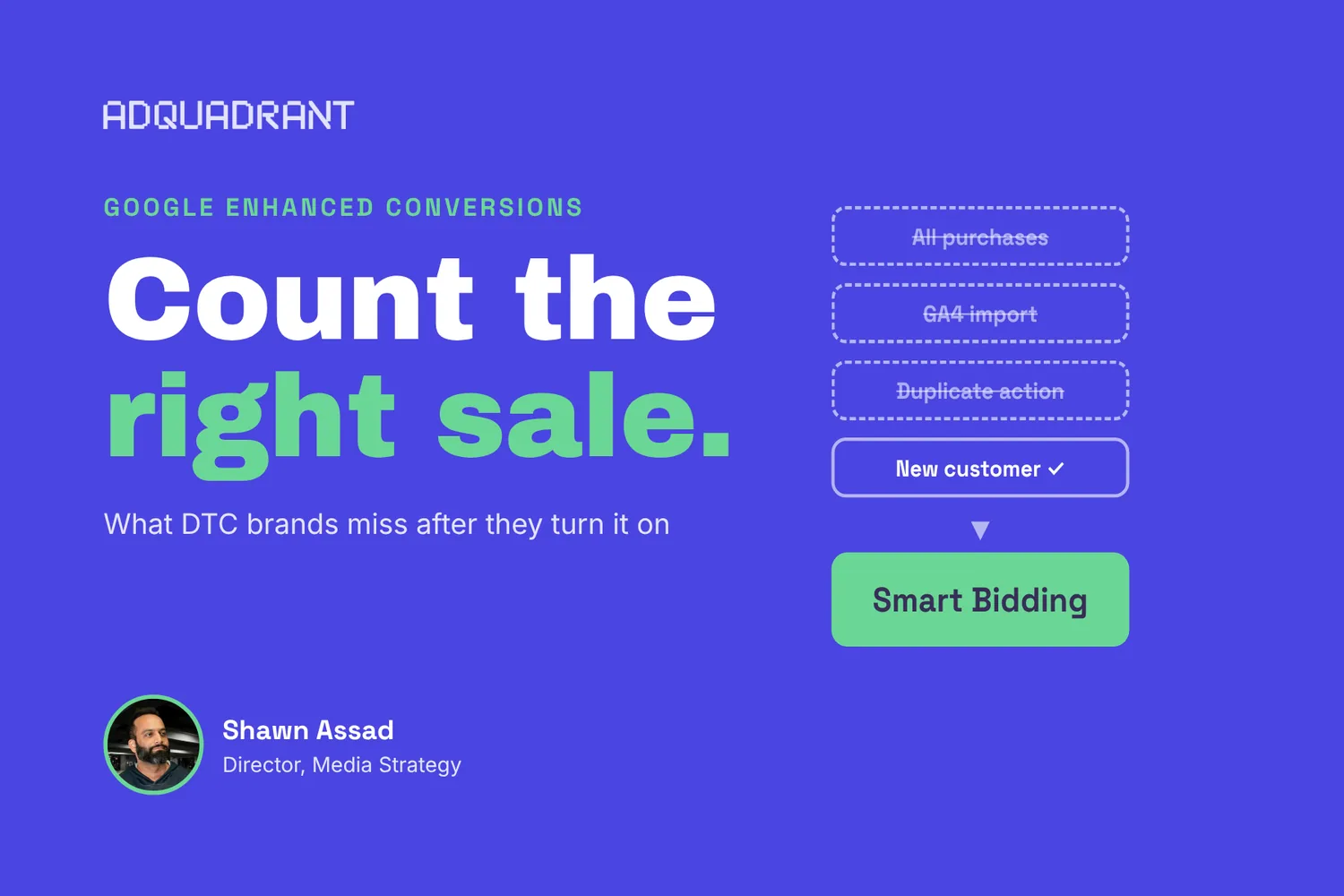

Almost every $10M+ DTC brand I audit already has enhanced conversions on. Google made that a toggle. So I don't spend much time there anymore. Where I do spend time is on two questions most brands haven't asked yet. Which conversion is each campaign actually bidding on, and what are you going to do when your reports stop agreeing with each other?
Quick refresher
At checkout, the customer's email, phone, name and address get hashed (SHA-256) and sent with the conversion. Google matches it against signed-in accounts and connects the order to the click even if the cookie didn't survive. Phone-to-laptop journeys, Safari clearing cookies, people declining tracking, subscription apps and third-party checkouts breaking the path... that's the stuff it helps recover.
In June 2026 Google rolled web and leads into a single setting and dropped the "pick your implementation method" step. If you'd already accepted the customer data terms you got moved over automatically. You can send through the tag, Data Manager and the API at once and Google dedupes.
That's the easy part.
The conversion you bid on matters more than how many you count
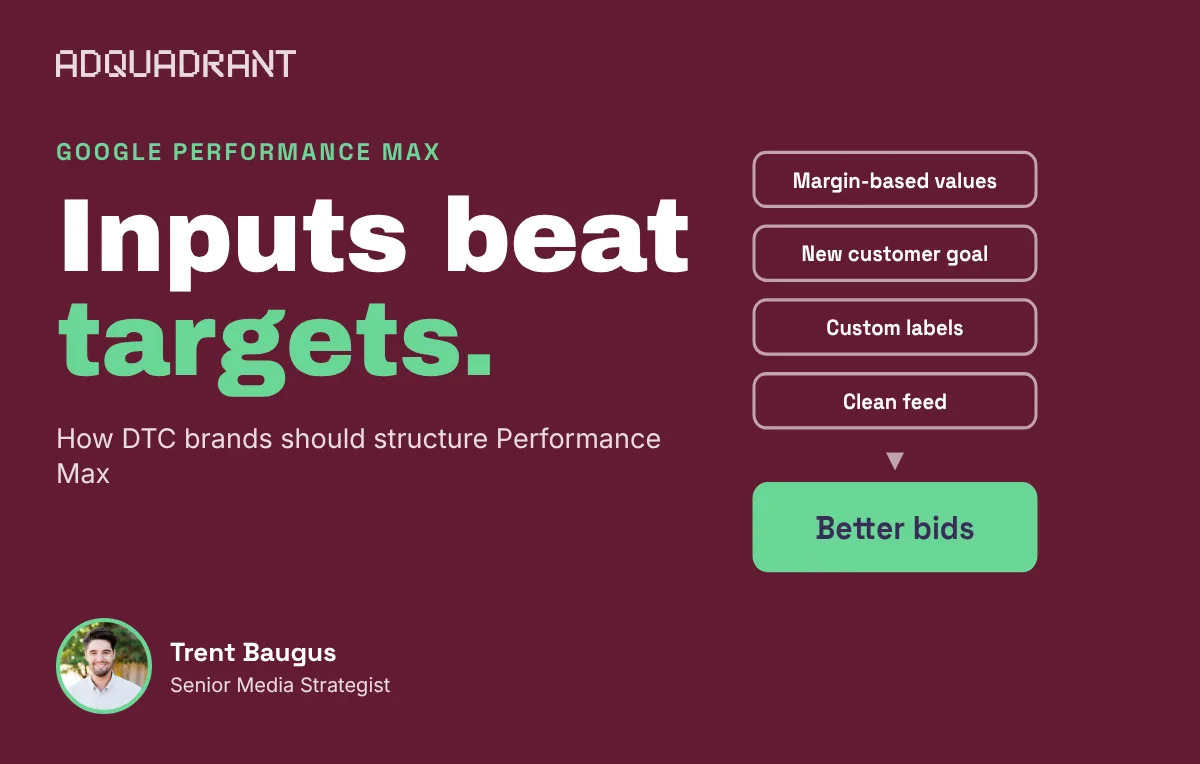
Smart Bidding goes after whatever you tell it to value. Feed it a goal that mixes new and returning customers, or counts an order twice, and it'll get really efficient at the wrong thing.
Two examples from this year. In a May audit, 4 of 7 campaigns in one account were optimizing on goals running 3.5x to 8.8x off the real new-customer count. Separately, a client asked me why ROAS swung so hard from month to month. Turned out campaigns had been optimizing on more than one conversion action at different points, so conversion value was inflated in some months and not others. It wasn't demand. It was the setup.
So the idea is one conversion per campaign, matched to that campaign's job. If the job is acquisition, the conversion should only fire for new customers, and ideally the back end decides who's new, not the cookie.
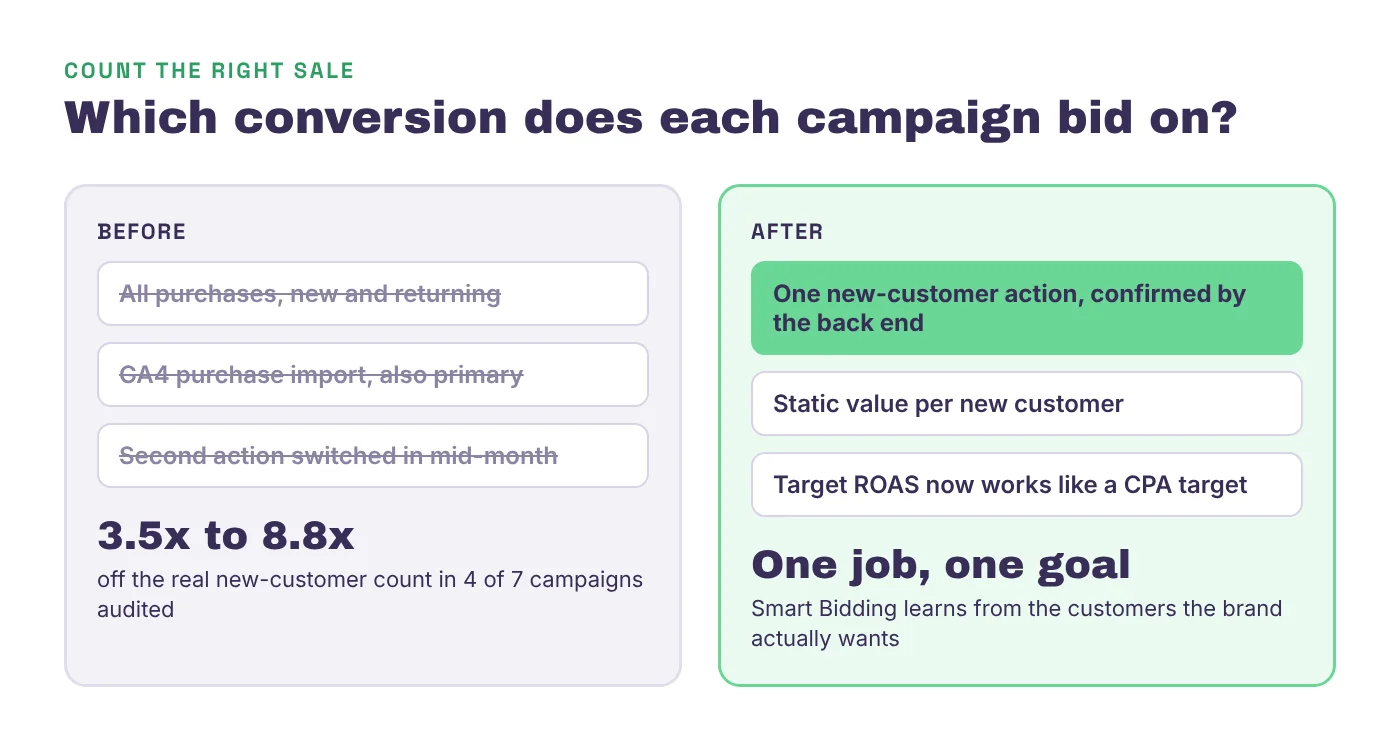
Here's an example. A large DTC brand we manage got put on a strict new-customer CPA guardrail, and we had to pull spend on the top Shopping campaign by 35%. Rather than keep cutting, we changed what it was learning from. One conversion action, new customers only (confirmed by their back end), static value. Shopping doesn't have tCPA, so a static value turns tROAS into a CPA lever. The month after, new-customer CPA was down 18.8%, the lowest in that campaign's 5+ year history. New customers up 4.8%. Spend down 14%. It also stopped returning customers from diluting the signal.
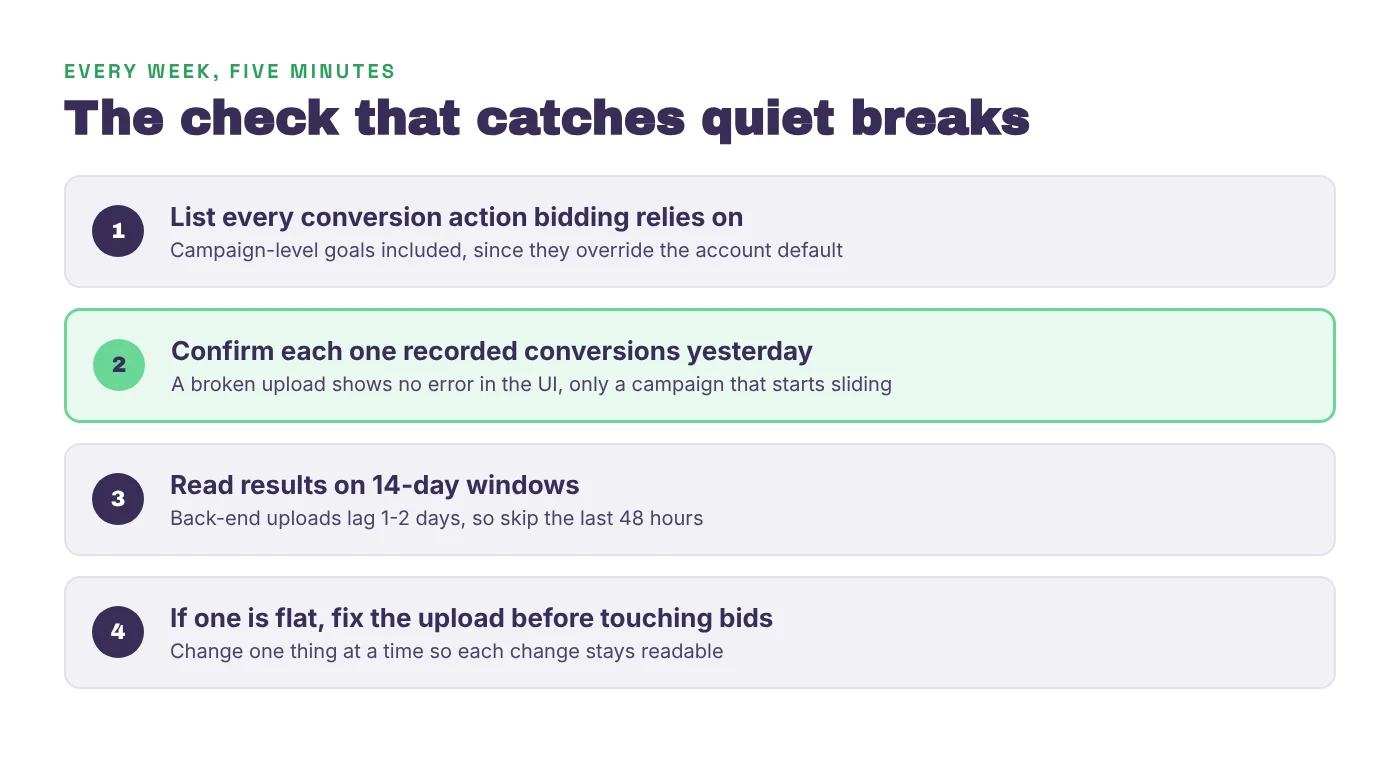
Also, look at campaign-level goals, not just the account primary. Campaign goals override the account default and that's usually where I find the mess.
ECL isn't just for lead gen
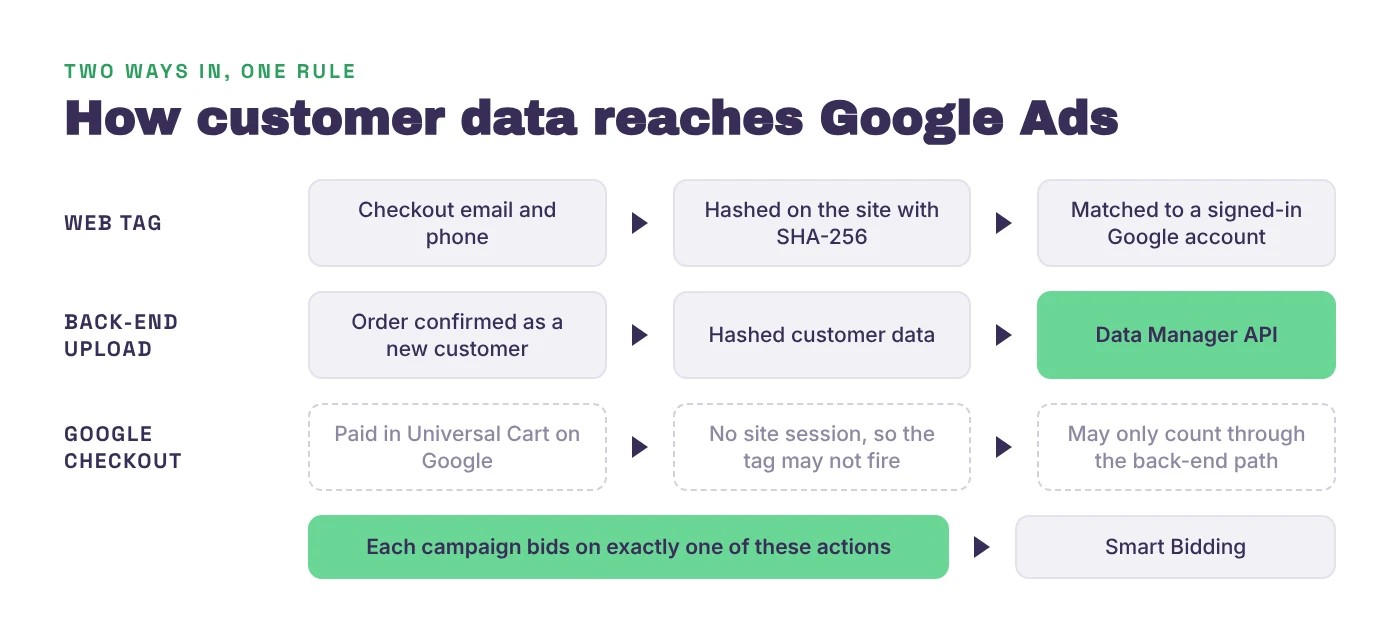
The name throws people off. Enhanced conversions for leads (ECL) is really just you uploading conversions from your own system with hashed PII, instead of relying on the pixel.
Plenty of DTC brands have a back end that knows a lot more than the tag. New vs returning, subscription status, which orders came through an affiliate and need deduping. For those brands this is where I'd put the effort.
How I think about it:
- Web tag if the purchase event on the site is the truth. Most Shopify stores can do this through the Google & YouTube app in an afternoon.
- Back-end upload if the truth shows up after checkout. Budget a few weeks of dev time and expect a 1-2 day lag.
- Larger brands usually run both. Fine, just make sure campaigns only bid on one of them.
We moved that same brand off last-click GCLID uploads and onto ECL in October 2025. Their MTA tool showed Google touching roughly 31.5% more new-customer journeys than the GCLID uploads were giving it credit for. It also opens the door to campaign types that never really worked under last-click, like Demand Gen. We're still reading that one, so I'll hold off on calling it.
Side note if you're migrating to the Shopify Google & YouTube app. Go through the old theme code before you delete anything. We did this for a client in 2025 and the old script was passing a new_customer flag we had to make sure carried over.
Heads up, your reports will look worse first
This is the part I'd warn every brand about.
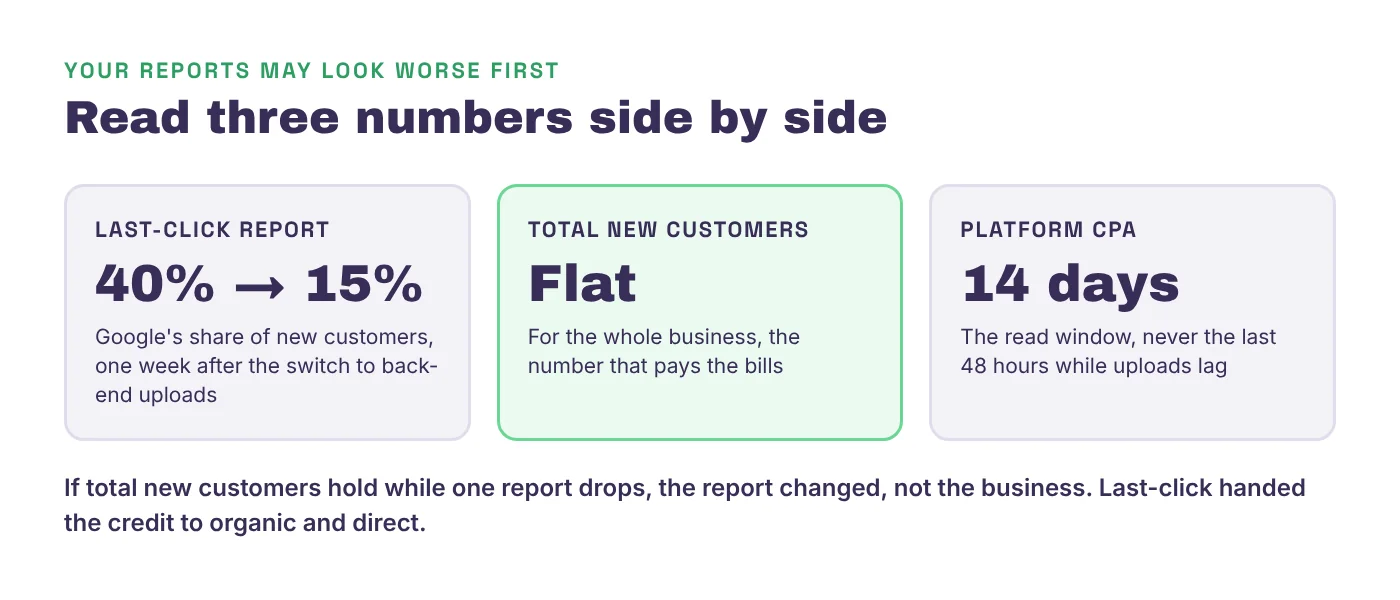
Within about a week of switching to ECL, Google's share of new customers in the client's last-click affiliate system dropped from ~40% to ~15%. Total new customers for the business? Flat. Google was now optimizing toward any touchpoint, and last-click handed that credit to organic and direct.
Honestly, it caught me off guard. I knew attribution would shift, but not that much, and it took some digging (and a long Slack thread with leadership) to explain. Around two and a half weeks in, back-end attribution started coming back and paid new-customer CPA with fees hit its lowest point to date. If anyone had judged it on week one, it would've looked like a failure.
What we do now is read three numbers next to each other: back-end attribution, total new customers, and platform CPA. If the business number holds while one report drops, I go after the report before I touch the campaign.
Patience, and one change at a time
ECL uploads lag 1-2 days. Don't look at the last 48 hours. I use 14-day windows minimum.
I also broke my own rule this August. We turned off brand, loaded ~650 negatives and changed tROAS in the same week, and the brand test was confounded. Couldn't tell what did what. Now tROAS moves in steps (110% to 130% to 154%), two weeks apart, so each one is readable.
It breaks quietly
As of June 15, 2026, new offline conversion and ECL integrations have to go through the Data Manager API, not the Google Ads API. Existing ones still work but Google is treating that as a transition. If uploads stop, you won't necessarily see an error in the UI. You'll see a campaign start sliding.
A few we've run into. A Google rep caught an ECL issue in two of our lead gen accounts, and we only went looking because performance dipped. A Microsoft PMax campaign wasn't recording conversions while the brand campaign in the same account was. And we had to upgrade our API access tier so usage caps wouldn't interrupt uploads.
My habit is to check once a week that every conversion action bidding relies on recorded something yesterday. Takes five minutes.
Some sales won't hit your site
Google started rolling out Universal Cart in the US on October 15 across Search, AI Mode and the Gemini app. Some merchants let shoppers pay right in the cart with Google Pay, others hand the cart back to their own site. When it's paid on Google's side, you get the order without the session, so the pixel may never fire. Server-side order data through Data Manager is how those get counted. If you're already uploading from the back end, you're in decent shape.
Did it actually make you money?
More conversions in the platform doesn't mean more sales.
So for one client I pitched a geo holdout. Basically we go dark on Google non-brand in a handful of matched DMAs and leave everything else running as normal. Closer to six weeks, not two. Then we look at total new customers in WorkMagic, and use their MTA tool and back end to sanity check it.
Before it starts we agree on two things. How small of a lift the test can actually pick up, and what result makes us pull the plug. That way if it comes back flat, nobody's arguing after the fact about what flat means.
My pitch to the client was pretty simple. I don't know if the gaps go our way. They don't either. Right now we're both spending like we know. The test gets us a real number. And for what it's worth, going dark in a few markets saves money while it runs, which makes the CFO conversation a lot easier.
More on the setup in our incrementality testing playbook.
How we handle it at Adquadrant
First thing we do on a new account is look at tracking, before we touch a bid or a budget. Is enhanced conversions on and actually recording? Is consent mode set up? Any duplicate purchase actions? Are the back-end uploads landing? Then I go campaign by campaign and check which goal it's really bidding on, because that's usually where the surprises are.
After that it's a weekly habit. Did every conversion we bid on record something yesterday? If not, we go find out why.
And when we change tracking now, the client hears from us first what the reports are probably going to do. Learned that one the hard way (see above).
We run our own account the same way. In May 2026 we started sending qualified HubSpot leads back to Google with ECL, so our campaigns optimize toward pipeline and not just form fills. The team's take was "night and day."
If you want a second set of eyes on what your campaigns are actually learning from, reach out to our Google team.
About the author
Shawn is a former US Marine who earned his B.A. in Psychology from California State University, Northridge, followed by an M.B.A. from Pepperdine University. He has been working in digital marketing for over 10 years, with a passion for data, cats, and a digital nomad lifestyle.