Brands scale TikTok Shop with GMV Max by turning it on after the shop already sells, not before. GMV Max is TikTok's automated campaign type for Shop ads, and it learns from the orders, creator videos and engagement your shop already has. Give it steady sales and a deep bench of proven creator content for each product, and it scales what is working. Give it a cold shop, and it spends your budget learning very little.
I lead social commerce across a portfolio of more than 25 TikTok Shop brands, and the pattern I see most often is a brand that opens a shop, switches on GMV Max in week one and decides TikTok "doesn't work" a month later. The channel works. The order of operations was wrong. GMV Max is a scaling layer, not a launch strategy.
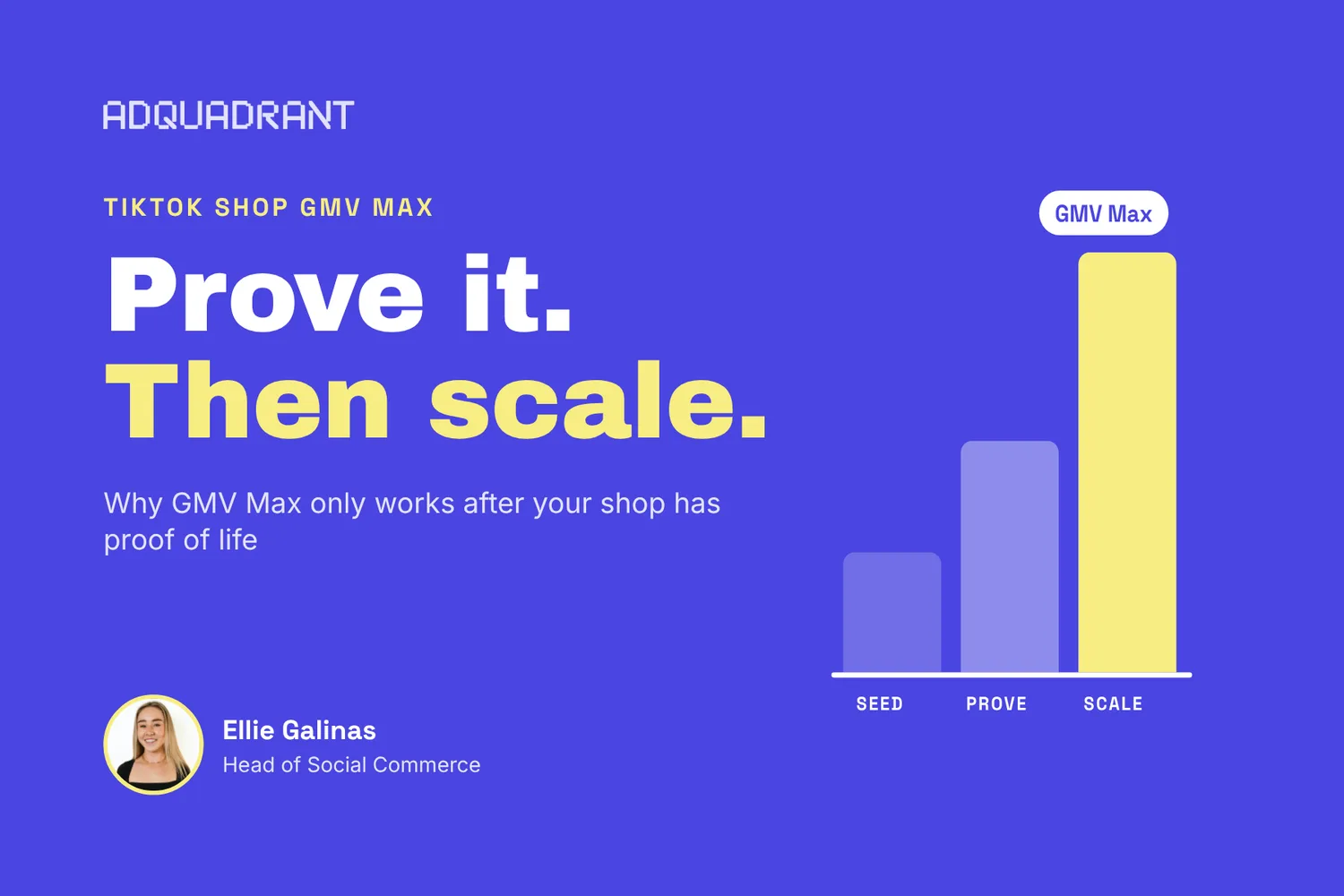
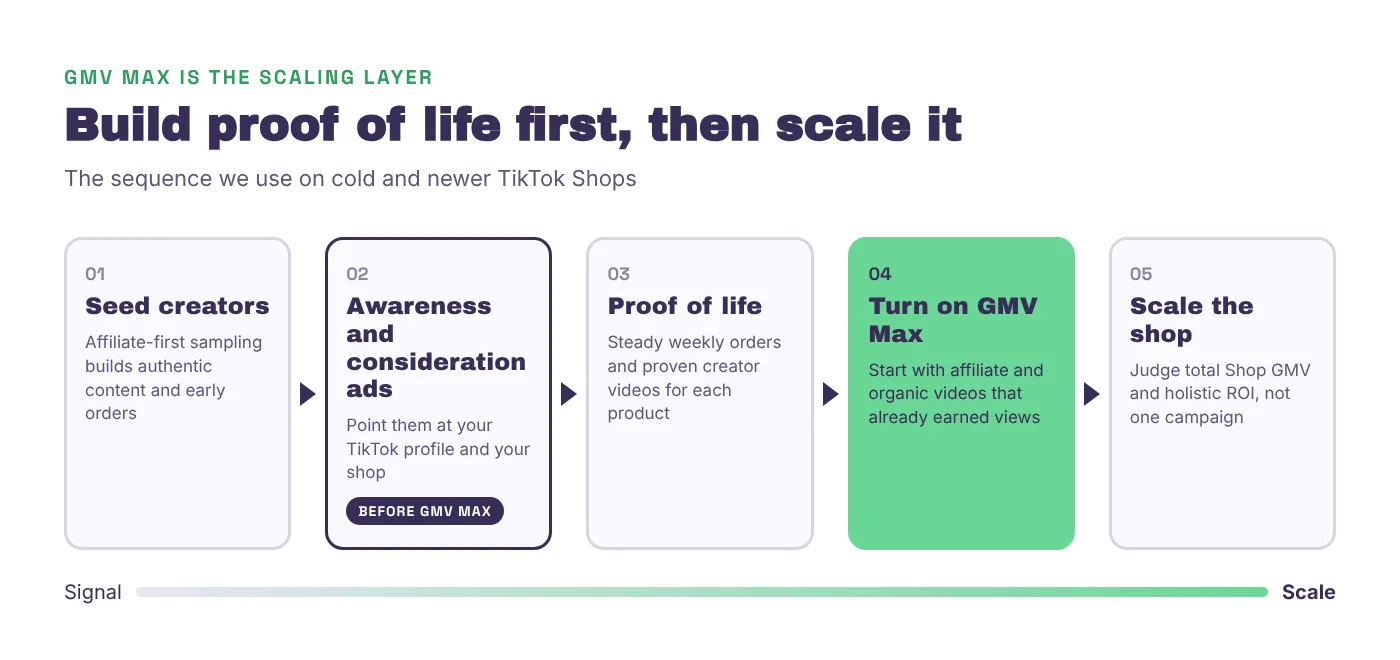
The short version. GMV Max amplifies traction that already exists. Build demand first with creators, affiliates and awareness and consideration ads, prove the shop can sell, then hand GMV Max a budget big enough to learn and judge it on total shop performance, not one campaign at a time.
Why do so many TikTok Shops launch and stall?
When a TikTok Shop stalls, the problem is rarely access. It is signal quality. TikTok rewards products that show early engagement, clean fulfillment and real buyer proof. A shop with thin listings, no reviews and no creator activity looks unproven to shoppers and to the algorithm, so distribution stays small.
That is the dead launch. The brand opens the shop, uploads products, posts a few videos and waits for traffic that never comes. TikTok Shop runs on momentum. The platform is looking for people watching, clicking, buying, reviewing and talking about the product, and paid media cannot fake those signals for long.
The fix starts with an affiliate-first approach. Seed product to creators before heavy media spend begins, so the shop builds a base of authentic creator content, early conversion data and social proof. Shops with an active creator program produce exactly the engagement data that paid campaigns can later build on.
Before any paid plan, audit shop health in four areas.
- Product listings. Clear titles, strong thumbnails, short benefit-led descriptions and accurate pricing.
- Inventory. Enough units in stock to handle a spike without selling out mid-push.
- Fulfillment. Fast ship times, low cancellation rates and consistent operations.
- Reviews and proof. Enough early customer feedback to lower buyer hesitation.
What is TikTok GMV Max, and why does it need proof of life?
GMV Max is TikTok's automated campaign type for TikTok Shop. You choose the products, set a budget and an ROI target, and the system handles targeting, bidding, placements and creative selection. TikTok describes it as optimizing for your shop's total channel ROI, across paid and organic traffic, rather than for a single ad.
Two details explain why it needs history. First, GMV Max builds ads from the videos already tied to your products. With auto-select on, it explores every existing and future video with no cap, and it pulls in affiliate videos creators have authorized for your products. Second, TikTok's own budget guidance is a formula built on your past sales. Its recommended budget is two times your historical non-LIVE GMV divided by your ROI target, and its recommended ROI target is historical GMV divided by historical ad cost. A shop with no sales history gives that formula nothing to work with.
The simplest way to think about it. Creator content is the fire. GMV Max is the accelerant. It does not replace product-market fit, creative that resonates or operational discipline. It multiplies them when they already exist.
What should you run before GMV Max?
My first recommendation for a new or cold shop is to run awareness and consideration ads before GMV Max, and to point them at both your TikTok profile and your shop. Profile traffic builds followers and repeat viewers who see every new post. Shop traffic builds product views, shop tab browsing and add-to-carts. Both feed the signals GMV Max will later optimize against.
Run those ads alongside the creator program, not instead of it. The affiliate side generates content and early orders, the shop tab starts to convert, and the awareness and consideration layer widens the pool of people who have already met the brand. GMV Max comes in once those pieces are producing positive signals, as the layer that scales them.
How do you know your shop is ready for GMV Max?
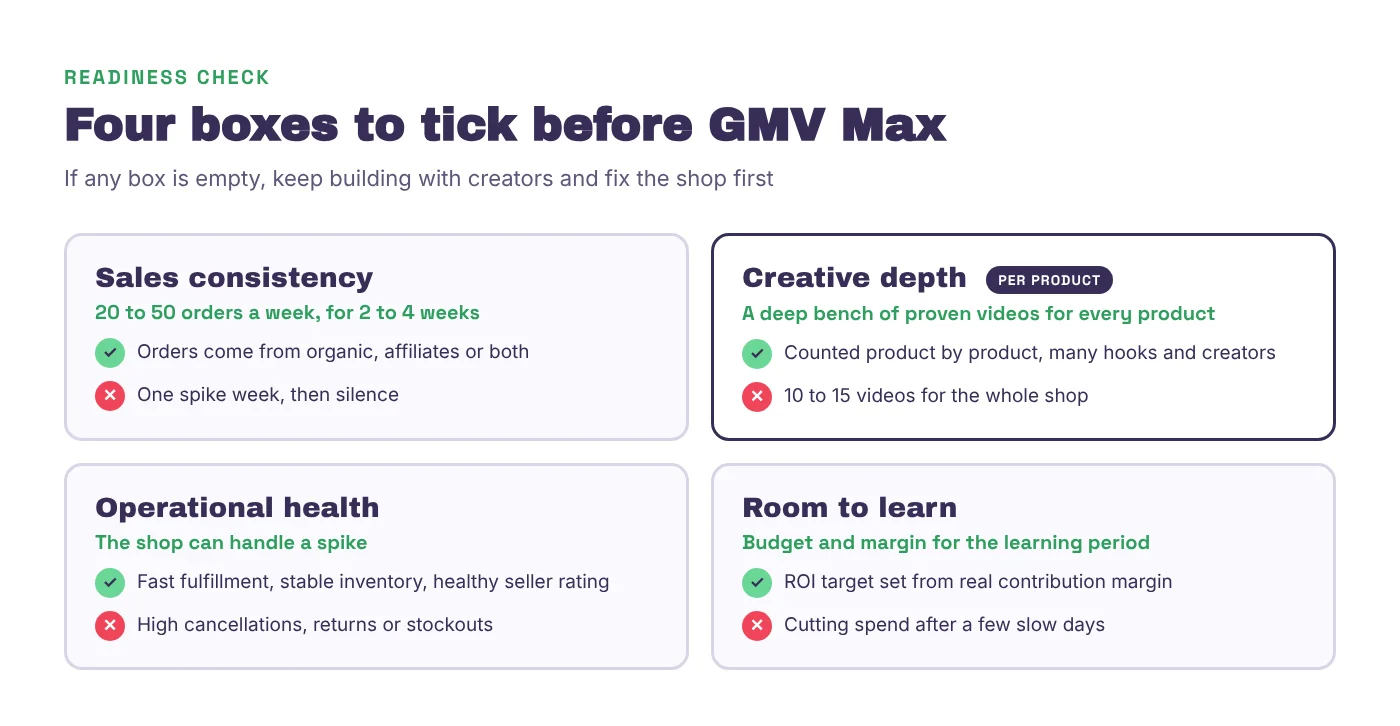
Turning GMV Max on too early usually buys expensive learning. The system can only optimize from the signals you give it, so thin order volume and thin creative lead to unstable results. Check four things first.
- Sales consistency. A useful starting benchmark is 20 to 50 orders a week, held for two to four weeks, from organic content, affiliate creators or both.
- Creative depth, counted per product. This is where most readiness checklists come up short. The common rule of thumb is 10 to 15 usable creator videos, and in my experience that is not enough. Count your creative library product by product, not for the shop as a whole. Every product you push into GMV Max needs its own bench of creator videos that already show life, with different hooks, creators and angles, because GMV Max will rotate through whatever is anchored to that product and fatigue arrives fast.
- Operational health. Fast fulfillment, low cancellation, return and refund rates, stable inventory and a seller rating that does not put the account at risk.
- Room to learn. Contribution margin that can absorb a learning period without forcing early cuts, and an ROI target grounded in real economics, including product cost, shipping, discounts and repeat purchase behavior.
If these are not in place, wait. Build more demand through creators and fix the shop experience first. Pausing GMV Max mid-learning throws away the data it has gathered and slows recovery.
How should cold-start brands set up GMV Max?
For a brand that is newer to TikTok Shop, feed GMV Max content that has already earned attention. Start with the affiliate and organic videos that have the strongest engagement and view counts, rather than fresh brand-made ads that have never been tested in the feed. Proven content gives the system a head start on who watches, who clicks and who buys.
- Authorize your best affiliate videos. Ask top creators to authorize their posts so GMV Max can use them, and use video codes for anything that does not show up automatically.
- Start the ROI target near the recommendation. TikTok suggests starting at its recommended ROI or slightly lower. A lower target buys delivery and data. Tighten it once volume is steady.
- Hold settings long enough to read them. TikTok advises keeping each ROI setting for at least three full days before changing it. Daily tinkering resets the learning.
- Keep new creative coming. Fresh creator videos should land every week or two. Do not wait for performance to drop before rotating.
How much should you budget for GMV Max?
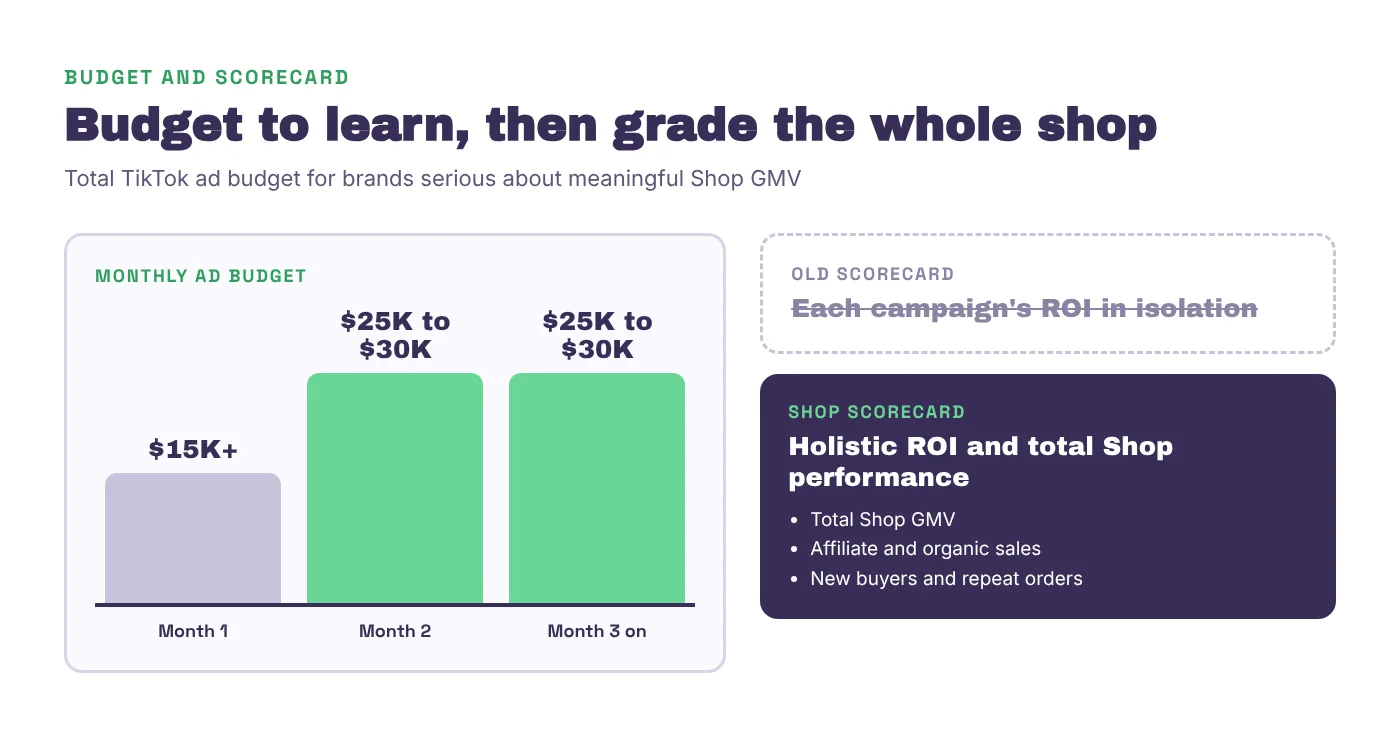
For brands that are serious about driving meaningful Shop GMV, I recommend a total ad budget of $15,000 or more in month one, enough to generate real data and momentum. From month two onward, $25,000 to $30,000 a month is a stronger benchmark.
The bigger shift is how you judge that spend. GMV Max is built to optimize total shop ROI across paid, organic and affiliate traffic, so grading each campaign in isolation misses most of what it does. Look at holistic ROI and total Shop performance. If shop GMV, affiliate sales and organic orders are all climbing while one campaign's in-platform ROI dips, the shop is working.
A simple way to set the approach based on where your shop is today.
- Strong order history, stable margins and a reliable creator pipeline. Run GMV Max with an ROI target and your proven creator videos. Watch efficiency, order volume and creative fatigue.
- Some order history, limited signal. Start with a lower ROI target to buy learning, then tighten. Watch cost swings, conversion quality and how fast the system learns.
- Weak order history, poor seller health or thin content. Do not scale yet. Fix operations, reviews, listings and creator volume, and run awareness and consideration ads while you do.
Where does GMV Max fall short, and who should wait?
GMV Max is not the right tool for every shop. With unreliable fulfillment, it scales a bad customer experience. With a thin creative library, it overworks a handful of videos, which speeds up fatigue and raises cost. With tight margins, the learning period can hurt, and a forced pause mid-campaign resets progress.
There is also a control tradeoff. GMV Max removes some of the manual levers experienced media buyers rely on. That is fine when the inputs are strong, and frustrating when they are not. GMV Max rewards patience and system building. Brands that rush it usually spend more and learn less.
How Adquadrant approaches GMV Max
My team runs TikTok Shop for more than 25 brands, and we treat it as one system. Affiliate recruitment, sampling, paid partnerships, creator communities and GMV Max sit with one team, so the people seeding creators are the same people deciding which videos get paid budget.
We work in a set order.
- Audit the shop and the affiliate program. Listings, fulfillment and reviews, plus the numbers most brands never look at, such as GMV per sample shipped and how concentrated sales are in a few creators or a few products.
- Build the creator engine. Sampling, commission structure and creator challenges, from tiered contests and retainers to GMV leaderboards, so new content keeps replacing old videos.
- Warm the audience. Awareness and consideration ads to the profile and the shop while the creator program ramps.
- Scale with GMV Max. Start with the affiliate and organic videos that have already earned engagement, plan creative per product, and budget in ramps starting at $15,000 or more in month one.
- Judge the shop, not the campaign. Report on total Shop performance and holistic ROI. For brands that want proof beyond platform reporting, we run incrementality testing with WorkMagic, our measurement partner.
First Saturday Lime shows what happens when the creator engine comes first. We grew weekly creator videos from 110 to 610, and Shop GMV went from about $100,000 in March 2026 to $1.3 million in May, including a $108,224 single day at a 7.1x ROI. GMV Max scaled that momentum. It did not create it. With Freck Beauty, the creator side alone moved the sample-request rate to 26.9%, against roughly 1% as a typical standard, which is the kind of content pipeline GMV Max needs before it can scale.

How to choose a TikTok Shop partner for GMV Max
- One team for creators and paid. Affiliate, sampling and GMV Max should not live in separate silos with separate goals.
- A cold-start plan. Ask what they run before GMV Max and what signals they wait for before scaling.
- Creative planned per product. They should know how many usable videos each product has, not just the shop total.
- Budget tied to data. A clear month one and month two plan, with the reasoning behind each number.
- Shop-level reporting. Results judged on total Shop GMV and holistic ROI, with a way to test what is truly incremental.
- Named results with real numbers. GMV, order volume and ROI from brands they can name.
What to do this month
- Audit your TikTok Shop across listings, reviews, fulfillment and inventory.
- Build or expand an affiliate-first creator program to generate authentic commerce content.
- Run awareness and consideration ads to your TikTok profile and your shop.
- Count usable creator videos per product and fill the gaps before you scale.
- Set your efficiency threshold from contribution margin, not vanity return metrics.
- Turn on GMV Max once orders are steady and operations are stable, with a month one budget big enough to learn.
TikTok Shop rewards brands that build systems, not shortcuts. If you want a team that builds the creator engine first and scales it with GMV Max, talk to Adquadrant's TikTok Shop team.
About the author
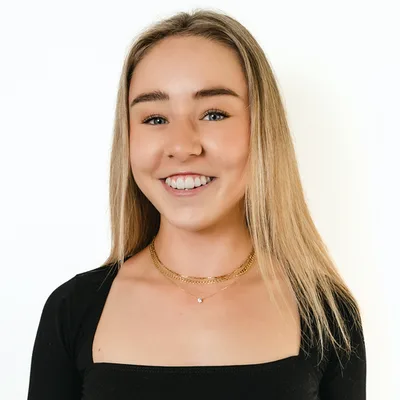
Ellie is a social commerce leader with a background spanning enterprise social strategy, creator and influencer marketing, and the full TikTok Shop ecosystem.
As Head of Social Commerce at Adquadrant, Ellie leads strategy, team development, and innovation across a portfolio of 25+ brands, overseeing everything from affiliate recruitment, sampling, and paid partnerships to creator communities, LIVE, and ongoing performance optimization. Her experience ranges from leading organic social strategy for major enterprise brands to building the teams, systems, and processes behind high-growth social commerce programs. She is especially passionate about developing high-performing teams, creating scalable ways of working, and leveraging emerging technology and AI to shape what's next in creator commerce.
Outside of work, Ellie loves staying active, discovering new restaurants and coffee shops, traveling whenever she can, spending time with friends and family, and learning more about health and wellness.