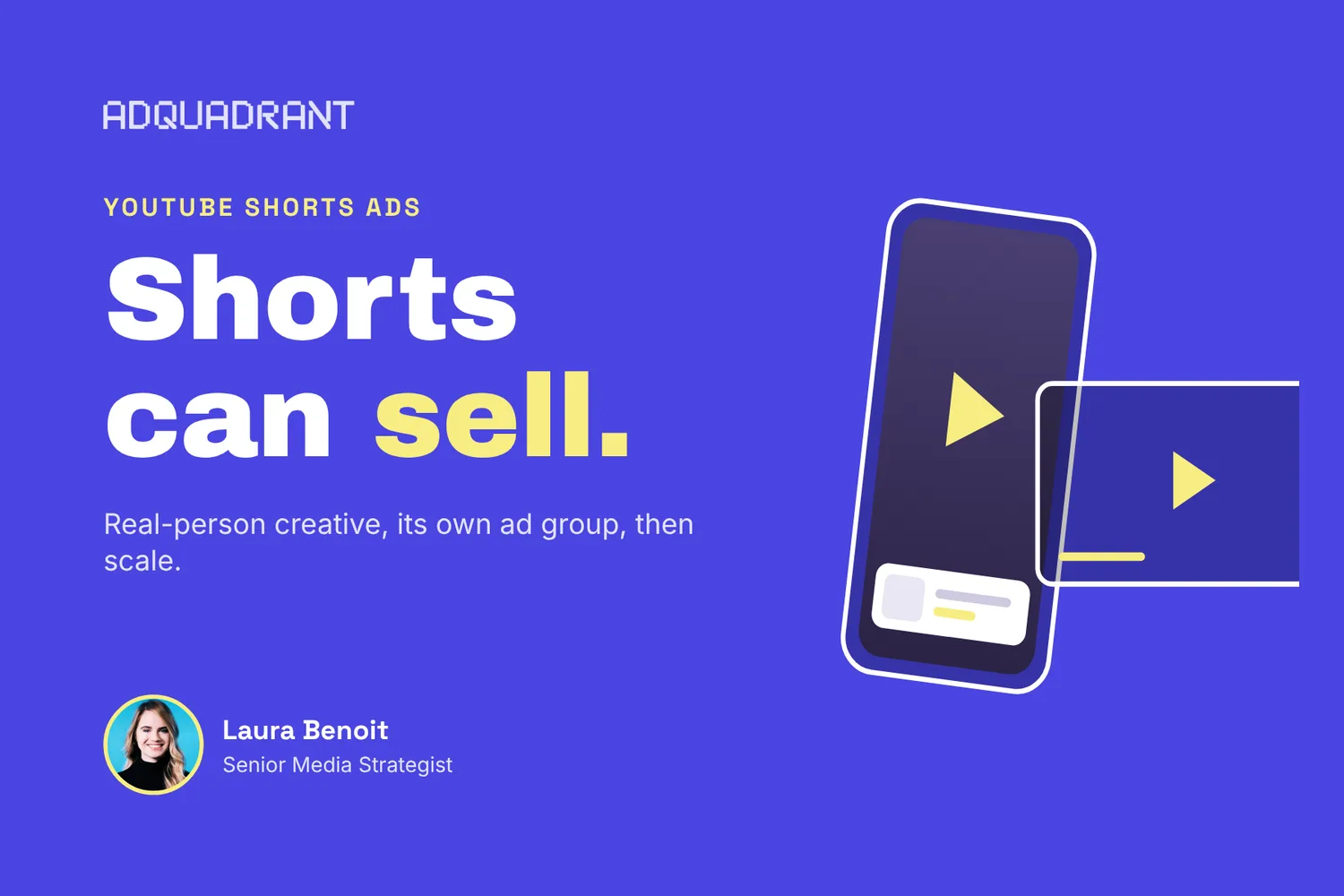

YouTube Shorts can be a performance channel for DTC brands, but only if you treat it like one. That means creative built for Shorts (real people, not resized assets), its own ad group so you can see what Shorts itself is doing, and a test before you scale. Judge it on purchases and incremental revenue, not views.
I run YouTube for DTC brands, and Shorts is where I see the most money wasted and the most upside left on the table. Usually it's the same account. Here's what's worked for me and what I'd skip.
Is YouTube Shorts a performance channel or a brand channel?
It can be held to revenue. Shorts ads run in the vertical feed between organic videos, the viewer decides in a second or two whether to keep watching, and with a product feed attached they can tap straight to a product page. That's a buying moment, not just a view.
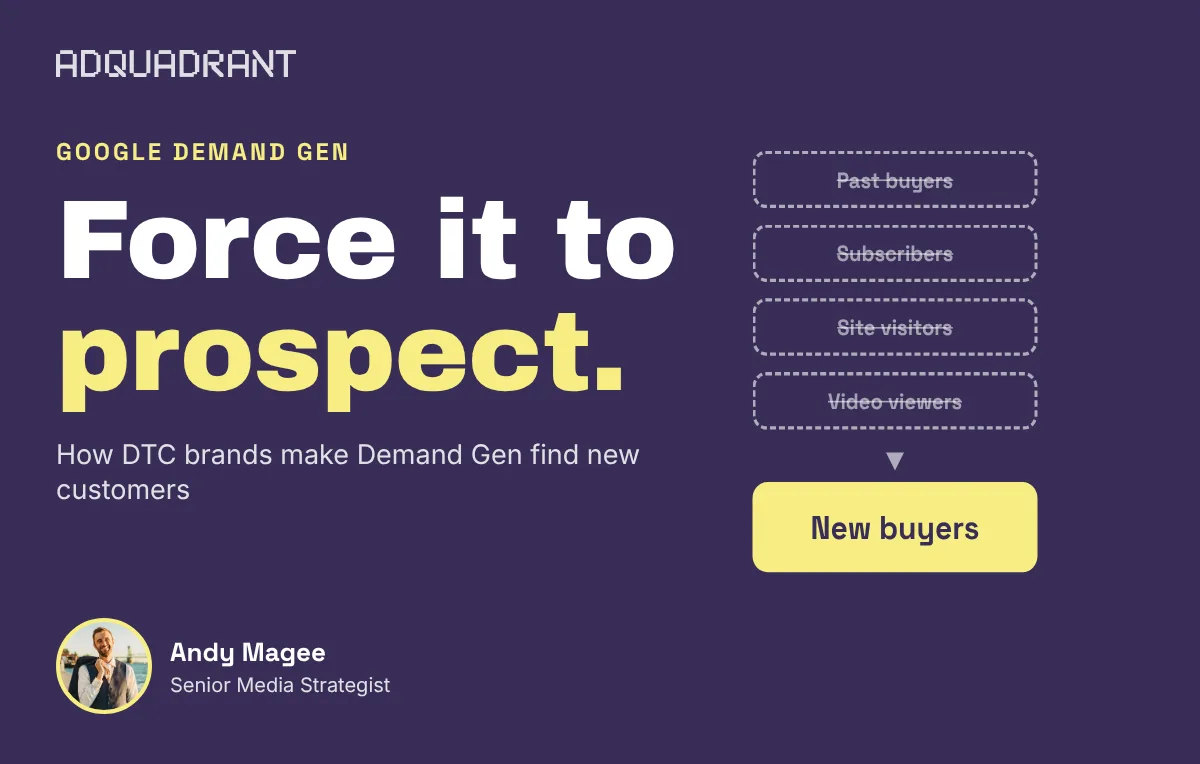
The problem is that most brands never actually see Shorts on its own. Most Shorts spend comes through Demand Gen, which also serves in-stream, in-feed, Discover and Gmail, and 9x16 creator videos end up serving almost entirely on Shorts anyway. So blended reporting hides how Shorts itself is doing, and it either gets too much credit or none.
How do you set up YouTube Shorts ads to be measured on their own?
Give Shorts its own ad group in Demand Gen and use channel controls to serve on YouTube Shorts only. Channel controls live at the ad group level (Channels, then "Let me choose"), so you can keep a broader Demand Gen ad group running next to it and compare the two.
- Link the brand's YouTube channel to Google Ads so Shorts viewers become a remarketing list you can use in Demand Gen.
- For DTC, link Merchant Center to the Demand Gen campaign so the Shorts ads are shoppable. Products from the feed show with image and price next to the video, and a viewer can tap straight to the product page.
- Bid on purchases where you have the volume, and pass real order values back to Google.
Why AI-generated and resized creative doesn't work on Shorts
On one DTC brand we manage, we ran our Meta and TikTok videos on Shorts, mostly AI-generated, and none of them found traction. What changed things was real-person UGC, plus asking the creative team to put YouTube-specific concepts in every deck. Resizing a library of assets is not the same as moving a winner over.
If AI creative isn't working and the brand is short on real footage, these are the easiest ways I've found to get more UGC.
- YouTube Creator Partnerships in Google Ads (formerly BrandConnect). Find creators who already post about the brand or the category, then run their videos through creator partnerships boost in Demand Gen. Google says creator partnerships boost on Shorts drove an average 30% increase in conversion lift for Demand Gen campaigns, based on its own global data from January 2025 to January 2026.
- Ask creators you already work with to post on YouTube. On another brand, a creator who agreed to upload had the video come through as a Short, which we could then run as an ad.
- Bring in a third-party UGC studio or creator platform. For one brand we added an outside creative partner in June and tested their first batch on TikTok, Meta and YouTube Shorts at the same time.
- Write a Shorts-specific brief. Our brief for a recent product launch covered the target audience, Google's ABCD guidance and past top performers, with 4 themes and 4 variations per theme.
Watch Performance Max before you add Shorts videos
Performance Max will move spend into YouTube on its own, including auto-generated videos. On one account, a Performance Max campaign scaled unprofitable YouTube spend, so we rebuilt the creative and audiences in Demand Gen where we could control where it served.
If you do want Shorts videos in Performance Max, test them before you add them outright. Use a Performance Max asset experiment (Experiments, then Assets, Assets provided by you, Performance Max, with the Video subtype). Part of the traffic sees the campaign as it is and part sees it with the new videos, so you can read whether they add conversions and ROAS instead of guessing from asset ratings.
How do you measure whether YouTube Shorts is driving sales?
I agree Shorts can be held to revenue, but test it in isolation before you scale it. Platform ROAS will claim sales from brand searchers and returning customers who were going to buy anyway, so the dashboard number is a starting point, not the answer.
- Read the Shorts-only ad group against the broader Demand Gen ad group, on purchases and cost per add to cart.
- Check Google-reported revenue against your store's order data.
- Look at profit, not just revenue. A high ROAS on low-margin products can still lose money.
- Before a big budget increase, run a conversion lift study or a geo holdout. Our incrementality testing playbook walks through both.
When YouTube Shorts isn't the right call
- You can't produce or source a few new real-person videos a month. Shorts burns through creative fast.
- The product doesn't have a visual story or a quick demo.
- You aren't willing to give Shorts its own ad group and a test, so it will get judged on blended numbers either way.
How Adquadrant approaches YouTube Shorts
For the $10M+ brands we work with, YouTube sits inside the Google plan next to Search, Shopping and Performance Max. We brief Shorts natively, source real-person creative through creators and UGC partners, and split Shorts into its own ad group so we can see what it adds.
Revelry is a good example. Their 2026 budget came in at roughly half the prior year, and our team protected prospecting with a dedicated YouTube Shorts campaign in Demand Gen optimized to add to cart. Total spend came down 53%, Demand Gen's share of the budget rose from 6.8% to 8.5%, and cost per add to cart fell 66% in four months.

We read results against incremental revenue, not platform credit. As a WorkMagic Official Agency Partner, we run lift tests that show what YouTube added on top of what a brand would have sold anyway, and that decides where the next dollar goes.
How to choose a partner for YouTube Shorts
- They build Shorts creative natively instead of resizing Meta and TikTok assets.
- They have a way to source real-person UGC, through creators, Creator Partnerships or a UGC studio.
- They split Shorts into its own ad group with channel controls.
- They watch where Performance Max is spending on YouTube and test videos before adding them.
- They connect Merchant Center and the YouTube channel to Demand Gen.
- They measure on purchases and incrementality, not views or platform ROAS alone.
If you want Shorts held to revenue, talk to the Adquadrant YouTube team.
About the author
Originally from Boston, MA, Laura moved to San Diego in 2021 and enjoys exploring California via beaches, hikes, and burrito shops. A graduate of Emmanuel College, she began her marketing career in higher education before transitioning to digital marketing agencies, where she has been for the past five years.